
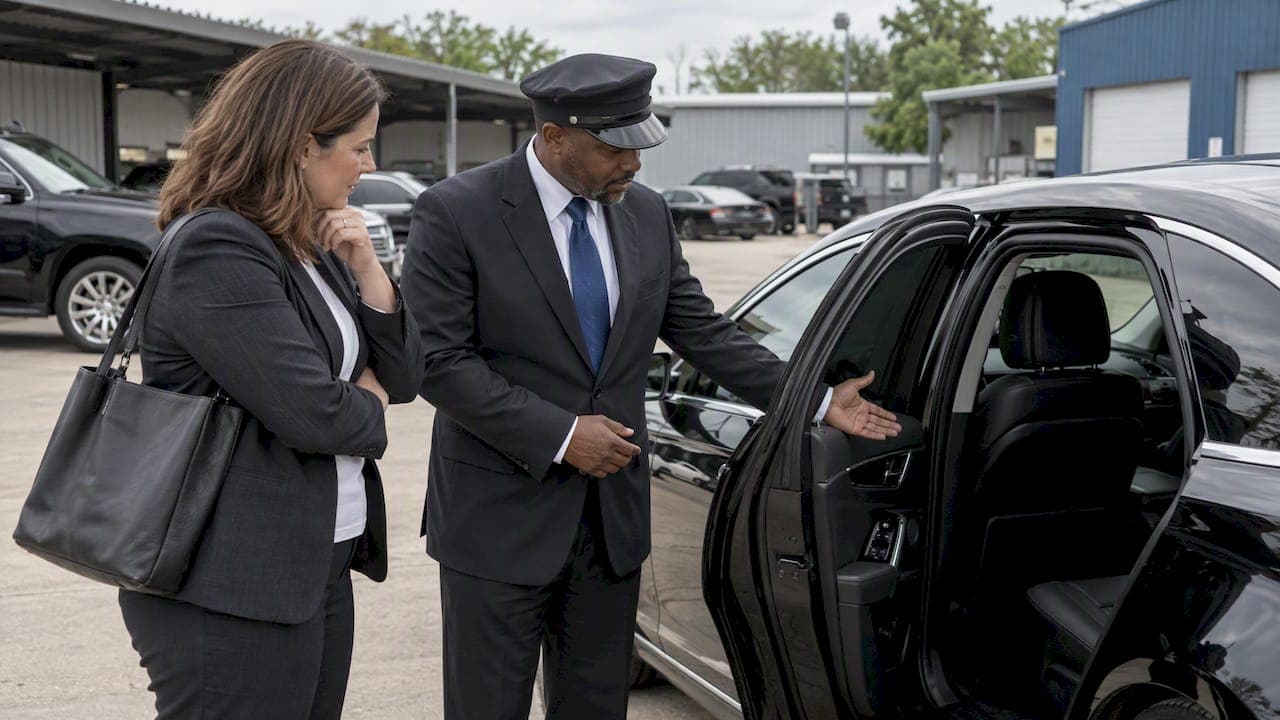
Secure transportation for executives means luxury chauffeur-driven transport, not armored vehicles or close-protection services, used for airport transfers, corporate events, VIP guest logistics, and weddings. The most common contexts are picking up a visiting board member, moving a wedding party between venues, or shuttling conference speakers on a tight schedule. Three priorities decide whether a booking goes smoothly: safety, punctuality backed by flight tracking, and clear, upfront pricing.
TL;DR:
- Confirm vendors provide proof of driver vetting, sufficient insurance coverage, and vehicle maintenance documentation before booking.
- Build in at least four to six weeks lead time for multi-vehicle event bookings to ensure vehicle availability and proper scheduling.
- Verify that the provider tracks flights, incorporates buffer times, and has a clear contingency plan for delays or cancellations.
- Choose vehicle types based on group size, luggage, and the desired event tone, ensuring accessibility and special requirements are addressed upfront.
- Budget transportation at 8% to 15% of the total event cost and ask for detailed, written quotes separating all fee components.
Table of Contents
- Why secure executive chauffeured transport matters for planners and travel managers
- Evaluation criteria: a checklist for vetting executive transport providers
- Service types and vehicle selections: matching vehicles to executive use cases
- Booking checklist and timeline: what to book when
- Pricing and budgeting: estimating and controlling executive transport costs
- Privacy and confidentiality for executive passengers
- Emergency and contingency protocols
- How APEX LIMO approaches secure executive transport
- Next steps: requesting a quote or booking with APEX LIMO
- FAQ
- Sources
Why secure executive chauffeured transport matters for planners and travel managers
Executives and VIP guests judge an entire event by how smoothly their ground transportation runs. A late pickup or an unvetted driver reflects on the planner who booked it, not just the vendor behind the wheel. Travel managers increasingly treat ground transport as a duty-of-care issue rather than a convenience line item, and recent GBTA and NLA research found that chauffeured transportation is commonly permitted for accessibility needs, client visits, and special events across corporate travel policies.
Budget matters too. Transportation commonly represents about 8% to 15% of the total event budget for mid-scale corporate events and weddings, which means a planner who sets that ceiling early avoids scrambling for funds later. These factors should shape how you write an RFP and compare vendor quotes:
- Safety documentation: ask for proof of driver vetting, insurance, and vehicle maintenance before signing.
- Punctuality systems: confirm the provider tracks flights and builds in buffer time for delays.
- Payment clarity: look for flat rates or corporate billing options that avoid surprise fees.
Evaluation criteria: a checklist for vetting executive transport providers
Comparing quotes side by side only works when you ask every vendor the same questions. Use this order when you build your shortlist, since each item builds on the one before it.
- Driver vetting and training: request background check policies, licensing records, and any defensive driving certifications.
- Insurance limits: confirm the certificate of insurance (COI) covers the vehicle class and passenger count you need.
- Punctuality systems: ask how the provider monitors flights, what buffer time they build in, and how they escalate a delay.
- Fleet condition: check vehicle age, maintenance schedules, and interior standards, especially for stretch limousines and vans that see heavy use.
- Accessibility: confirm ADA-compliant vehicles are available if any guest needs one.
- Pricing transparency: get a written quote that separates base rate, wait time, gratuity, and any surge or holiday pricing.
- Deposit and cancellation terms: know what you lose if plans change 48 hours out versus same-day.
- Corporate billing: ask whether the provider supports invoicing or monthly statements for repeat bookings.
- Group and multi-stop capability: verify the fleet can handle luggage-heavy transfers or multiple pickup points without delay.
- Escort or lane access: for high-profile arrivals, confirm whether the provider has experience coordinating with venue security or local police escorts.
Our deep dive on why executive event transport differs from standard service covers the operational gap between a standard car service and one built for VIP logistics.
Pro Tip: Ask every vendor for their COI and a sample driver training checklist before you request a final quote. Providers who hesitate are telling you something.
Service types and vehicle selections: matching vehicles to executive use cases
Vehicle choice depends on headcount, luggage, and the tone you want to set. An executive sedan suits a single traveler on an airport run where discretion and speed matter most. A luxury SUV makes sense when a traveler needs extra space for equipment or a second passenger, and it reads as a step up in presence without the formality of a stretch limousine.
Larger groups change the calculation entirely:
- Sprinter vans handle small groups with heavy luggage, common for conference teams arriving together.
- Stretch limousines and SUV stretches fit VIP arrivals, wedding parties, and red-carpet moments where the vehicle itself is part of the experience.
- Party buses or motorcoaches move large guest lists efficiently for corporate shuttles or wedding guest transfers between venue and hotel.
Our guide to corporate event transport types breaks down which vehicle class fits specific event formats in more detail. Whatever you choose, confirm accessibility features ahead of time: a last-minute scramble to find an ADA-compliant vehicle is avoidable with one phone call during booking. Our executive sedan page shows specs and photos if you want to see what a single-traveler booking actually looks like before committing.
Booking checklist and timeline: what to book when
Lead time changes by scope. A single airport transfer can often be booked a few days out, but event fleets for weddings or conferences need weeks of coordination, and same-day requests should be reserved for genuine emergencies since availability narrows fast.
- Four to six weeks out: confirm vehicle count, headcount, and event schedule for multi-vehicle bookings.
- Two weeks out: submit passenger details, flight numbers, and any special instructions like child seats or wheelchair access.
- 48 hours out: reconfirm pickup times and staging locations with your on-site contact.
- Day of: the chauffeur briefing happens, real-time flight monitoring begins, and a dedicated contact stays reachable for last-minute changes.
Our article on why airport transfer reliability matters for executives goes deeper on how flight tracking actually works behind the scenes. Build in a contingency plan too: a backup vehicle on standby and a defined hold window for delayed flights prevent a single disruption from cascading into a missed meeting.
Pro Tip: Share your event's master timeline with the transport provider, not just individual pickup times. Chauffeurs who see the whole day plan better around traffic and gaps.
Pricing and budgeting: estimating and controlling executive transport costs
Pricing for executive transport usually falls into three models: flat-rate transfers for point-to-point trips, hourly charters for multi-stop days, and packaged pricing for full events like weddings. Cost drivers include vehicle class, peak-season timing, wait time beyond the contracted window, and last-minute changes.
Transportation commonly runs 8% to 15% of total event budget for mid-scale corporate events and weddings, which gives planners a workable starting ceiling before refining by vehicle mix.
- Start with the 8 to 15 percent range, then adjust up if you need stretch limousines or multiple vehicles.
- Ask about multi-trip discounts for repeat airport transfers across a multi-day conference.
- Corporate accounts often unlock predictable billing instead of per-trip invoicing.
- Deposits and packaged event rates can lock in pricing before peak-season surge applies.
Privacy and confidentiality for executive passengers
Executives often need to work, take calls, or simply avoid being recognized during transit, which makes discretion as important as the vehicle itself. A chauffeur who understands confidentiality keeps passenger itineraries private, avoids discussing trip details with other clients or on social media, and uses tinted windows and quiet cabins to let a passenger work uninterrupted.

Ask providers directly how they handle passenger information: do dispatchers share only the details a driver needs, and is passenger data stored securely rather than passed around loosely? For high-profile guests, confirm whether the provider can route to a private entrance or staging area instead of a public curb, and whether non-disclosure expectations are standard practice for their chauffeur team. These details rarely appear in a standard sales pitch, so it is worth asking the question plainly before you book.
Emergency and contingency protocols
Even a well-planned itinerary runs into weather delays, flight cancellations, or a vehicle breakdown. A provider with a real contingency plan keeps a backup vehicle staged nearby for multi-vehicle events and has a dispatcher who can redirect a car within minutes rather than starting from scratch.

Ask what happens if a flight lands two hours late: does the chauffeur wait, and is there a cutoff before additional wait-time fees apply? Confirm there is a single point of contact reachable by phone throughout the event, not just an automated booking confirmation. For weddings or large corporate shuttles, ask how the provider handles a vehicle mechanical issue mid-route, since a swap plan should exist before you need it rather than being improvised on the day.
How APEX LIMO approaches secure executive transport
We built our chauffeur service around the same criteria planners should demand from any provider: a fully customized experience rather than a one-size-fits-all package, a vetted and trained chauffeur team, and a modern, spotless fleet maintained to a consistent standard. We back punctuality with flight tracking and built-in buffer time, so a delayed arrival does not turn into a missed pickup.
For multi-stop events, we coordinate staged logistics and assign a dedicated point of contact so a planner is never chasing updates mid-event. Planners working with us can request vehicle photos, proof of insurance, and chauffeur credentialing as part of the booking conversation, the same proof points we recommend asking any provider to produce.
— Jason
Next steps: requesting a quote or booking with APEX LIMO
Once you know your headcount, vehicle preference, date, and flight details, getting a quote takes a few minutes. We offer various packages for planners who want ongoing event or airport transfer coverage, alongside one-off bookings for a single event.

To move forward:
- Gather your event date, pickup locations, and passenger count.
- Note any flight numbers or special instructions ahead of time.
- Browse our fleet options to choose a vehicle class.
- Reach our services page to request a custom quote for your event.
For weddings specifically, our wedding limo service page outlines what to expect from booking through the send-off.
FAQ
What counts as secure transportation for executives?
It refers to chauffeur-driven luxury transport, such as sedans, SUVs, vans, and limousines, used for airport transfers, corporate events, and weddings. It does not refer to armored vehicles or close-protection security services.
How far in advance should I book executive transport?
Single airport transfers can often be booked a few days ahead, but multi-vehicle event fleets need four to six weeks of lead time to confirm vehicles and schedules. Same-day requests are possible but carry a higher risk of limited availability.
How much of my event budget should go to transportation?
Transportation commonly runs 8% to 15% of the total event budget for mid-scale corporate events and weddings. Starting there and adjusting for vehicle class keeps the budget realistic from the outset.
What should I ask a provider about driver safety?
Ask for proof of background checks, licensing, and any defensive driving training, along with a current certificate of insurance. Providers who can produce these quickly are generally more operationally mature than those who cannot.
Can executive transport accommodate large groups?
Yes, sprinter vans handle small groups with luggage, while party buses or motorcoaches move larger guest lists for weddings or corporate shuttles. Confirm accessibility needs and multi-stop logistics when booking for a group.
Sources
- Safety is top priority for managed ground transportation, says report from GBTA and NLA
- Safety, sustainability and cost drive today’s business travel ground transportation strategies, according to new research - GBTA