
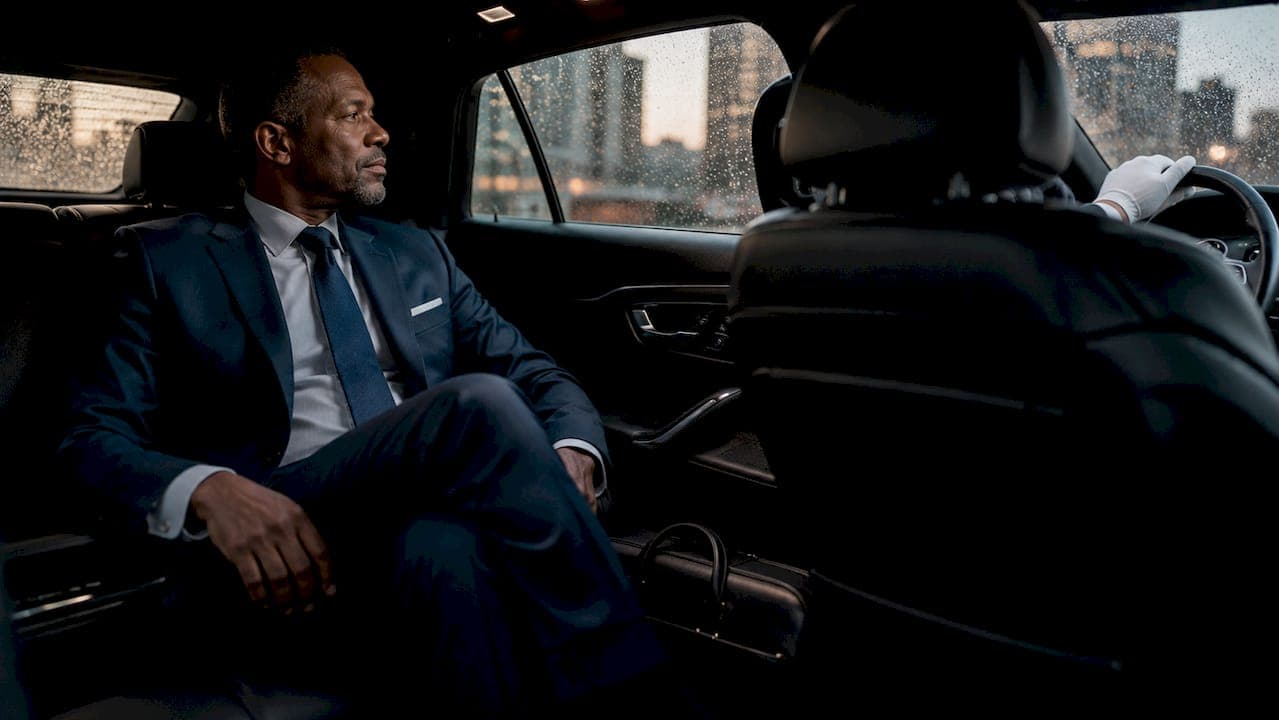
Discretion in corporate executive transport is defined as the deliberate practice of protecting a traveling executive's identity, conversations, and movements from unauthorized exposure. The role of discretion in corporate executive transport goes far beyond simple privacy. It is an operational discipline that protects sensitive decisions, shields confidential communications, and preserves the cognitive focus executives need to lead effectively. With over 50% of C-suite executives now using AI to support strategic decisions, the data they carry and the conversations they hold during transit are more sensitive than ever. APEX LIMO builds its entire executive service model around this standard.
What is the role of discretion in corporate executive transport?
Discretion in executive transport protects three things simultaneously: confidential communications, strategic decision data, and the executive's physical visibility. Each one carries real business risk when mismanaged.
Executives frequently use transit time to discuss negotiations, personnel changes, and acquisition targets. A vehicle without controlled privacy protocols is not a mobile office. It is a liability. One in three major executive decisions is reversed or changed within 18 months, which reflects the cognitive pressure executives operate under. Reducing distraction and information leakage during transit directly supports better decision quality.

The industry term for this practice is executive mobility management, and it encompasses far more than booking a car. It covers route selection, chauffeur conduct, communication controls, and arrival timing. When all of these elements work together, the vehicle becomes a protected environment for high-stakes thinking.
APEX LIMO treats this not as a premium add-on but as the baseline standard for every corporate booking. That distinction separates professional executive transport from standard car services.
How does discretion support decision-making during business travel?
Executives make consequential decisions during transit more often than most organizations acknowledge. A board member reviewing acquisition terms in the back seat needs the same cognitive conditions as a conference room, not a taxi.
The concept of cognitive quiet is central to this. Chauffeurs trained to be unobtrusive avoid initiating conversation, minimize interruptions, and maintain silence unless directly addressed. That discipline preserves the mental bandwidth executives need for complex judgment. Removing ambient distraction is not a comfort feature. It is a performance requirement.
Discretion also prevents information leakage through indirect channels. A chauffeur who overhears a merger discussion and mentions it casually to another client creates a breach. The risk is not theoretical. It is the reason structured decision-making frameworks now explicitly require that physical transport align with enterprise governance and security standards.
- Confidential negotiations: Executives can review deal terms, legal documents, and personnel decisions without exposure.
- Strategic briefings: Pre-meeting preparation happens in a controlled environment, not a shared space.
- Sensitive calls: Calls with legal counsel, board members, or investors require acoustic and visual privacy.
- Mental recovery: Transit between high-pressure engagements gives executives uninterrupted time to reset.
Pro Tip: Before booking any executive transport, ask the provider directly whether chauffeurs sign confidentiality agreements. If the answer is vague, the privacy standard is vague.
What operational practices enforce discretion in executive transport?
True discretion is a system, not a personality trait. It requires documented protocols, legal agreements, and trained behavior at every point of contact.
The most effective executive transport providers build discretion into operations through the following steps:
- Criminal and driving record verification. Comprehensive background checks on all chauffeurs are mandatory. This is the foundation of client trust, not an optional screening.
- Non-disclosure agreements. NDAs are the industry standard for legally binding chauffeur confidentiality. They shift discretion from expectation to enforceable obligation.
- Passenger data controls. Chauffeurs receive only the information needed to complete the booking. Destination details, client identity, and meeting context are shared on a strict need-to-know basis.
- Route intelligence. Disciplined route planning avoids high-visibility areas, media presence, and predictable patterns that could expose an executive's movements.
- Controlled arrival protocols. Timing and positioning at pickup and drop-off points are managed to minimize public exposure and paparazzi risk.
- Communication discipline. Chauffeurs do not discuss previous clients, routes, or any detail of past bookings under any circumstances.
Discretion as a systemic discipline means no single element carries the full weight. The NDA protects against verbal disclosure. The route plan protects against physical exposure. The background check protects against insider risk. All three must function together.
Pro Tip: Request a written copy of a provider's confidentiality protocol before your first booking. A provider that cannot produce one does not have one.
How does executive transport discretion compare to standard business travel?
The gap between executive transport and standard business travel options is not about vehicle quality. It is about the depth of the privacy infrastructure behind the service.
| Feature | Executive transport services | Standard business travel options |
|---|---|---|
| Chauffeur screening | Full criminal and driving history checks | Basic license verification |
| Confidentiality agreements | NDAs required before employment | Not standard practice |
| Passenger data handling | Strict need-to-know protocols | Booking details shared broadly |
| Route planning | Customized to avoid exposure | Standard GPS routing |
| Chauffeur conduct training | Formal silence and discretion protocols | No structured conduct standard |
| Arrival management | Controlled timing and positioning | Standard pickup and drop-off |
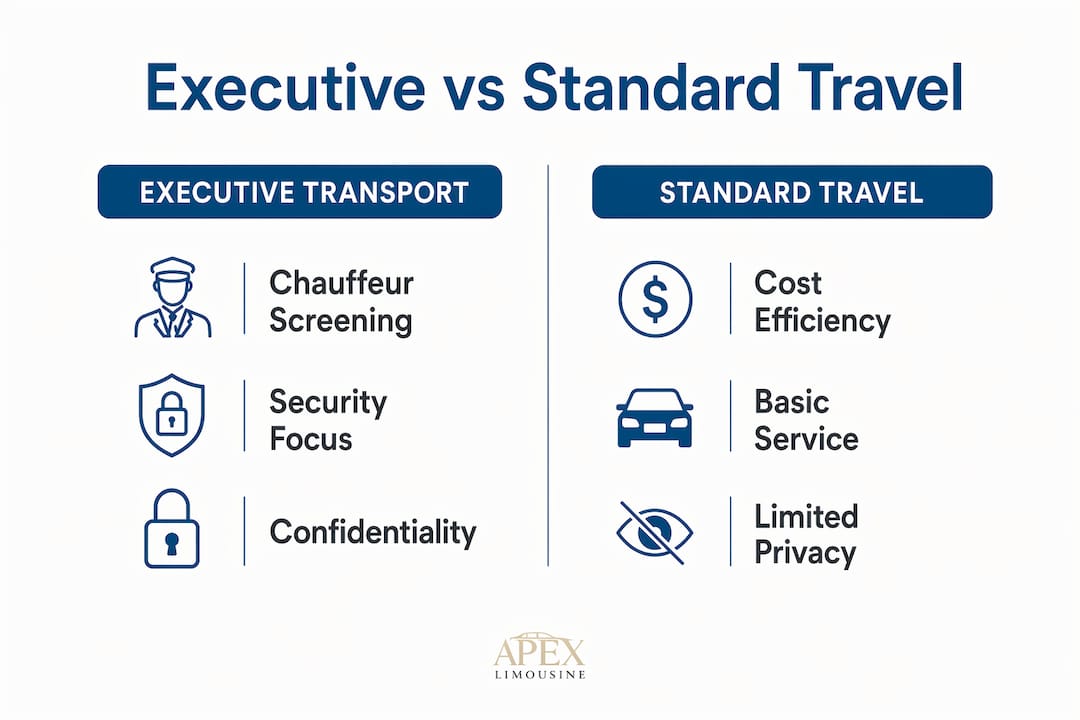
Standard car services optimize for efficiency and cost. Executive transport services optimize for security and confidentiality. That is a fundamentally different design goal. The difference shows up most clearly when something goes wrong. A leaked route, an overheard conversation, or a photographed arrival can damage a negotiation, a stock price, or a reputation.
Chauffeurs in executive services act as privacy gatekeepers, not just drivers. That role requires training, accountability, and legal structure that standard services do not provide. For executives managing enterprise risk, that gap is not acceptable.
What are the practical benefits of extreme discretion in executive transport?
Discretion in executive transport delivers measurable operational value beyond privacy protection. The benefits compound across every high-stakes trip.
- Reduced operational risk. Controlled routes and vetted chauffeurs eliminate the most common vectors for information exposure during transit.
- Higher productivity. Executives who trust their transport environment use transit time for calls, document review, and preparation. That time is otherwise lost.
- Faster decision cycles. Cognitive quiet during transit supports clearer thinking. Executives arrive at meetings prepared, not distracted.
- Preserved trust relationships. A provider who has never breached confidentiality builds a long-term relationship that becomes part of the executive's operational infrastructure.
- Brand and reputation protection. Unplanned visibility during sensitive periods, such as M&A activity or leadership transitions, carries real reputational risk. Discreet transport removes that exposure.
The professional chauffeur standards that govern executive transport are not arbitrary. They exist because the cost of a single discretion failure can far exceed the cost of years of premium service. For executives managing high-stakes decisions, that math is straightforward.
Discretion is infrastructure, not a luxury upgrade
From my experience working with corporate clients who travel at the executive level, the biggest mistake I see is treating discretion as a premium feature rather than a baseline requirement. Executives who think this way discover the gap only after something goes wrong.
The most telling indicator of a transport provider's discretion standard is not the vehicle. It is the chauffeur's behavior in the first 60 seconds. Does the driver initiate conversation? Does the driver confirm the destination loudly in a public space? Does the driver ask unnecessary questions about the meeting? These are not minor etiquette issues. They are operational failures.
I have seen executives choose transport based on vehicle aesthetics and then conduct sensitive calls in cars where the driver had no NDA, no formal training, and no route protocol. The vehicle looked right. The service was not. The two are not the same thing.
My advice is direct: evaluate your transport provider the same way you evaluate any vendor with access to sensitive information. Ask for their screening process, their confidentiality agreements, and their conduct protocols in writing. If a provider cannot answer those questions clearly, they are not operating at the executive standard. Visibility is a business risk. Treat it like one.
— Jason
APEX LIMO's approach to discreet executive transport in Austin
Corporate executives who require genuine discretion need a provider built around that standard from the ground up.

APEX LIMO's executive chauffeur service in Austin is designed specifically for high-profile clients who cannot afford a privacy failure during transit. Every chauffeur undergoes rigorous background screening, operates under formal confidentiality protocols, and is trained in the conduct standards that protect sensitive communications on the move. Route planning, arrival management, and communication discipline are built into every booking. For executives who need a transport partner that treats discretion as infrastructure, APEX LIMO delivers that standard consistently. Request a free quote to discuss your executive transport requirements.
FAQ
What does discretion mean in executive transport?
Discretion in executive transport means protecting an executive's identity, movements, and conversations through vetted chauffeurs, NDAs, controlled routes, and strict communication protocols. It is a systemic operational standard, not a personal preference.
Why do executives need private transport for business travel?
Executives carry sensitive data and conduct confidential communications during transit. Standard transport services lack the screening, legal agreements, and conduct protocols required to protect that information.
What is cognitive quiet in executive transport?
Cognitive quiet refers to the distraction-free environment created when a chauffeur maintains silence and avoids unnecessary interaction. It preserves executive focus and supports higher-quality decision-making during transit.
Are NDAs standard for executive chauffeurs?
NDAs are the industry standard for professional executive transport services. They create a legally binding confidentiality obligation that goes beyond informal expectations of discretion.
How does route planning protect executive privacy?
Disciplined route planning avoids high-visibility areas, predictable patterns, and locations with media presence. This reduces the risk of unauthorized observation or photography during sensitive travel periods.
Key takeaways
Discretion in corporate executive transport is an operational system, not a service feature, and it requires NDAs, vetted chauffeurs, route intelligence, and conduct protocols working together to protect executive privacy and decision quality.
| Point | Details |
|---|---|
| Discretion is a system | Effective executive transport requires NDAs, background checks, route planning, and conduct protocols together. |
| Cognitive quiet drives productivity | Trained chauffeurs who avoid distraction protect executive focus and improve decision quality during transit. |
| Standard services fall short | Generic transport options lack the legal agreements and conduct training required for executive-level privacy. |
| Visibility is a business risk | Uncontrolled executive movements during sensitive periods can damage negotiations, stock prices, and reputations. |
| Provider vetting is non-negotiable | Executives should request written confidentiality protocols and screening records before selecting any transport provider. |