

A chauffeur manages your entire journey with hospitality-level service and training; a driver just gets you from one point to another. Both sit behind the wheel of a vehicle, but the chauffeur role carries a different standard of training, presentation, and anticipation of your needs. The comparison table below breaks down exactly where those differences show up.
TL;DR:
- Chauffeurs are trained in customer service, vehicle maintenance, and itinerary management, ensuring a more prepared and discreet experience.
- They operate luxury vehicles with professional presentation, partial fleet maintenance, and amenities like water and phone chargers, unlike regular driver’s cars.
- Bookings, pricing, and credentials should be verified with specific questions about vetting, insurance, vehicle upkeep, and service details beforehand.
- Safety protocols involve regular vehicle inspections, advanced route planning, and recurring background checks, which are less common with standard drivers.
- Relying on operational standards and verifiable processes over marketing claims ensures a true professional chauffeur service.
Table of Contents
- Chauffeur vs Driver: A Quick Comparison
- What a Chauffeur Does That a Driver Usually Doesn't
- Training, Credentials, and Background Checks to Ask About
- Vehicle Types, Presentation, and Onboard Amenities
- When to Hire a Chauffeur vs a Driver
- Pricing Expectations and Booking Models Explained
- How a Professional Chauffeur Service Actually Delivers This
- The Bottom Line on Chauffeur vs Driver
- Employee vs Independent Contractor: Why It Matters to You
- How the Chauffeur Role Differs Around the World and Across Industries
- Safety Protocols: Where the Gap Is Widest
- The Technology Each Side Actually Uses
- Why This Comparison Gets Oversimplified
- Sources
Chauffeur vs Driver: A Quick Comparison
The fastest way to see the difference between a chauffeur and a driver is to line up what each one actually delivers, side by side.
- Service scope: A chauffeur manages the full trip, including planning, communication, and passenger care. A driver focuses narrowly on operating the vehicle safely from point A to point B.
- Training: Chauffeurs typically complete defensive driving courses and customer service or etiquette training. Drivers usually meet only the minimum licensing standard for their vehicle class.
- Attire and presentation: Chauffeurs dress in formal uniforms and follow strict etiquette standards. Drivers dress casually, with no consistent presentation standard.
- Vehicles: Chauffeurs operate maintained luxury fleets: sedans, SUVs, or stretch limousines with amenities. Drivers often use personal vehicles or standard rideshare cars.
- Booking model: Chauffeur services run on confirmed bookings with hourly or flat rates. Driver services tend toward per-trip or metered, on-demand pricing.
- Pricing shape: Chauffeur pricing usually bundles wait time and amenities into one rate. Driver pricing fluctuates with distance, time, and surge demand.
Best for: choose a chauffeur for weddings, corporate travel, and airport pickups where timing and presentation matter. Choose a driver for short, low-stakes errands where cost is the only variable.
What a Chauffeur Does That a Driver Usually Doesn't
The daily job description is where the service gap becomes obvious. A chauffeur's work starts long before you get in the car: checking your flight status, mapping the fastest route around known traffic, staging the vehicle, and greeting you with a door opened before you reach the handle. Job postings and career guides for chauffeurs consistently list itinerary management and discretion alongside driving skill, not instead of it.
A driver's job, by contrast, is mostly reactive. Get you where you're going, help with a bag if asked, follow the GPS. There's nothing wrong with that model for a quick ride, but it's a different job.
- Chauffeurs: pre-trip planning, flight monitoring, luggage handling, door service, itinerary coordination.
- Drivers: safe operation, basic navigation, occasional passenger assistance.
Pro Tip: Ask any provider whether the same chauffeur handles your pickup and drop-off, or whether you'll get whoever is available. Consistency in assignment is often the clearest sign you're paying for a chauffeur experience rather than a rotating pool of drivers.
Training, Credentials, and Background Checks to Ask About
Anyone can claim to be "professional." The training and vetting behind that claim are what you should actually verify. Reputable chauffeur employers run defensive driving instruction, customer service training, and formal background checks that go well beyond the state minimum required for a standard driver's license.
Before booking, ask a provider directly:
- What defensive driving or advanced driving certification does the chauffeur hold?
- Is a background check run before hire, and how often is it refreshed?
- Does the company review driving records on a recurring basis, not just at hiring?
- Is the chauffeur commercially licensed for the vehicle class you're booking?
- Who handles customer service training, and how long is it?
A provider that answers these questions specifically, rather than with a vague "yes, we vet everyone," is usually the one that takes it seriously.
Vehicle Types, Presentation, and Onboard Amenities
The vehicle itself tells you a lot before the chauffeur ever says a word. A well-run fleet includes executive sedans, luxury SUVs, and stretch limousines, kept to a maintenance standard well above what a personal car sees.
- Expect bottled water, phone chargers, and privacy shades as baseline amenities on chauffeured vehicles.
- "Commercial standard" upkeep means rolling replacement schedules, daily pre-trip inspection checks, and interior detailing between bookings, not just an occasional car wash.
- Drivers, especially those using personal vehicles or standard fleet cars, offer far less predictability. Cleanliness and mechanical condition vary from one ride to the next.
Vehicle presentation and punctuality are among the clearest trust signals a reputable chauffeur service can offer, and they're easy to verify with photos before you book.
When to Hire a Chauffeur vs a Driver
Run through this before you book anything:
- Define what the trip actually needs. Privacy, a polished corporate image, a tight flight connection, or full-service handling of luggage and logistics all point toward a chauffeur. A short errand or a low-budget, ad-hoc ride points toward a standard driver.
- Compare quotes against your checklist. Match what each provider offers against the training, vehicle, and service items that matter for your event.
- Confirm credentials and insurance before you pay anything. Ask for proof of commercial insurance and licensing, not just a verbal assurance.
- Request the service details in writing. Get wait-time policy, cancellation terms, and gratuity expectations spelled out before the day of the event.
Questions worth asking at booking: What's the wait policy if my flight is delayed? What amenities come standard? Is gratuity included or added separately? What's the cancellation window? A provider who hesitates on any of these is telling you something.
Pricing Expectations and Booking Models Explained
Chauffeur services almost always price by the hour or as a flat rate that bundles in a set amount of wait time and standard amenities, which works well for weddings, corporate accounts, and events where the schedule can shift. Driver services, especially on-demand ones, tend to price per trip or by the meter, with fixed pricing at booking reducing the surprise charges that metered models can produce during surge periods.
When comparing quotes, ask for an itemized breakdown rather than a single number. Confirm whether wait time beyond a grace period is billed separately, and check whether gratuity is already built into the rate or added at the end. Those three questions alone resolve most of the sticker shock people report after booking on-demand rides for events.
How a Professional Chauffeur Service Actually Delivers This
Operationally, this isn't complicated but it does take consistency. A reputable service stages each vehicle before the trip, monitors incoming flights in real time, runs background checks on every chauffeur before they're assigned to a client, and confirms details directly with the client ahead of pickup.
APEX LIMO's Austin chauffeur service publishes client testimonials and explainer content around exactly these standards, from vehicle condition to chauffeur professionalism at events.
When you're checking any provider, look for:
- Photos of the actual fleet, not stock imagery.
- A stated vetting or training process, in specific terms.
- Client testimonials that mention punctuality and vehicle condition specifically.
- A clear arrival procedure, such as name boards or flight tracking for airport pickups.
The Bottom Line on Chauffeur vs Driver
The core distinction holds up under any amount of scrutiny: a chauffeur sells a managed, hospitality-driven experience, and a driver sells transportation. Getting this right before you book saves you from mismatched expectations on the day that matters most.
Three things to do next: run through the decision checklist above, ask any provider for their credentials and insurance in writing, and compare at least two written quotes side by side before you commit.
Employee vs Independent Contractor: Why It Matters to You
Most chauffeurs working for established limousine companies are classified as employees, which means the company handles their training, background checks, insurance coverage, and ongoing supervision. This structure is a big part of why chauffeur services can guarantee consistent standards. The company is directly accountable for who shows up and how they behave.
Drivers in the on-demand economy are frequently classified as independent contractors. They typically supply their own vehicle, set their own availability, and carry a different insurance relationship with the platform they drive for. That's not automatically a problem, but it does shift where accountability sits if something goes wrong during the ride.
For you as the customer, this distinction matters most in two places: insurance coverage and recourse. When a chauffeur is an employee, the employer generally carries commercial liability coverage specific to that vehicle and driver. With independent contractor models, coverage can be more layered, sometimes involving the platform, sometimes the individual's own policy, depending on the moment in the trip. If a provider can't clearly explain who's insured and how, that's worth asking about directly rather than assuming it's covered.
How the Chauffeur Role Differs Around the World and Across Industries
The word "chauffeur" carries more formal weight in some markets than others. In parts of Europe, certain municipalities license chauffeurs separately from standard drivers, with distinct exams and permits tied specifically to for-hire luxury or limousine work. In the United States, there's no single federal definition of "chauffeur." Standards come from individual companies and, in some cases, state-level commercial licensing requirements for the vehicle class involved.
Culturally, the expectations attached to the title also shift. In markets with a long history of private car service, hospitality and etiquette training are assumed to be baseline. In markets where ridesharing dominates, "chauffeur" sometimes gets used loosely as a marketing term for any professional driver, even without the training that traditionally came with the title.
This is exactly why asking direct questions about training and credentials matters more than trusting the job title alone. A company using "chauffeur" as a branding word without the underlying vetting isn't doing anything illegal, but it isn't giving you what the term historically implies either. The safest approach, wherever you're booking, is to treat the word as a starting point for questions, not a guarantee.
Safety Protocols: Where the Gap Is Widest
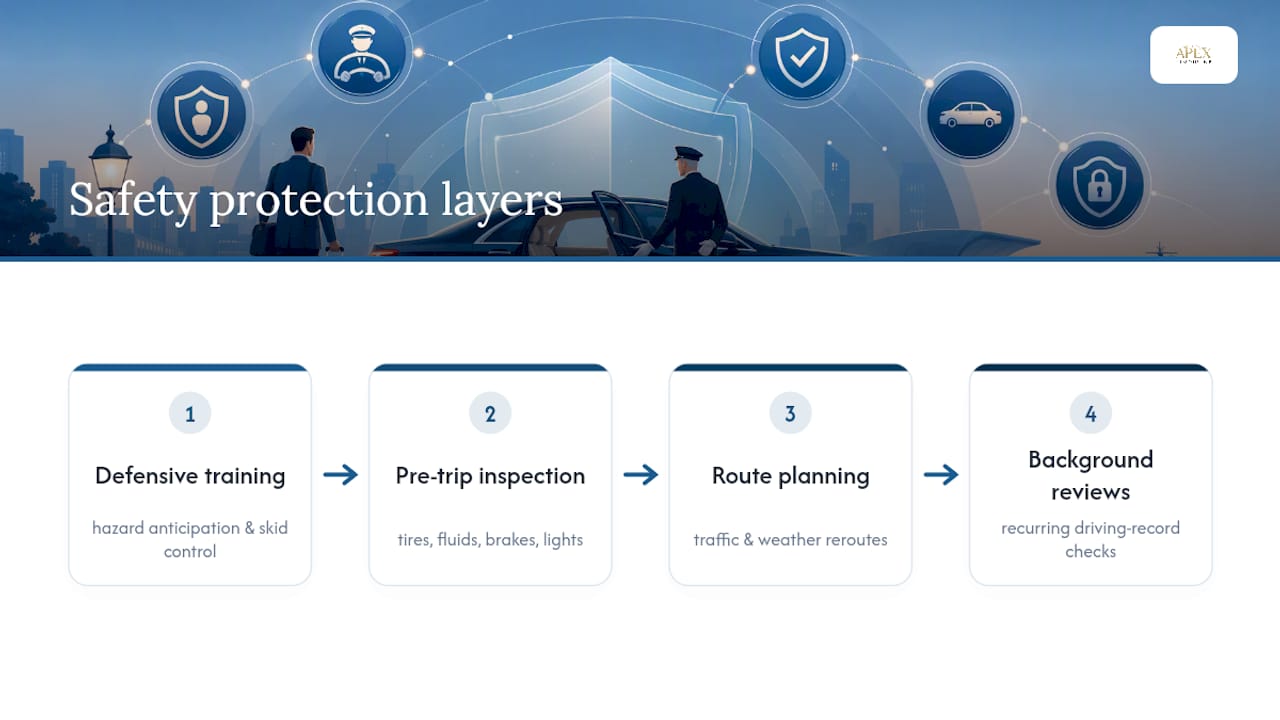
Safety is where the difference between a chauffeur and a driver tends to show up most concretely, even if it's the least visible part of the service. Chauffeurs at established companies usually go through structured defensive driving training, which covers hazard anticipation, skid control, and evasive maneuvering, on top of standard licensing.
Vehicle inspection is another gap. A chauffeur company typically runs pre-trip checks on tires, fluids, brakes, and lights before every shift, not just at scheduled service intervals. That daily discipline catches small mechanical issues before they become road hazards.
Route planning also plays into safety more than people expect. A chauffeur monitoring traffic and weather conditions in advance can reroute around a hazard before you're in it, rather than reacting once you're stuck. Drivers using standard navigation apps get the same live traffic data, but without the same layer of pre-trip contingency planning that dedicated chauffeur dispatch teams build in for weddings, corporate events, or airport runs with tight windows.
Background checks tie all of this together. A one-time check at hiring tells you less than a company that reruns driving record reviews on a recurring schedule, since a clean record from two years ago doesn't guarantee one today.
The Technology Each Side Actually Uses
Chauffeur services typically run on dedicated dispatch and fleet management software that tracks vehicle location, driver assignment, and client communication in one system. Flight tracking integration is common for airport transfers, letting a chauffeur adjust pickup timing automatically if a flight lands early or late, rather than waiting for a text from the passenger.
Drivers, particularly those working through app-based platforms, rely mostly on the platform's own navigation and dispatch tools, which are built for volume and speed rather than the kind of white-glove coordination a corporate account or wedding party needs. GPS navigation is standard on both sides at this point. The difference shows up in what surrounds it: chauffeur services often layer in electronic confirmations, digital name boards for airport pickups, and direct-line communication with a dispatcher rather than an app-only chat function.
None of this technology replaces training or judgment, but it does explain why chauffeur bookings tend to feel more coordinated. The systems behind the scene are built for anticipation, not just navigation.
Why This Comparison Gets Oversimplified
Most articles treat "chauffeur vs driver" as a vocabulary question, like it's just about which word sounds fancier. That's backwards. The real story here is operational: training programs, vetting cadence, vehicle maintenance schedules, and dispatch systems that either exist at a company or don't. The word on the website tells you almost nothing on its own.
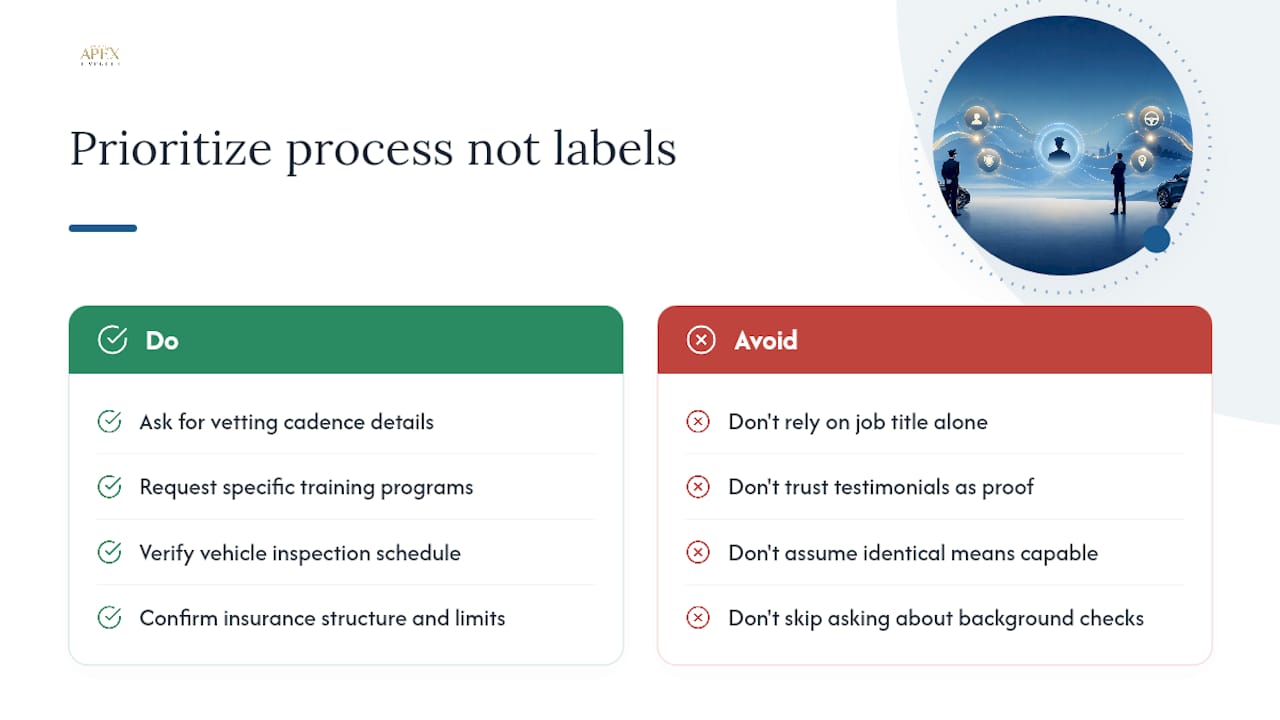
What gets underrated in most advice on this topic is how much of the difference is invisible until something goes wrong. A driver and a chauffeur can look identical for nine trips out of ten. The tenth trip, the one with a delayed flight, a last-minute route change, or a client who needs discretion handled well, is where the training and structure either show up or don't. That's a hard thing to shop for, which is exactly why asking specific questions about background checks, insurance, and vehicle inspection schedules matters more than reading a mission statement.
If you take one thing from this comparison, make it this: prioritize verifiable process over marketing language. A company that can describe its vetting cadence, insurance structure, and vehicle maintenance routine in specific terms is telling you something a glossy testimonial page can't.
— Jason
Ready to see this standard in practice? APEX LIMO's Austin fleet runs on the training, vetting, and staging practices described above, whether you're booking a wedding, a corporate transfer, or an airport pickup with flight tracking built in. If your event needs live entertainment on top of transportation, luxury hospitality music services pair well with a chauffeured arrival for weddings and corporate functions alike.
Sources
- Chauffeur — Wikipedia
- What Makes a Chauffeur Different from a Driver? | Arion
- What Is a Chauffeur? (Plus Work Environment and Salary) - Indeed