

Driver background screening is defined as the formal process of verifying a chauffeur's criminal history, driving record, and fitness for duty before placing them behind the wheel with passengers. The role of background checks for limo drivers goes far beyond a simple records search. A thorough vetting process covers criminal history at the county, state, and federal levels, Motor Vehicle Record (MVR) reviews, drug and alcohol screenings, and ongoing monitoring after hire. Knowing what these checks involve gives you the tools to choose a limo service that takes passenger safety seriously, not one that treats screening as a paperwork formality.
What key components make up a comprehensive background check for limo drivers?
A comprehensive chauffeur background check must cover criminal background checks, MVR review for 3–10 years, drug and alcohol screenings, and FMCSA Clearinghouse queries for CDL drivers. Each layer targets a different risk. Criminal checks catch convictions that disqualify a driver from transporting passengers. MVR reviews reveal patterns of reckless driving, license suspensions, or repeat traffic violations that a clean interview would never expose.
Here is what a complete limo driver screening process includes:
- Criminal background check: Searches county, state, and federal databases for felonies, misdemeanors, and sex offender registries.
- Motor Vehicle Record (MVR) review: Covers 3–10 years of driving history, flagging DUIs, license suspensions, and at-fault accidents.
- Pre-employment drug and alcohol screening: Required before a driver's first shift, and repeated randomly throughout employment.
- FMCSA Drug and Alcohol Clearinghouse query: Mandatory for CDL holders, this federal database tracks drug and alcohol violations across all employers.
- Employment verification: Confirms prior driving roles and surfaces gaps or misrepresentations in a driver's work history.
- Driving simulation or road assessment: Some premium operators add this step to evaluate real-world judgment under pressure.
A typical screening process lasts 2–4 weeks and includes multiple stages. That timeline reflects genuine diligence, not bureaucratic delay. Rushing it produces gaps.
Pro Tip: Ask any limo company how far back their MVR review goes. A three-year lookback is the minimum; a seven-to-ten-year review is the mark of a serious operator.

Cost is a real factor. Background checks through vendors run roughly $95 per chauffeur, with compliance windows requiring initiation within 10 days of a driver's invitation to the platform. Reputable companies absorb this cost without hesitation. A company that cuts corners on screening fees will cut corners elsewhere too.
How does continuous monitoring enhance limo driver safety beyond initial checks?
Continuous monitoring is defined as an ongoing system that delivers real-time alerts when a driver receives a new criminal charge or driving violation after hire. A one-time background check captures a driver's history up to the day of screening. It tells you nothing about what happens the following month.
Continuous monitoring alerts employers to new criminal charges or driving violations immediately, enabling prompt action rather than waiting for annual reviews. That immediacy matters. A driver who receives a DUI on a Saturday night can be flagged and removed from the schedule before Monday's corporate pickup. Without monitoring, that driver could transport clients for months before anyone notices.
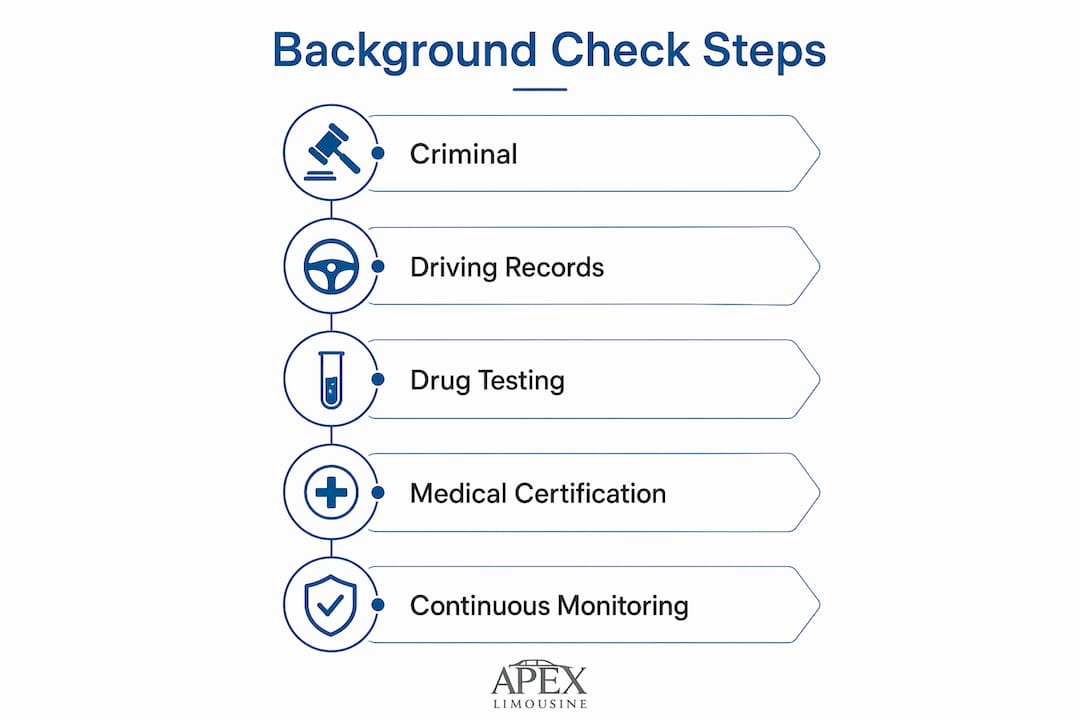
The best limo services build continuous monitoring into their formal Safety Management Plans. Industry standards require continuous driver monitoring, commercial liability insurance, multiple vehicle inspections, and formal Safety Management Plans as integrated safety systems. These plans document training protocols, incident reporting procedures, and emergency response steps. They are not optional extras. They are the architecture of a safe operation.
Pro Tip: When evaluating a limo service, ask directly: "How often do you re-screen your drivers, and what triggers an immediate review?" A confident, specific answer signals a company that treats safety as a system, not a slogan.
For you as a client, continuous monitoring means your chauffeur's record is not frozen at the date of hire. It is a living file. That distinction separates a professionally run limo service from one that checks a box and moves on.
How do licensed limo drivers differ from rideshare drivers in background checks?
The regulatory gap between licensed chauffeurs and gig-based rideshare drivers is wider than most clients realize. Regulated limo services operate under stricter frameworks requiring background checks performed by state patrol, random drug testing, and higher insurance, unlike gig-based rideshare platforms. That difference is not a matter of preference. It is written into law.
| Safety requirement | Licensed limo chauffeur | Gig-based rideshare driver |
|---|---|---|
| Background check authority | State patrol or equivalent agency | Third-party vendor, self-reported |
| Drug testing | Pre-employment and random | Not universally required |
| Commercial insurance | $1,000,000+ combined single limit | Lower minimums, varies by state |
| Vehicle inspection | Mandatory, state-approved | Self-reported or app-based |
| Safety Management Plan | Required by regulation | Not required |
| Defensive driving course | Mandatory in regulated states | Not required |
Licensed limo carriers must follow strict state requirements including state patrol background checks, drug testing, medical certification, and a defensive driving course. Gig drivers are frequently exempt from these laws. That exemption is not a technicality. It means a rideshare driver could have a recent violation that a state patrol check would have caught, but a vendor-run app check missed entirely.
Commercial liability insurance for licensed limo services typically exceeds $1,050,000 combined single limit. That coverage level reflects the seriousness of transporting clients at scale. It also protects you directly if an incident occurs. Lower insurance minimums in the rideshare space shift that risk back onto passengers.
For clients booking transportation for weddings, proms, or corporate events, the limo vs. rideshare distinction is a safety decision, not just a comfort preference.
How can you verify a limo company's background check process?
Many limo services operate with minimal verification through third-party aggregators, treating background checks as compliance boxes rather than thorough safety measures. That means the burden of verification falls partly on you. Asking the right questions before you book is the most direct protection you have.
Request these items from any limo company before signing a contract:
- Written screening policy: A document that outlines which checks are run, how far back they go, and which agency performs them.
- Proof of drug testing program: Confirmation of pre-employment and random testing, not just a verbal assurance.
- Insurance certificate: A current certificate of insurance showing commercial liability coverage and its limits.
- Driver license verification records: Proof that each driver's CDL or chauffeur license is current and in good standing.
- Re-screening frequency: A clear statement of how often drivers are re-screened and what triggers an immediate review.
Reputable companies provide formal screening procedures on request without hesitation. A company that deflects, gives vague answers, or offers only verbal reassurances is a red flag. Verbal promises carry no weight if something goes wrong.
Professional driver hiring also includes structured behavioral interviews to gauge judgment and professionalism beyond what a resume reveals. Ask whether the company uses behavioral interviewing as part of its hiring process. It signals that the operator thinks about driver character, not just driver records. For high-stakes events like prom night or a corporate executive transfer, that depth of vetting matters. A parent's guide to vetting limo companies covers exactly these questions in detail.
Pro Tip: If a company cannot name the agency that runs its background checks, walk away. Legitimate operators know exactly who screens their drivers and can prove it.
Key Takeaways
A limo driver's background check is only as strong as the system behind it. Companies that combine criminal screening, MVR review, drug testing, and continuous monitoring deliver a fundamentally different level of passenger protection than those that run a single check at hire.
| Point | Details |
|---|---|
| Multi-layer screening is the standard | Criminal checks, MVR review, drug testing, and FMCSA queries together form a complete vetting process. |
| Continuous monitoring closes the gap | Real-time alerts catch new violations after hire, not just at the point of employment. |
| Licensed limos outpace rideshare on safety | State patrol checks, mandatory drug testing, and $1,000,000+ insurance set licensed chauffeurs apart. |
| Documentation is your proof | Always request written screening policies, insurance certificates, and re-screening frequency before booking. |
| Behavioral interviews add a layer | Structured interviews assess judgment and professionalism that records alone cannot reveal. |
Why I think most clients ask the wrong question about driver safety
Most clients ask, "Does your company do background checks?" That is the wrong question. Every company says yes. The right question is, "Can you show me your written screening policy and tell me who performs your state patrol check?"
I have seen the gap between what companies claim and what they document. A single background check run through a budget vendor is not the same as a state patrol review followed by random drug testing and continuous monitoring. The difference is not visible from the outside. You have to ask for it.
The limo industry has a real split between operators who treat screening as a genuine safety system and those who treat it as a marketing line. The latter group relies on clients not knowing what to ask. Once you know that licensed chauffeurs in regulated states must carry over $1,000,000 in commercial liability insurance and submit to state-approved background checks, you stop accepting vague assurances.
Continuous monitoring is the detail that separates serious operators from the rest. A driver who passes a check in january and gets a DUI in march is still driving your family in april if the company does not monitor. That is not a hypothetical. It is a documented gap in how many services operate. When I evaluate any transportation provider, re-screening frequency is the first thing I ask about. The answer tells me everything about how seriously they take passenger safety.
— Jason
APEX LIMO's approach to chauffeur safety in Austin
APEX LIMO applies a multi-layered driver vetting process that goes well beyond a single background check. Every chauffeur undergoes criminal history screening, MVR review, drug testing, and continuous monitoring after hire. Commercial liability insurance and full regulatory compliance are standard, not optional.

For clients booking executive chauffeur service in Austin, that means every ride is backed by documented safety standards, not verbal promises. Whether the occasion is a corporate event, a wedding, or prom night, APEX LIMO's commitment to thorough driver screening gives you confidence before the car ever arrives. Review the full range of Austin limo services and reach out to confirm the safety standards that matter to you.
FAQ
What does a limo driver background check include?
A complete limo driver background check covers criminal records at the county, state, and federal levels, an MVR review for 3–10 years, pre-employment drug and alcohol screening, and FMCSA Clearinghouse queries for CDL holders. The full process typically takes 2–4 weeks.
How is a licensed chauffeur different from a rideshare driver in terms of vetting?
Licensed chauffeurs in regulated states must pass state patrol background checks, random drug testing, and medical certification, while gig-based rideshare drivers are frequently exempt from these requirements. Licensed limo services also carry commercial liability insurance exceeding $1,000,000.
What is continuous driver monitoring and why does it matter?
Continuous monitoring delivers real-time alerts when a driver receives a new criminal charge or driving violation after hire, allowing a company to act immediately rather than waiting for an annual review. It is the key difference between a one-time check and an ongoing safety system.
What should I ask a limo company before booking?
Request written documentation of their screening policy, proof of drug testing, a current insurance certificate, and their re-screening frequency. Companies that cannot provide these documents on request are a red flag for safety commitment.
Are background checks enough to guarantee a safe limo driver?
Background checks are necessary but not sufficient on their own. The strongest operators combine criminal screening, MVR review, drug testing, continuous monitoring, and structured behavioral interviews to assess both records and real-world judgment.