

Discreet transportation practices come down to operational discipline, not tinted windows or a quiet lobby exit. The core requirement is enforceable process: minimum-necessary information sharing, written NDAs, vetted drivers, and a documented data-retention policy. Before booking anyone, ask for three things in writing: an operational NDA, a data-deletion policy, and proof of driver vetting. If a provider hedges on any of those, keep looking.
TL;DR:
- Ensure you obtain written proof of an enforceable NDA, a data deletion policy, and driver vetting before booking a discreet trip.
- Use minimum-necessary information sharing, vetted staff, and staged routing to minimize surveillance risk during sensitive transportation.
- Match the level of discretion controls to the trip's exposure, increasing measures for high-profile, legal, or asset movements.
- Rely on encrypted communication channels, role-based data access, and vehicle anonymity to maintain operational confidentiality.
- Confirm in writing that all booking data is deleted after the trip and that drivers are trained in confidentiality and social engineering awareness.
Table of Contents
- What Are the Core Elements of Discreet Transportation?
- When Does a Trip Actually Need Discreet Controls?
- What Does a Practical Discreet-Trip Checklist Look Like?
- How Should Providers Vet and Train Drivers?
- How Do Routing and Staging Prevent Surveillance?
- What Data and Communication Controls Actually Matter?
- Does the Vehicle Itself Need to Be Different?
- What's Different About Airport and FBO Transfers?
- How Do You Scale Controls to Match the Actual Risk?
- What Should You Demand Before You Book?
- How APEX LIMO Builds Discretion Into Every Booking
- Ready to Book a Discreet Transfer?
- Where to Verify These Standards Yourself
- Sources
What Are the Core Elements of Discreet Transportation?
True discretion is a system, not a finish. It's built from five working parts that have to function together, not a single feature bolted onto a nice car.
- Minimum-necessary information: drivers and dispatchers get only what they need to complete the run, often just a pickup point and a reference code, never a full itinerary or client name.
- Enforceable NDAs: agreements that name specific covered information, set retention timelines, and spell out penalties, not a generic one-page form.
- Routing and staging discipline: pre-checked routes, staged vehicles, and timing buffers that avoid predictable patterns.
- Vetted, trained staff: background-checked chauffeurs who've been through confidentiality and social-engineering training.
- Data lifecycle controls: a written schedule for when booking data gets deleted, not indefinite storage "just in case."
One misconception trips up a lot of buyers: discretion isn't the same as visible security. A provider that layers in legal NDAs, encrypted dispatch, and staff training is operating at a different level than one that just uses blacked-out SUVs. Conspicuous security details or heavily branded vehicles often work against the goal, drawing exactly the attention you're trying to avoid.
When Does a Trip Actually Need Discreet Controls?
Not every ride needs this level of process. Here's how to judge it:
- Executive and VIP travel — board members, founders, or public-facing executives whose schedules carry business or reputational risk if leaked.
- Sensitive medical appointments — trips where the destination itself reveals private health information.
- Legal and court appearances — moments where press or opposing parties may be watching arrival times and routes.
- High-value asset movement — transporting valuables, documents, or people alongside sensitive cargo.
- Private events — weddings, galas, or closed-door meetings where guest lists are confidential.
Airports, red-carpet events, active litigation, and any publicized schedule all amplify exposure, since they concentrate cameras, crowds, and predictable timing in one place. The quick rule: match your visibility, your profile, and the consequence of exposure to the tier of controls you request. A quiet corporate pickup and a courthouse transfer during a high-profile trial are not the same job, even if the car looks identical.
What Does a Practical Discreet-Trip Checklist Look Like?
Breaking this into four phases keeps it manageable, whether you're an executive assistant booking for a principal or a planner coordinating a private event.
- Pre-booking: Share only what's operationally required. Request the NDA and data-retention terms in writing before you send any itinerary details.
- Pre-departure: Have the provider run an advance check of the venue or pickup point, stage the vehicle out of direct sightlines, and brief the driver on a need-to-know basis only.
- On-the-day: Use encrypted messaging for status updates, avoid posting or confirming plans on shared calendars visible to non-essential staff, and keep at least one fallback route ready.
- Post-trip: Confirm in writing that booking data has been deleted per the agreed schedule, and hold a short debrief if anything deviated from plan.
This sequence mirrors how experienced executive transfer operations structure their process, building privacy in before the car ever leaves the garage rather than reacting after a problem shows up.
Pro Tip: Ask your provider whether drivers see your name at all, or just a reference code and coordinates. Anonymized booking identifiers are a simple structural fix that closes off a surprising number of accidental leaks.
How Should Providers Vet and Train Drivers?
The people driving the car matter more than the car itself. Thorough vetting includes multi-jurisdictional background checks (not just a local record search), driving history review, and drug screening, repeated on a schedule rather than once at hire.
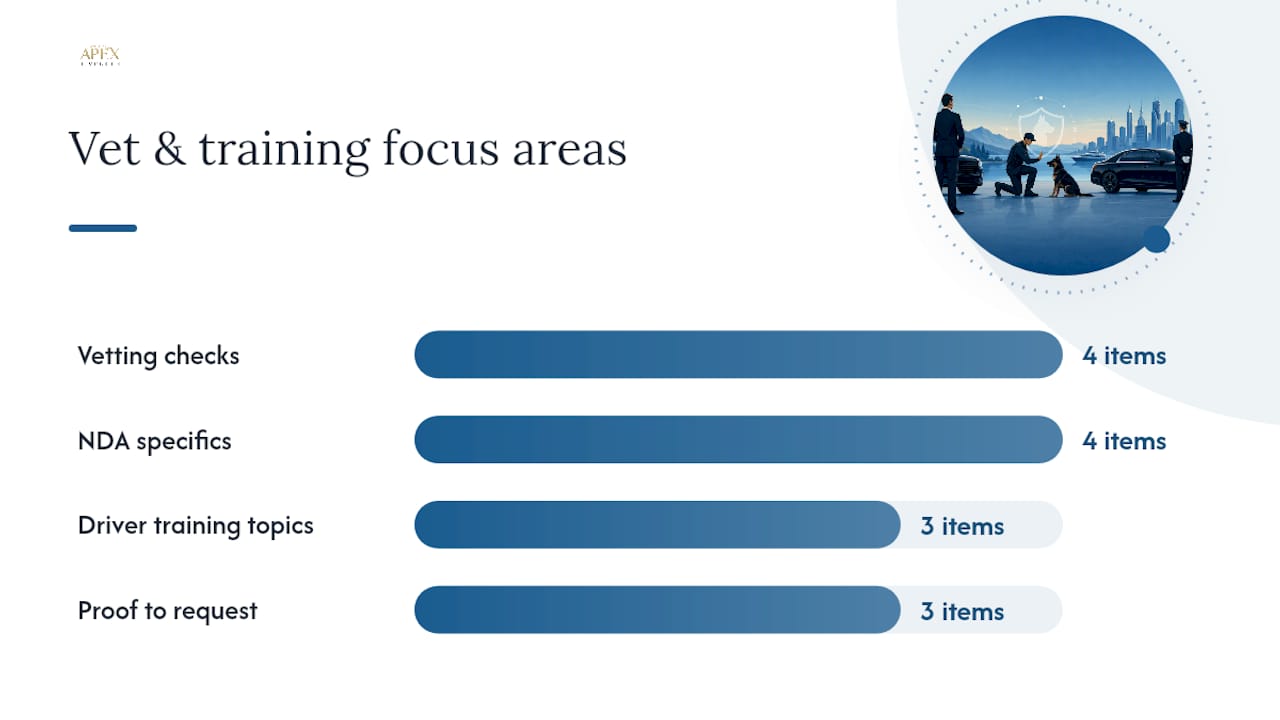
An operational NDA worth signing specifies scope (what information is covered), duration (how long the obligation lasts, sometimes indefinitely for certain data), penalties for breach, and a named escalation path if something goes wrong. A vague, boilerplate NDA without those specifics offers little real protection.
Training should go beyond defensive driving:
- Confidentiality refreshers on a recurring basis, not just at onboarding.
- Media handling guidance for drivers who may be approached by reporters or bystanders.
- Social-engineering awareness, since a friendly stranger asking "casual" questions about a client's schedule is a common probing tactic.
Booking discretion that actually holds up starts before the trip, in how personnel and information get filtered from the start. If you want proof, ask for a redacted background-check summary, a training certificate, and a written NDA excerpt. A provider confident in its process will hand these over without much resistance.
How Do Routing and Staging Prevent Surveillance?
Route and staging decisions scale with risk. A low-profile corporate pickup might just need one alternate route on file. A high-exposure movement, like a courthouse transfer during a publicized case, calls for a full anti-surveillance approach.
- Vary routes trip to trip rather than repeating the same path at the same time daily.
- Run an advance sweep of the venue, entrance, and loading area before the principal arrives.
- Use tactical decoys (a second vehicle or staggered departure) for very high-risk movements.
- Coordinate curbside and loading-area logistics directly with venue security under NDA, so the handoff stays quiet on both ends.
Predictability is the enemy here. A driver who takes the same route to the same building at the same time every week has, without meaning to, built a surveillance schedule for anyone paying attention.
What Data and Communication Controls Actually Matter?
This is where a lot of otherwise careful operations fall apart. Booking a "discreet" ride over SMS or a consumer chat app defeats the purpose, since those channels aren't built for operational confidentiality and often retain messages indefinitely.
- Use encrypted dispatch and secure operational channels for bookings and status updates, not consumer messaging apps.
- Set minimal logging by default, with a written schedule for when data gets deleted rather than stored indefinitely.
- Apply role-based access so only staff who need telemetry (like live vehicle location) can see it.
- Require multi-factor authentication on dispatch consoles and audit logs that track who accessed what.
Clients increasingly have a real negotiating tool here: data-retention rights under frameworks like CCPA let you request deletion where applicable, so ask directly rather than assuming a provider's default policy protects you.
Pro Tip: Disable nonessential tracking features on in-vehicle devices before a sensitive trip, and confirm the dispatch app itself doesn't retain a location history longer than the trip requires.
Does the Vehicle Itself Need to Be Different?
Vehicle choice affects visibility more than most people expect. An understated sedan or SUV blends into traffic in a way a stretch limo or heavily branded van simply can't, and for staff or family movement, a mid-size SUV often balances discretion with practical capacity better than a larger vehicle would.
- Choose unmarked vehicles with minimal or no exterior branding for low-profile work.
- Conservative chauffeur attire (a plain suit, no company logos) reduces visual signals that draw attention.
- Interior privacy features, like tinted glass or sound dampening, matter most for confidential calls or conversations en route, less so for a simple point-to-point transfer.
Match the vehicle to the job. A discreet airport pickup rarely needs a stretch limo; a private event with a full party might.
What's Different About Airport and FBO Transfers?
Airports and private terminals concentrate cameras, staff, and strangers in a small space, which makes them one of the highest-exposure points in any trip. Confirming airside versus landside access permissions in advance avoids delays that force a principal to wait visibly in a public area.
- Confirm access credentials and staging location with the airport or FBO before the day of travel.
- Build in timing buffers so the handoff happens quickly, without a driver circling or waiting curbside.
- Coordinate directly with flight departments or FBO staff, sharing only the details needed to complete the handoff, consistent with the same minimum-disclosure approach used for other high-exposure transfers.
A quiet curbside handoff timed to the minute beats an elaborate security presence that just draws eyes.
How Do You Scale Controls to Match the Actual Risk?
Not every trip needs the same level of protection, and over-applying controls wastes money without adding real value. A simple three-tier framework helps:
- Low risk: routine corporate travel, standard vetting and confidentiality agreement, no special routing needed.
- Increased risk: known public profile or a sensitive destination, add route variability, advance venue checks, and encrypted communications.
- Very high risk: active litigation, credible threats, or major public events, add advance teams, tactical decoys, and coordinated close protection.
Ask yourself how publicized the schedule is, how consequential exposure would be, and whether anyone has a specific reason to track this movement. The answer tells you which tier fits.
What Should You Demand Before You Book?
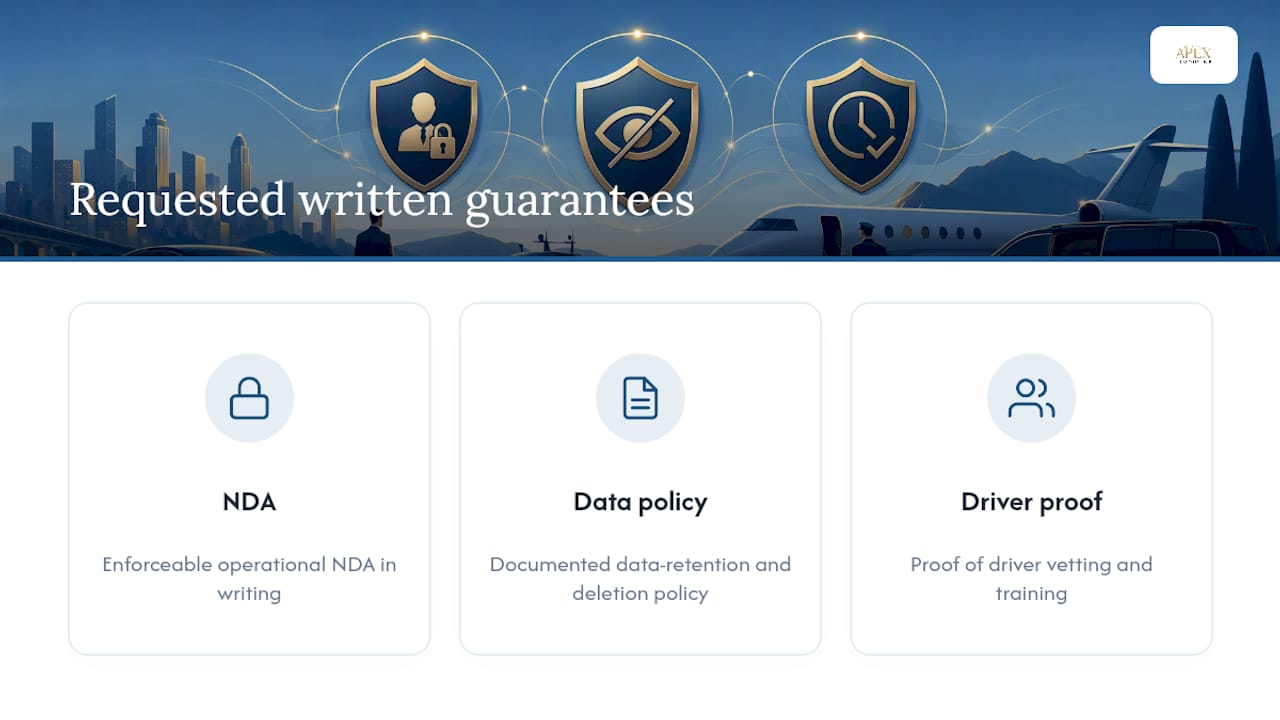
Get written, satisfactory answers to three questions before signing anything: Does the provider offer an enforceable operational NDA? Is there a documented data-retention and deletion policy? Can they show proof of driver vetting and training? Ask these directly in your booking email or RFP, and budget for advance planning time, since rushed bookings rarely allow for proper staging or venue checks.
How APEX LIMO Builds Discretion Into Every Booking
APEX LIMO trains chauffeurs on confidentiality protocols, applies enforceable NDAs to sensitive bookings, and tailors staging and concierge coordination to each client's exposure level. Clients arranging VIP or corporate transport can request NDA excerpts, a summary of data-retention practices, and vetting documentation directly during booking, the same standard detailed in APEX LIMO's VIP transportation protocols.
— Jason
Ready to Book a Discreet Transfer?
If you've read this far, you already know discretion isn't something you can bolt on after the fact, it has to be built into the booking from the first email. APEX LIMO handles that groundwork for corporate car service, VIP escort transport, and airport transfers across Austin, with trained chauffeurs and confidentiality measures built into the process rather than offered as an upsell.
Ask for the specifics when you request a quote: an NDA excerpt, a summary of how booking data gets retained and deleted, and an outline of driver training. Planners coordinating executive or VIP guests can also check APEX LIMO's corporate guest transport guidance for booking language that keeps information sharing to a minimum. When you're ready, request a quote and a privacy checklist through APEX LIMO's corporate car service page and get written answers before your event date, not after.
Where to Verify These Standards Yourself
Don't take any provider's word for it, check the standards directly. The layered privacy model referenced throughout this piece, covering NDAs, encrypted dispatch, and data lifecycle rules, comes from Hashtag Limo's breakdown of VIP privacy standards, while the booking-stage discipline recommendations draw on MLR Worldwide Service's guide to VIP transport. For a broader industry perspective on why chauffeured transport prioritizes safety and privacy, see Riga Global Travel's piece on private chauffeurs. If you want to verify a carrier's operating authority and inspection history directly, the FMCSA's public carrier snapshot tool is free and searchable by USDOT number.
Sources
- Executive Transfers: Balancing Security with Low-Profile Travel | Experience Life PMA
- How VIP Transport Stays Discreet | MLR Worldwide Service
- VIP Privacy & Discretion: 7 Layers of Secure Travel | Hashtag Limo
- FMCSA SAFER carrier snapshot (Stealth Shipping Solutions LLC)