

VIP corporate guest transport is defined as a premium, fully coordinated transportation service that moves high-profile corporate guests in luxury vehicles, managed by professional chauffeurs and a dedicated logistics team. The term covers far more than a nice car and a driver. It includes itinerary management, real-time route coordination, privacy protocols, and contingency planning. For corporate event planners and executives, understanding this service category is the first step toward protecting both your guests and your organization's reputation.
What does VIP corporate guest transport mean?
VIP corporate guest transport means placing accountability, not just comfort, at the center of every guest movement. The industry term for this service category is executive ground transportation, and it operates under a distinct set of standards that separate it from standard car services or ride-hailing apps.
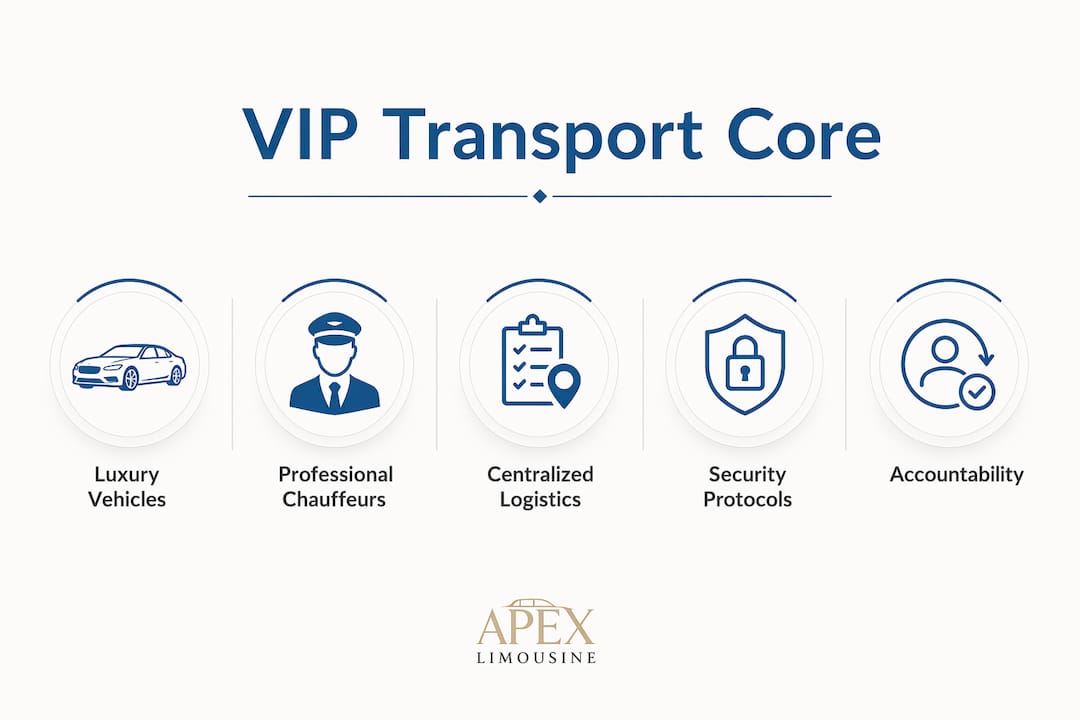
The core elements are three: luxury vehicles matched to guest status, professionally trained chauffeurs, and a centralized logistics coordinator who manages scheduling, real-time traffic, and last-minute changes. Each element is interdependent. A premium vehicle means nothing if the driver lacks event context or the routing fails under pressure.

Corporate guest transportation carries a direct reputational weight. When a keynote speaker misses an entrance because of a routing error, the failure reflects on the host organization, not the transport vendor. That accountability gap is why planners treat VIP travel arrangements as a logistics discipline, not a vendor purchase.
APEX LIMO builds its corporate service around this principle. Every booking includes a dedicated point of contact, pre-event route confirmation, and chauffeurs briefed on event schedules and access protocols.
What are the key components of VIP transport services?
Vehicle classes and their roles
The vehicle fleet defines the first impression. Executive sedans such as the Mercedes-Benz S-Class or Cadillac CT6 serve individual principals and guests of honor. Executive SUVs like the Cadillac Escalade or Lincoln Navigator accommodate small groups with added security presence. Mercedes-Benz Sprinter vans handle larger delegations while maintaining a professional appearance. Each vehicle class signals a different level of status and serves a different logistical purpose.
Chauffeur qualifications and discretion
Chauffeur standards in VIP corporate transportation go well beyond a commercial driver's license. Discretion and privacy are often more critical than vehicle brand. Chauffeurs routinely sign non-disclosure agreements and may hold security clearances for high-profile guests. Confidential itineraries and discreet pick-up points are standard protocols, not optional upgrades.
Logistics and security protocols
A dedicated logistics coordinator handles route mapping, timing buffers, itinerary adjustments, and real-time communication across the full event. This role prevents the most common failure in VIP transport: coordination breakdown, not vehicle shortage. Security integration includes background-checked drivers, pre-cleared access routes, and communication protocols aligned with event security teams.
Pro Tip: Request that your transport provider supply a single logistics contact number active from 48 hours before the event through final departure. This one change eliminates the most common communication gaps during multi-venue corporate programs.
| Vehicle type | Best use | Service level |
|---|---|---|
| Executive sedan | Individual principal or C-suite guest | Highest privacy, single occupant |
| Executive SUV | Small group or security detail | High comfort, moderate capacity |
| Sprinter van | Delegations of 8–14 guests | Group efficiency, professional finish |
| Coach or mini-coach | Large staff or support groups | Volume movement, standard service |
How do logistics and hierarchy shape VIP transport planning?
The Movement Hierarchy framework is the planning standard for corporate events with multiple guest tiers. It categorizes every person requiring transport into one of three groups, then assigns service standards accordingly.
- Principals: CEOs, keynote speakers, heads of state, or named VIPs. These guests receive dedicated vehicles, pre-cleared routes, and chauffeurs with full event briefings.
- Guests of honor: Senior executives, major clients, and board members. They receive executive-class vehicles with itinerary-matched timing and privacy protocols.
- Support staff: Coordinators, assistants, and technical crew. They move in group vehicles on fixed schedules with less individualized service.
This categorization does more than assign cars. It determines timing buffers, communication channels, and contingency plans for each tier. A principal arriving at a venue 10 minutes late requires a different response than a support staff delay. Planners who skip this framework often discover the gap when a high-value guest is left waiting at a hotel lobby.
Route mapping for principals always includes at least one alternate path. Timing buffers of 15–20 minutes per leg protect against traffic, security checks, and venue access queues. Intake discipline matters equally: each guest file should include their itinerary, preferred communication method, access credentials, and any security requirements.
A practical example: at a multi-day executive summit, the principal guest (a keynote speaker) travels in a dedicated sedan with a pre-briefed chauffeur and a direct line to the logistics coordinator. Senior clients travel in SUVs on a staggered schedule to avoid lobby congestion. Staff move in a Sprinter on a fixed loop. Each tier runs independently, but all three feed into one master timeline managed by a single coordinator.
Why should planners bundle VIP transport with hospitality services?
Bundling transportation with hospitality services such as hotel coordination, dining reservations, and concierge access reduces the number of vendors a planner manages and cuts the number of points where guest experience can break down. A guest whose car, hotel check-in, and dinner reservation are coordinated by one provider arrives at each stop without friction. Separate vendors create separate timelines, and those timelines rarely align perfectly under event-day pressure.
The administrative benefit is concrete. One contract, one invoice, and one point of escalation replace three or four separate vendor relationships. That reduction in overhead frees planners to focus on program content rather than logistics calls.
Cost consistency improves with bundled packages as well. Providers who manage transport and hospitality together have full visibility into the guest schedule. They can build accurate timing buffers and avoid the reactive pricing that comes with last-minute changes across multiple vendors.
APEX LIMO's client hospitality transportation service integrates ground transport with event access coordination, giving planners a single point of contact for guest movement from airport arrival through final departure.
Pro Tip: When negotiating a bundled hospitality package, ask the provider to include a written service timeline with named contacts at each stage. This document becomes your operational checklist and your accountability record if anything goes wrong.
What do VIP corporate transport costs and standards look like?
Pricing for corporate guest transportation follows two primary structures: flat-rate and hourly. Flat-rate contracts cover a defined route or event window at a fixed price. Hourly contracts bill by time on-call, which suits multi-stop programs but creates cost exposure if the schedule runs long.
VIP chauffeur pricing varies by vehicle class and service complexity. Entry-level sedan services start near £75 per hour in major markets, with armored or specialty vehicle pricing quoted on a bespoke basis. Security-integrated services and multi-vehicle programs carry premium rates that reflect coordination complexity, not just vehicle cost.
Commercial chauffeur licensing and livery insurance are legally required for all for-hire transport. Unlicensed providers create significant safety and legal risks for planners. If a guest is injured in an unlicensed vehicle, the liability can fall on the event organizer. Verifying licensing and insurance before signing any contract is a non-negotiable step in vendor evaluation.
Pro Tip: Lock in a fixed-rate contract for the full event window rather than an hourly arrangement. Surge pricing and overtime charges on hourly contracts can add 20–40% to your final invoice on a busy event day.
| Service type | Pricing model | Key cost drivers |
|---|---|---|
| Executive sedan | Flat rate or hourly | Route distance, wait time |
| Executive SUV | Flat rate or hourly | Group size, security add-ons |
| Sprinter van | Flat rate | Headcount, multi-stop routing |
| Security-integrated service | Bespoke quote | Clearance level, vehicle spec |
For planners evaluating vendors, the corporate event transportation guide from APEX LIMO outlines what to verify before committing to a provider in the Austin market.
Key Takeaways
VIP corporate guest transport succeeds when accountability, hierarchy planning, and licensed coordination replace the assumption that a luxury vehicle alone is sufficient.
| Point | Details |
|---|---|
| Core definition | VIP corporate guest transport combines luxury vehicles, trained chauffeurs, and logistics coordination into one accountable service. |
| Movement Hierarchy | Assign transport tiers to principals, guests of honor, and support staff to match service levels with guest status. |
| Discretion standards | Chauffeurs sign NDAs and follow confidential itinerary protocols as standard practice for high-profile guests. |
| Bundling advantage | Combining transport with hospitality services reduces vendor complexity and improves timing consistency across the event. |
| Legal compliance | Always verify commercial licensing and livery insurance before contracting any for-hire transport provider. |
Why accountability matters more than the vehicle
The most common mistake I see planners make is treating VIP transport as a procurement decision rather than an operational one. They compare vehicle photos and hourly rates, then hand off the booking and move on. The problems show up on event day, not in the quote.
Poor coordination, not vehicle shortage, is the most common failure in VIP transport. I have watched a flawlessly appointed sedan sit idle at the wrong entrance while a keynote speaker waited at the correct one. The car was perfect. The briefing was not.
The details that actually protect your guests are invisible when they work: a chauffeur who knows which entrance is pre-cleared, a logistics coordinator who monitors the flight board and adjusts pickup timing before you even know the flight landed early, a contingency route already mapped before the event starts. These are not luxury features. They are the baseline of a service that takes accountability seriously.
The significance of VIP transport in a corporate context is not the vehicle. It is the signal it sends to your guest about how your organization operates. A guest who moves through your event without friction, without waiting, and without a single awkward moment will remember the experience as professional and considered. That impression transfers directly to your organization's credibility.
— Jason
APEX LIMO's approach to corporate guest transport in Austin
Corporate event planners in Austin need a transport partner who understands both the logistics and the stakes of moving high-profile guests.

APEX LIMO provides luxury event transportation for corporate programs of every scale, from single-principal arrivals to multi-day executive summits. The fleet covers executive sedans, SUVs, and Sprinter vans, all maintained to the standard your guests expect. Every booking includes a dedicated logistics coordinator, pre-event route confirmation, and chauffeurs briefed on your event schedule and access protocols. APEX LIMO's executive chauffeur service is built for planners who need reliability, discretion, and a single point of contact from first booking through final departure.
FAQ
What is the difference between VIP transport and standard car service?
VIP corporate guest transport includes dedicated logistics coordination, chauffeur briefings, privacy protocols, and contingency planning. Standard car service provides a vehicle and driver without event-specific management.
Do VIP chauffeurs sign non-disclosure agreements?
Yes. Confidential itineraries and NDA requirements are standard practice for chauffeurs serving high-profile corporate guests, particularly principals and C-suite executives.
What is the Movement Hierarchy in corporate event transport?
The Movement Hierarchy categorizes guests into principals, guests of honor, and support staff, assigning different vehicle classes, timing buffers, and privacy levels to each group.
How do I verify a transport provider's legal compliance?
Confirm that the provider holds a commercial chauffeur license and active livery insurance before signing any contract. Unlicensed providers create legal liability for event organizers if an incident occurs.
Is a flat-rate or hourly contract better for corporate events?
A flat-rate contract gives planners cost certainty for the full event window. Hourly contracts carry overtime risk on busy event days and are better suited to short, single-stop transfers.