
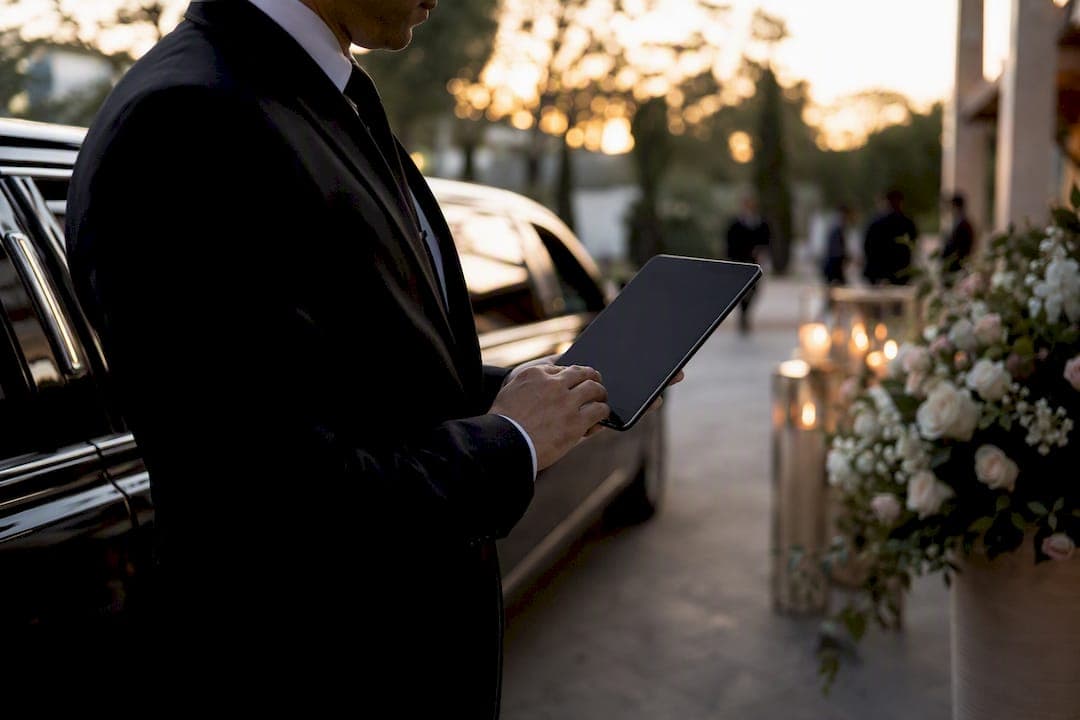
A successful celebrity transport plan delivers one outcome: discreet, secure, on-time movement with layered backup at every stage. That's the whole job, stripped of jargon. Everything else is execution.
Five things make it work: security coordination, a real staging plan, the right fleet with trained chauffeurs, tight timing windows, and contingency routing that kicks in before anything goes visibly wrong. Miss one and the others don't hold up.
Before you book a single vehicle, do this:
- Write a one-page transport brief covering arrival windows, headcount, and privacy requirements.
- Name a single transport lead who owns every routing and timing decision.
- Confirm who on the security side has final say if something changes mid-event.
That brief becomes the spine of everything that follows, from the vendor conversation to the day-of radio check.
Key Takeaways
Celebrity transport planning succeeds when security, staging, fleet choice, and timing windows operate as one coordinated system instead of four separate jobs.
| Point | Details |
|---|---|
| Start with a transport brief | Draft a one-page brief covering timing, headcount, and privacy needs before booking anything. |
| Limit manifest distribution | Keep full passenger details with two people; circulate a redacted version to everyone else. |
| Build in time windows, not fixed times | Use 10 to 15 minute windows and add 15% to 30% buffer for marine or weather-sensitive segments. |
| Assign one decision authority | Name a single transport lead with re-route authority so the convoy never stalls mid-route. |
| Choose a provider built for this work | APEX LIMO pairs fully customizable service with chauffeurs trained specifically in privacy and security protocol. |
Table of Contents
- What Does Celebrity Transport Planning Actually Include?
- How Far in Advance Should You Start Planning Transport?
- How Do You Coordinate Transport With Security Teams?
- Which Vehicles and Staging Setups Actually Work?
- What Happens on the Day of Transport?
- What Do Practitioners Actually Look For in a Transport Partner?
- Celebrity Transport Planning for Event Planners: A Practical Playbook
- Book Discreet, Professional Transport With APEX LIMO
- Sources
What Does Celebrity Transport Planning Actually Include?
Providers who specialize in this work sell more than a car and a driver. A real VIP transportation package includes a dedicated vehicle held for the client's exclusive use, a chauffeur briefed on the exact itinerary, and hourly or full-day coverage rather than single point-to-point runs. Privacy protections come standard: signed NDAs for staff who touch the manifest, and a strict limit on who inside the company even sees the client's name.
Beyond the core ride, expect:
- Multi-vehicle coordination when the group includes management, security, or family traveling separately.
- Wardrobe and luggage handling that keeps garment bags pressed and gear out of sight.
- In-vehicle amenities suited to the client, from water and chargers to blacked-out privacy glass.
Booking logistics matter as much as the ride itself. Ask about deposit structure, cancellation windows, and exactly what information the provider needs from you upfront, usually arrival times, headcount, luggage volume, and any known security concerns. A provider who asks vague questions at booking will improvise on the day. One who asks precise questions is already planning the route redundancy major events require.
How Far in Advance Should You Start Planning Transport?
Start planning well in advance for anything with security implications, and several weeks minimum for lower-profile moves. Permit applications for street closures or curbside holds often need the longest lead time of anything on this list, so file them first.
- Assign roles immediately. A transport lead, a security lead, a site liaison, and a client liaison, each with one clear job and no overlap.
- Start permit and municipal coordination early. Cities move slowly, and event-day traffic control or curb access approvals can take weeks.
- Run a site survey. Check curb width, loading dock access, elevator capacity, and at least two entry and exit points before you commit to a staging plan.
- Build your documents. A redacted manifest that strips passenger names from anyone outside the core team, a single contact sheet, and a time-window schedule rather than fixed clock times.
- Confirm production dependencies. If there's a show, a sound check, or a press schedule involved, transport choices depend on that timeline, not the other way around.
Pro Tip: Build your manifest in layers from day one. The full version with real names lives with two people. Everyone else works from the redacted version. Retrofitting privacy after the document has circulated is much harder than starting careful.
How Do You Coordinate Transport With Security Teams?
Route and staging decisions should never sit with transport alone. The strongest operations treat security as a co-owner from the first planning call, not a team that reviews the plan after it's finished. Decision authority should sit with one person on the day, full stop. Distribution lists for the manifest and route stay small by design.
A disciplined convoy has clear roles: a lead vehicle scouting ahead, a protection vehicle running close escort, the guest vehicle itself, and a support vehicle carrying luggage or overflow staff. Nobody freelances a lane change or a stop without the lead calling it.
- Use encrypted or end-to-end secured messaging for all day-of coordination, never standard text.
- Issue single-use digital manifests that expire after the event.
- Loop in local police or traffic control when the venue, crowd size, or route genuinely requires it, not as a default.
Major awards shows lean on this model at scale. Oscars-level operations run primary, secondary, and tertiary routes with full municipal coordination baked into the plan, not bolted on afterward. That same logic scales down to a single high-profile arrival at a hotel or a private venue. For dedicated escort arrangements, a private escort transport setup applies the same layered thinking on a smaller footprint.
Which Vehicles and Staging Setups Actually Work?
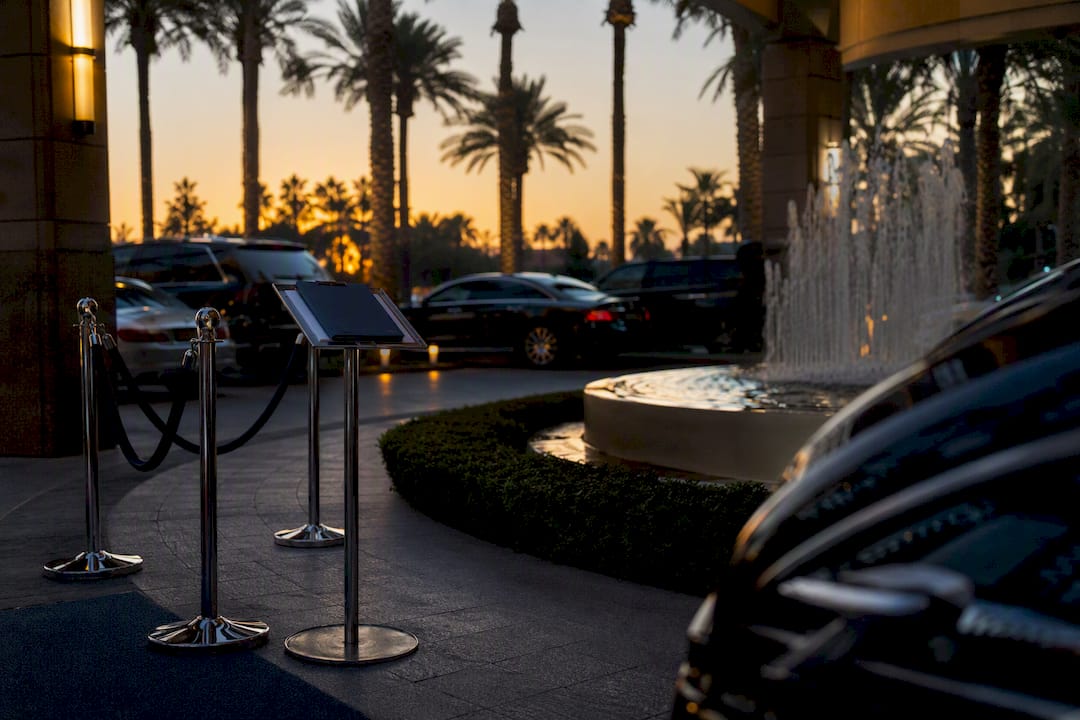
Vehicle choice should follow the itinerary's risk level, not just headcount. A sedan handles a low-exposure hotel-to-dinner run. A security SUV earns its place when crowd density or route uncertainty is real. A Sprinter van covers larger parties, gear, and staff without splitting the group across multiple cars, which itself reduces exposure.
Staging needs the same layered thinking:
- Set up a primary holding area close to the venue, and a decoy holding area elsewhere if press presence is heavy.
- For mixed-mode transfers, car to boat to helicopter, build in coordinated handover windows of five to ten minutes and a satellite comms fallback in case cell coverage drops.
- Choose unmarked, neutral vehicles for high-exposure moves; save branded fleet vehicles for lower-risk segments where visibility isn't a liability.
- Confirm door width, trunk space, and loading access match the client's wardrobe and luggage needs before the vehicle is booked, not on arrival.
What Happens on the Day of Transport?
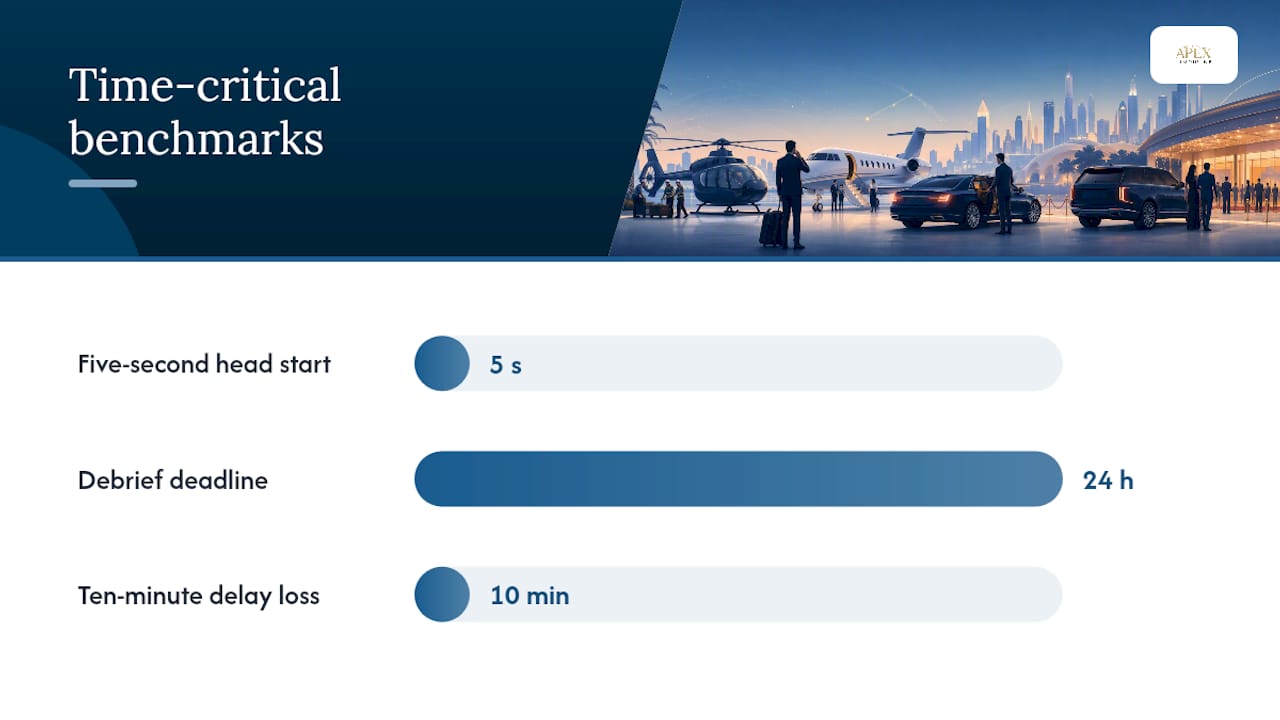
Time windows beat fixed times.
- Confirm primary, secondary, and tertiary routes the morning of, with live traffic checked against each.
- Deploy a decoy vehicle on high-press moves if the plan calls for one.
- Monitor in real time through geofencing and a hybrid mix of GPS tracking and driver check-ins, with a phone-based fallback if the tech drops.
- Set clear extraction triggers in advance, so the chauffeur and security lead both know exactly what circumstance authorizes an immediate departure.
- Debrief within 24 hours: what held, what nearly broke, and what changes before the next event.
On the highest-stakes arrivals, chauffeurs are trained to stay in the vehicle with the engine running rather than step away, so extraction is immediate if the situation calls for it. That's not paranoia. It's a five-second head start that matters exactly once, and you never know which event that will be.
Pro Tip: Give your re-route authority to one named person before the event, not a committee. A convoy that has to poll three people mid-route to change lanes has already lost the ten minutes that mattered.
What Do Practitioners Actually Look For in a Transport Partner?
Most of what separates a smooth arrival from a scramble happens in the questions asked before the booking, not the driving itself. APEX LIMO builds every high-profile booking around a fully customizable service, chauffeurs trained specifically on privacy protocol, and vehicles held to the same standard whether the client is walking a red carpet or slipping quietly into a private dinner.
A typical day-of role assignment looks like this: one transport lead running the schedule, one security liaison with final call authority, one chauffeur briefed only on the redacted itinerary, and one support driver handling luggage separately from the principal vehicle.
Experienced agents in this business consistently point to the same pattern: clients ask for NDAs, and they remember who kept things quiet the first time. Reputation, not marketing, is what actually books the next job.
When vetting any provider, ask for three things directly: a confidential manifest process, encrypted day-of communication, and a named on-call transport lead who isn't juggling five other events that night.
Celebrity Transport Planning for Event Planners: A Practical Playbook
The conventional advice on this topic obsesses over fleet size and vehicle luxury, and that's the wrong place to start. The research on major event operations, from Oscars logistics to concert transport, points somewhere else entirely: the plans that actually hold up are built on information control, not horsepower. Who knows the route. Who sees the manifest. Who has authority to change the plan at 9:47pm when the schedule slips.
I'd argue most planners overinvest in vehicle selection and underinvest in the single-decision-maker model. A gorgeous SUV with three people arguing over whether to reroute is worse than a modest sedan with one person cleared to make that call instantly. The Quiet Perimeter approach, splitting information into principal, operating, and public zones, sounds bureaucratic until you watch a plan fall apart because a valet mentioned an arrival time to the wrong person.
Start with who has authority and who has information. Everything else, vehicles, staging, timing, follows from that decision far more easily than the reverse.
— Jason
Book Discreet, Professional Transport With APEX LIMO
If you've read this far, you already know that most transportation providers can drive a car. Far fewer can run the privacy protocols, chauffeur training, and timing discipline this kind of booking actually demands. APEX LIMO built its Austin operation around exactly that gap: chauffeurs trained on discretion and comfort, vehicles held exclusively for your event, and packages customized around your itinerary instead of a generic hourly rate.
Whether you're arranging a red-carpet arrival, a corporate VIP transfer, or a private event where the guest list needs to stay off social media, APEX LIMO scales the same privacy-first approach the rest of this article describes. If your event involves a wedding weekend with multiple pickup points, pairing your transport plan with a detailed wedding weekend itinerary helps keep guest flow and vehicle staging aligned from the first toast to the last pickup.
Get in touch through APEX LIMO's booking page to discuss your event details and lock in vehicle availability before your date fills up.
Sources
- How stars arrive at the Oscars on time and in one piece
- Concierge Route: Designing multi-stop transport for celebs