

Corporate event transport types are categorized by passenger capacity and service purpose, ranging from executive sedans for solo VIPs to full-size motorcoaches carrying 55 or more attendees. Choosing the wrong vehicle type does not just inconvenience guests. It shapes how they perceive the entire event before they walk through the door. Transport sets the tone for event professionalism, making arrival and departure the two most critical impression points your planning controls. This guide breaks down every major category, with practical advice on matching each type to your event's size, guest tier, and logistics.
1. What are the main corporate event transport types by capacity?
The industry organizes corporate event transport types into four capacity tiers, each with distinct use cases and operational demands. Understanding these tiers is the fastest way to build a transport plan that fits your event.
| Vehicle Type | Capacity | Best Use Case | Complexity |
|---|---|---|---|
| Executive sedan or SUV | 1–6 passengers | VIPs, executives, airport transfers | Low |
| Passenger van or sprinter | 7–14 passengers | Small groups, staff coordination | Low to medium |
| Minibus | 15–30 passengers | Breakout groups, mid-size transfers | Medium |
| Full-size motorcoach | 40–55+ passengers | Large conferences, group arrivals | High |
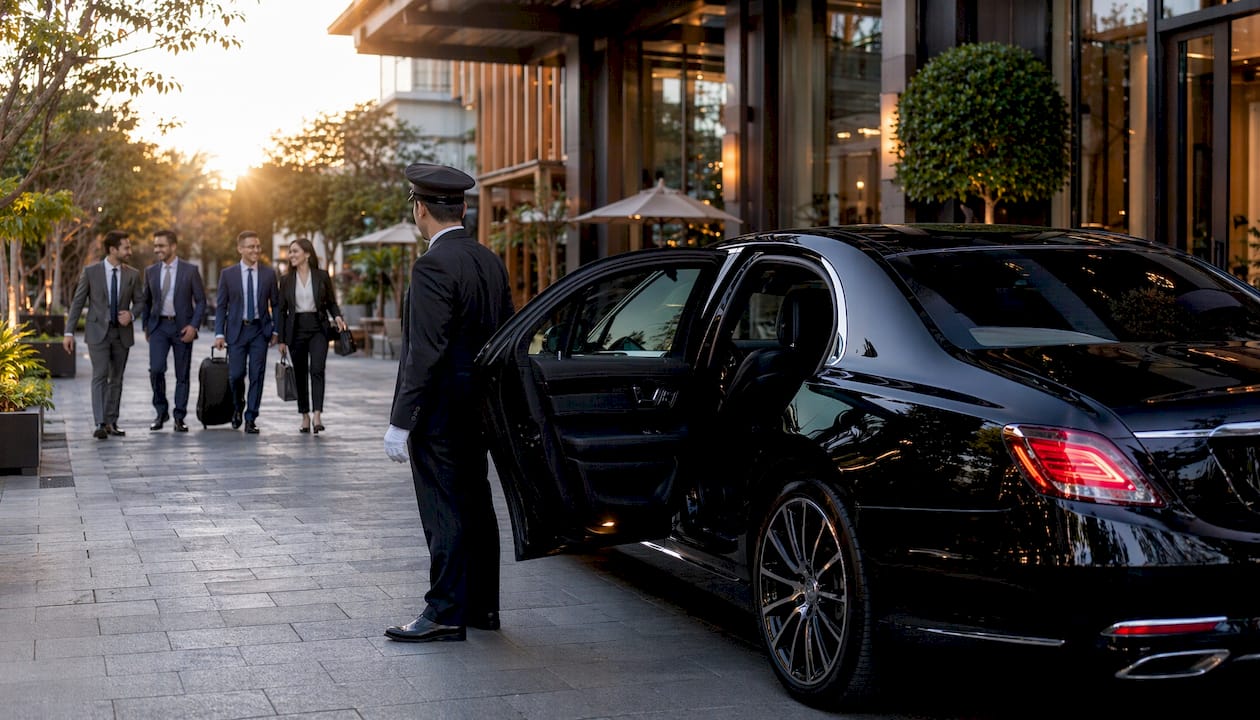
Capacity tiers and pricing from 2026 sources show sprinter rates starting around $135 per hour, with full-size buses reaching $500 per hour. That cost gap reflects the difference in driver requirements, fuel, and logistical coordination. Knowing your headcount before you contact any provider saves significant time and money.
Pro Tip: Book vehicles by confirmed headcount, not estimated attendance. Overestimating by even one tier can double your per-seat cost.
2. Executive sedans and SUVs for VIP and executive transport
Executive sedans and SUVs are the standard choice for VIP and executive arrivals. They carry 1–6 passengers and prioritize privacy, punctuality, and brand impression over volume.
Vehicles in this category include models like the BMW i7, BMW X7, and Mercedes-Benz Sprinter executive vans. These are not interchangeable with standard rental cars. A chauffeur-driven executive sedan signals to a C-suite guest that the event is professionally managed from the moment they land. Chauffeur services cost more than charter options, but they are the right tool for guests whose experience directly affects business outcomes.
Flight tracking integration is a key feature of quality executive transport. When a VIP's flight lands early or late, a professional chauffeur adjusts without the planner lifting a finger. That reliability is what separates executive transport from general group solutions.
3. Passenger vans and sprinters for small group coordination
Passenger vans and sprinters handle the 7–14 passenger range and fill the gap between individual executive cars and larger buses. They work well for staff coordination, breakout session transfers, and moving small delegations between venues.
Sprinters are particularly useful for events with multiple pickup locations. A single sprinter can run a loop between a hotel block and a conference center, keeping small groups moving without requiring a full bus commitment. The lower hourly rate compared to motorcoaches makes them a cost-efficient choice for secondary guest tiers. Planners often underuse this category, defaulting to either sedans or large buses when a sprinter would serve better.
4. Minibuses for mid-size groups and breakout transfers
Minibuses carry 15–30 passengers and are the most flexible vehicle type for events with multiple session tracks or off-site activities. They are large enough to move a meaningful group but small enough to access venues that cannot accommodate a full motorcoach.
Height clearances are a real operational concern with minibuses and larger vehicles. Parking garages, hotel drop-off areas, and convention center loading docks all have specific height limits. Confirming clearances before finalizing your route prevents the kind of last-minute rerouting that causes cascading delays. Minibuses also work well for VIP group dinners, where a full motorcoach would feel impersonal but individual cars would fragment the group dynamic.
5. Full-size motorcoaches for large conferences and group arrivals
Full-size motorcoaches carry 40–55 or more passengers and deliver the lowest cost per seat for large groups traveling the same route. They are the backbone of conference group transportation for events with 200 or more attendees.
The operational complexity of motorcoaches is real. Hours of Service regulations limit how long a driver can operate before requiring a mandatory rest period. Planners must build buffer time into every motorcoach schedule. Adding 15–20 minutes per hour of travel time for boarding and traffic is a standard industry practice. Failing to account for this is one of the most common reasons large-event transport runs late.
Consolidating guests into motorcoaches rather than running multiple smaller vehicles improves group control and punctual arrival. More vehicles do not equal better service. They equal more coordination points and more opportunities for delays.
6. How corporate shuttle services improve event flow
Corporate shuttle services operate as continuous loops between fixed points, typically a hotel block, a parking area, and the event venue. They are the most effective tool for managing large attendee volumes without requiring individual vehicle assignments.
The key to a functional shuttle loop is staffing boarding points. A single coordinator at each stop prevents confusion, manages queues, and communicates delays in real time. Wave arrivals for events with more than 200 attendees reduce bottlenecks by staggering departure times across guest groups. Without wave scheduling, every shuttle fills at the same moment and the system collapses under its own demand.
Technology now plays a direct role in shuttle management. Flight tracking tools allow planners to adjust airport pickup timing without manual monitoring. Attendee-facing apps can display real-time shuttle locations, reducing the number of guests who miss a loop because they did not know where to stand. These tools are no longer optional for events above 300 attendees.
Pro Tip: Assign a dedicated on-site transport coordinator who has no other event responsibilities. Split attention is the primary cause of shuttle system failures.
7. What factors should planners consider when selecting transport types?
Guest segmentation into tiers is the primary driver of successful corporate event transport planning. Executives, VIPs, and general attendees have different service expectations and different tolerances for wait time.
A structured approach to selecting event transportation options covers five areas:
- Movement patterns. Map every transfer your guests will make, from airport to hotel, hotel to venue, and venue to dinner.
- Guest segmentation. Assign vehicle types by guest tier. Executives get sedans. General attendees get shuttle loops or motorcoaches.
- Logistics confirmation. Verify route clearances, parking permissions, and drop-off access at every location.
- Real-time tracking. Confirm your provider has tools to monitor vehicle locations and communicate delays.
- Vehicle selection by headcount. Lock in vehicle types only after you have confirmed attendance numbers, not estimates.
Booking vehicles 3–6 months in advance and using wave arrivals for events over 200 attendees reduces bottlenecks significantly. Late bookings limit your vehicle options and often push you into less suitable alternatives. Unmanaged events see delays in over 50% of cases, which is a direct reflection of skipped planning steps.
8. Benefits and challenges of luxury executive transport
Luxury executive transport delivers three things that group solutions cannot: privacy, precision timing, and a visible signal of guest importance. When a board member or keynote speaker arrives in a chauffeur-driven BMW i7, the message to other attendees is clear. This event takes its guests seriously.
The cost is the primary challenge. Executive chauffeur services carry a higher hourly rate than any group transport option. The return on that cost is not measured in per-seat efficiency. It is measured in the impression left on guests whose relationship with your organization has long-term value.
Luxury transport is not a budget line to minimize. For the right guests, it is the most cost-effective investment in the event's outcome. A VIP who arrives stressed, late, or confused about pickup logistics carries that experience into every session they attend.
Coordinating executive transport with the broader event schedule requires direct communication between your chauffeur provider and your event timeline. APEX LIMO's executive chauffeur service in Austin includes trained chauffeurs who coordinate directly with event staff, adjusting pickup times as the program shifts.
9. How to optimize cost and guest experience with a mixed transport strategy
A mixed transport strategy uses different vehicle types for different guest tiers and transfer types within the same event. It is the most cost-efficient approach for events with 100 or more attendees.
The core principle is consolidation where it makes sense and individualization where it matters. General attendees travel by shuttle or motorcoach. Executives and VIPs travel by sedan or SUV. Breakout groups use minibuses or sprinters. This structure reduces total vehicle count while maintaining service quality at every tier.
Cost management requires attention to hidden expenses:
- Gratuities. Most quotes do not include driver gratuity. Budget 15–20% of the vehicle cost per driver.
- Tolls and parking fees. These appear as line items on final invoices if not addressed upfront.
- Insurance requirements. Some venues require proof of commercial insurance from transport providers before allowing vehicle access.
- Overtime charges. Events that run long trigger overtime rates. Build buffer into your schedule.
Require itemized quotes that include gratuities, tolls, and fees before signing any agreement. Verbal agreements are not sufficient for complex shuttle routes. Always request a visual route map alongside the quote.
Pro Tip: Request itemized quotes from at least two providers and compare line by line, not just the total. The lowest total quote often excludes the most costs.
Electric vehicles and rideshare voucher programs are emerging as sustainability options for general attendee transport. They work best for smaller events or as a supplement to a primary shuttle system, not as a replacement for structured group transport.
Key takeaways
The most effective corporate event transport plan matches vehicle type to guest tier, books 3–6 months in advance, and uses wave arrivals and dedicated coordinators to prevent delays.
| Point | Details |
|---|---|
| Match vehicle to guest tier | Executives need sedans or SUVs; general attendees move efficiently by shuttle or motorcoach. |
| Book 3–6 months early | Late bookings limit vehicle options and increase the risk of unsuitable alternatives. |
| Use wave arrivals for large groups | Staggered departures prevent shuttle system overload at events with 200 or more attendees. |
| Require itemized quotes | Verbal agreements miss gratuities, tolls, and overtime charges that inflate final costs. |
| Assign a dedicated coordinator | On-site transport management is the single most effective way to prevent schedule failures. |
What I've learned about corporate event transport after years of planning
Transport is the first thing guests experience and the last thing they remember. Every other element of your event can execute perfectly, but a confused pickup process or a 30-minute wait for a shuttle will define how attendees describe the event afterward.
The planning mistake I see most often is treating transport as a logistics afterthought. Planners finalize the venue, the catering, and the program, then call a transport provider two weeks out. At that point, the best vehicles are already booked, and you are choosing from whatever remains. The corporate event transportation guide I recommend to every planner I work with makes this point clearly: transport planning starts the same day venue planning starts.
The other oversight is underestimating the value of a dedicated on-site coordinator. This is not the same person managing registration or running the AV board. Transport coordination requires full attention, a radio or phone line to every driver, and the authority to make real-time decisions. Without that person, even a well-planned system falls apart when one vehicle runs late and creates a cascade.
My honest advice for 2026: build your transport plan around confirmed headcount and guest tiers before you finalize any other vendor contract. The vehicle mix follows from those two inputs. Everything else is execution.
— Jason
APEX LIMO's corporate transport services for Austin events
APEX LIMO serves corporate event planners across Austin with a fleet that covers every transport tier, from executive sedans and SUVs for VIP arrivals to group solutions for larger delegations.
Every APEX LIMO chauffeur is trained to coordinate directly with event staff, adjust to schedule changes, and maintain the professional standard that executive guests expect. For planners managing Austin corporate events, APEX LIMO offers custom transport planning that accounts for your guest tiers, venue logistics, and timeline. Contact APEX LIMO to discuss your event's specific transport needs and get an itemized quote built around your actual headcount and schedule.
FAQ
What are the main corporate event transport types?
Corporate event transport types include executive sedans and SUVs for 1–6 passengers, passenger vans and sprinters for 7–14, minibuses for 15–30, and full-size motorcoaches for 40–55 or more attendees. Each type serves a distinct guest tier and logistical purpose.
How far in advance should I book event transport?
Book vehicles 3–6 months before your event date. Late bookings reduce available vehicle options and often result in higher rates or less suitable alternatives for your guest count.
What is a wave arrival strategy?
A wave arrival strategy staggers guest departure times across multiple groups to prevent all shuttles from filling simultaneously. It is the standard approach for events with more than 200 attendees and significantly reduces bottlenecks at pickup points.
When should I use executive chauffeur service instead of group transport?
Use executive chauffeur service for C-suite guests, keynote speakers, and VIPs whose arrival experience directly affects business relationships. Group transport is the right choice for general attendees where per-seat cost efficiency matters more than individualized service.
What hidden costs should I watch for in event transport quotes?
Watch for driver gratuities, tolls, parking fees, overtime charges, and insurance requirements. Always request an itemized quote in writing. Verbal agreements do not capture these line items, and they appear on final invoices without prior notice.