

Punctual airport transport prevents missed meetings, protects deals, and preserves professional credibility. Book a flight-aware, SLA-backed transfer before your next trip, or require these specific contract terms from your provider before signing anything.
Here is what to demand from any business airport transfer:
- Flight tracking: real-time monitoring via FlightAware or OAG, checked every 15–30 minutes
- Staged pickup: driver on-site at least 15 minutes before scheduled pickup
- Wait-time policy: 60 minutes complimentary for domestic arrivals, 90 minutes for international
- Active dispatch: a dedicated team that can reroute or reassign, not just a solo driver
Many business travelers rank ground transport reliability as a top duty-of-care factor for their organizations. That figure alone justifies making punctuality a procurement requirement, not an afterthought.
Table of Contents
- Why punctuality in business airport transport affects your deals and reputation
- How professional providers actually guarantee punctual pickups
- What your company actually gains from reliable airport transfers
- Common threats to punctuality and how good providers handle them
- How to choose a provider that actually delivers on punctuality
- What research and expert commentary say about punctuality as a business discipline
- Key Takeaways
- The operational reality behind a punctual pickup
- APEX LIMO brings SLA-backed punctuality to Austin executive transfers
- Useful sources for SLA drafting and further reading
Why punctuality in business airport transport affects your deals and reputation
Late ground transport rarely stays a minor inconvenience. It cascades. A delayed pickup at Austin-Bergstrom means a missed connection, which means arriving at a client meeting two hours late, which means starting a negotiation already on the back foot.
The downstream costs are concrete: airline rebooking fees, lost negotiation time, and the cognitive performance hit that comes from rushing through an airport under stress. An executive who sprints to a gate and lands frazzled is not the same person who closes deals. Arriving composed preserves negotiation leverage in ways that are hard to quantify but easy to lose.
Reliability in transit functions as a proxy for organizational integrity. A punctual transfer signals a company's respect for partners' time and readiness to perform.
Consider three scenarios where timeliness in corporate travel is the difference between a win and a write-off. An executive heading to a morning investor pitch who misses her flight because a rideshare canceled at 4:45 AM. A sales director arriving 40 minutes late to a contract signing because his driver got stuck in terminal access traffic with no rerouting support. A visiting client whose first impression of your company is standing alone at baggage claim, phone in hand, wondering where the car is. Each scenario is preventable with the right provider.
How professional providers actually guarantee punctual pickups
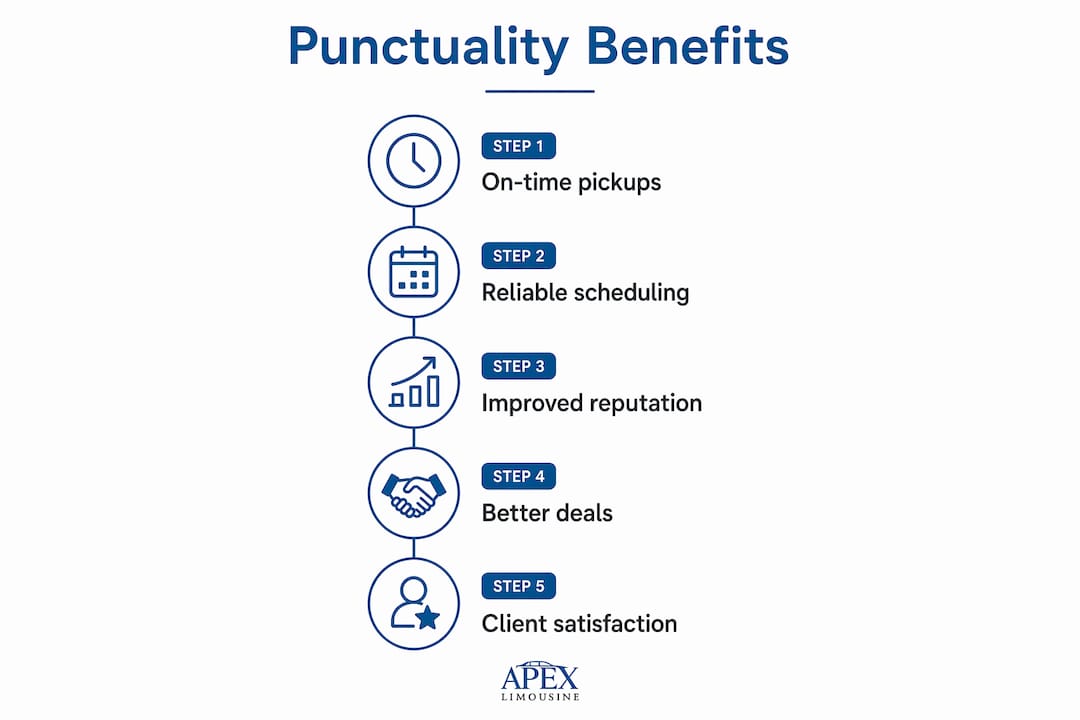
Punctual airport pickups are the product of active management, not individual driver heroics. The systems behind a reliable transfer matter far more than any single chauffeur's effort.
The core operational practices that separate professional services from everything else:
- Flight-number collection at booking: without it, real-time adjustment is impossible
- API-based flight monitoring: tools like FlightAware and OAG check status every 15–30 minutes and trigger automatic pickup adjustments without charging the client
- Driver staging: chauffeur on-site 15–20 minutes before the scheduled pickup window
- Meet-and-greet service: driver inside the terminal at baggage claim, not circling the departures loop
- Fixed fares and master-account billing: removes any incentive for a driver to rush or cut corners on timing
- Dispatch redundancy: a team that can reassign or reroute proactively, not a single driver operating alone
The SLA metrics that define a credible provider look like this:
| SLA Element | Professional Standard | Source |
|---|---|---|
| Driver staging time | 15–20 min before pickup | Empire Limo Transfer |
| Domestic arrival wait | 60 min complimentary | Empire Limo Transfer |
| International arrival wait | 90 min complimentary | Empire Limo Transfer |
| On-time rate target | 98.5–99.5% | Empire Limo Transfer |
| Flight-check frequency | Every 15–30 min | Empire Limo Transfer |

Pro Tip: Ask your provider which flight-data API they use and how far in advance automatic pickup adjustments can shift without client penalty. A provider using FlightAware or OAG with a two-hour adjustment window is operating at a meaningfully higher standard than one relying on manual checks.
What your company actually gains from reliable airport transfers
The global airport transfer services market is substantial and is expected to grow steadily in the coming years. Business travelers are the primary demand driver, and the reason is straightforward: they prioritize punctuality over price.
The benefits that justify that preference:
- Predictable schedules: tight itineraries with back-to-back meetings depend on ground transport that shows up exactly when planned
- Cognitive readiness: a traveler who arrives without rushing is sharper in the room; stress degrades decision-making in ways that matter during negotiations
- Client impression: how a visiting executive is picked up reflects directly on the host company's professionalism
- Operational ROI: a provider hitting a 98.5–99.5% on-time rate means roughly one delay per 100 trips; at scale across a corporate travel program, that reduction in meeting-impacting delays is measurable in recovered revenue and avoided rebooking costs
For airport transfer reliability that reaches this standard, the operational infrastructure behind the service matters as much as the vehicle itself.
Common threats to punctuality and how good providers handle them
Most delays happen on the ground, not in the air. Traffic, terminal access rules, customs queues, and seasonal volume are the real culprits, and local driver knowledge plus active dispatch support are what mitigate them.

| Risk | Provider Action | Traveler Action |
|---|---|---|
| Flight delay or early arrival | Auto-adjust pickup via flight API | Provide flight number at booking |
| Terminal access congestion | Stage driver in advance; use meet-and-greet | Request inside-terminal pickup |
| Customs and immigration queues | Build 90-min international wait into SLA | Confirm international arrival policy before trip |
| Rideshare cancellation at off-hours | Pre-booked dedicated driver assigned in advance | Avoid on-demand apps for early-morning or late-night flights |
| Driver unavailability | Dispatch redundancy and reserved backup drivers | Confirm redundancy policy in master agreement |
Rideshare supply thins dramatically at early-morning and late-night windows, exactly when many business flights depart. A 5:00 AM pickup is not the moment to discover your app-based driver canceled. Professional services assign a dedicated chauffeur at booking and maintain dispatch redundancy to cover any gap.
Pro Tip: Add explicit language to your master account agreement requiring the provider to notify you of any pickup adjustment within 10 minutes of a flight status change. That single clause eliminates the most common source of cascading delays: a driver who knew about a delay but didn't communicate it.
How to choose a provider that actually delivers on punctuality
Not every company that calls itself a "professional chauffeur service" operates at the same standard. Here is a numbered checklist for procurement and travel managers evaluating airport transfer providers:
- Confirm flight-tracking capability. Ask which API they use (FlightAware, OAG, or equivalent) and how frequently they check status. Every 15–30 minutes is the professional standard.
- Request the published on-time KPI. A credible provider can tell you their on-time rate. If they cannot, that is your answer.
- Review SLA details in writing. Staging time, complimentary wait allowances (60/90 minutes), and automatic adjustment windows should all appear in the contract.
- Ask about dispatch redundancy. A solo driver with no backup is a single point of failure. Require a dedicated dispatch team.
- Verify driver training and background checks. Chauffeurs should hold commercial licenses and pass criminal background screening.
- Check insurance coverage. Commercial livery insurance is not the same as personal auto insurance; confirm the policy type and limits.
- Understand cancellation and change terms. A provider that charges penalty fees for airline-caused delays is transferring their operational risk to you.
| Feature | Professional Chauffeur Service | Rideshare App | Shared Shuttle |
|---|---|---|---|
| Pre-assigned driver | Yes | No | No |
| Real-time flight tracking | Yes | No | Rarely |
| Complimentary wait time | 60–90 min | None | Fixed schedule only |
| Dispatch redundancy | Yes | No | Partial |
| Fixed fare | Yes | Surge pricing | Yes |
| Meet-and-greet inside terminal | Yes | No | No |
| SLA documentation | Yes | No | No |
For corporate airport transfer best practices and ready-to-use SLA language, travel managers can find detailed procurement templates that map directly to these criteria.
Red flags to walk away from: no flight tracking at all, variable pricing for airport pickups, fees charged when an airline causes the delay, and no ability to verify driver staging.
What research and expert commentary say about punctuality as a business discipline
The connection between punctual transport and professional credibility runs deeper than logistics. Consistent timeliness builds leverage and mutual respect in business relationships; it signals moral authority before a word is spoken.
Punctual airport pickups are the product of active management — flight monitoring and dispatch coordination — rather than individual driver heroics.
Research-backed takeaways procurement teams can use directly in RFP documents and SLA clauses:
- Require flight-number collection at booking as a non-negotiable; without it, real-time coordination is structurally impossible
- Specify on-time rate targets of 98.5–99.5% in the master account agreement, with reporting cadence (monthly or quarterly)
- Include explicit wait-time allowances: 60 minutes for domestic arrivals, 90 minutes for international, at no additional charge
- Mandate dispatch redundancy language: the provider must maintain backup driver capacity and proactive rerouting capability, not just a single assigned chauffeur
The National Limousine Association and the Global Business Travel Association both publish standards and benchmarks that support these procurement criteria. Grounding your RFP in those frameworks gives your SLA language institutional backing.
Key Takeaways
Punctual airport transport is a measurable operational capability, not a vague promise: demand SLA terms, flight-tracking proof, and published on-time KPIs before signing any corporate transfer agreement.
| Point | Details |
|---|---|
| Require flight tracking at booking | Providers must collect flight numbers and monitor status every 15–30 minutes via FlightAware or OAG. |
| Demand staged pickup in writing | Driver staging 15–20 minutes before pickup is the professional standard; verify it is in the contract. |
| Include wait-time allowances | SLA must specify 60 minutes complimentary for domestic arrivals and 90 minutes for international. |
| Target 98.5–99.5% on-time rate | Ask for the published KPI; a provider who cannot state it is not tracking it. |
| APEX LIMO for Austin transfers | APEX LIMO provides SLA-backed executive airport transfers with trained chauffeurs, flight monitoring, and master-account billing. |
The operational reality behind a punctual pickup
Running a punctual airport transfer program is a team discipline, not a driver discipline. At APEX LIMO, dispatch monitors every active flight from the moment a booking is confirmed, adjusting pickup windows in real time as status changes. Chauffeurs stage at the terminal before the scheduled window, not at the curb when the passenger calls. When a flight lands early or a customs queue runs long, the dispatch team already knows and has already communicated the update. Punctuality at this level is systemic: it requires the right technology, trained people, and SLA commitments that hold the whole operation accountable. No single chauffeur, however skilled, can deliver that consistency alone.
APEX LIMO brings SLA-backed punctuality to Austin executive transfers
For business travelers who need a transfer that actually shows up, APEX LIMO delivers executive chauffeur service in Austin built around the operational standards this article describes: real-time flight monitoring, staged pickups, trained chauffeurs with commercial credentials, and master-account billing that removes friction from corporate travel programs.

The service features that align with professional procurement criteria:
- Real-time flight tracking with automatic pickup adjustments
- Driver staging at least 15 minutes before scheduled pickup
- Meet-and-greet inside the terminal for arriving executives
- Complimentary wait time for domestic and international arrivals
- Fully vetted, professionally trained chauffeurs
- Fixed fares and corporate account billing with no surge pricing
If your current provider cannot answer the questions in the checklist above, that gap has a cost. Book your next executive transfer with APEX LIMO or contact the team to discuss a master account agreement tailored to your travel program.
Useful sources for SLA drafting and further reading
The sources below are the most useful for procurement teams building SLA language, travel managers evaluating providers, and executives who want to understand what a credible airport transfer commitment looks like.
- Optimizing Your Airport Transfer SLA for Corporate Travel Success: the single best source for SLA clause language, staging standards, wait-time allowances, and on-time KPI benchmarks. Start here when drafting a master account agreement.
- How to Ensure Punctual Pickup for Business Travelers: practical guidance on pre-booked versus on-demand services, with specific notes on early-morning and late-night flight risk.
- What Makes Airport Pickups Punctual? (Taxi Nova): ground-level operational breakdown of why delays happen and how local knowledge and dispatch support mitigate them.
- Why Punctuality Matters in Executive Travel (Heylux Chauffeur): connects timeliness to professional credibility and deal outcomes; useful for internal stakeholder communication.
- National Limousine Association (limo.org): industry standards body for professional ground transportation; a reference for driver credentialing and service benchmarks.
- Global Business Travel Association (gbta.org): publishes duty-of-care benchmarks and business-travel policy frameworks that support ground transport procurement criteria.
- How to Track Flight Delays for Limo Service (APEX LIMO Blog): technical walkthrough of flight-tracking APIs and dispatch integration; useful for evaluating a provider's monitoring capability.
- Corporate Airport Transfer Best Practices (APEX LIMO Blog): procurement templates and SLA guidance for travel managers, with Austin-specific operational context.