

Tracking flight delays for limo service is the process of monitoring live arrival data through automated aviation feeds to adjust chauffeur dispatch times accurately. Professional limo services integrate real-time systems like FlightAware and OAG to track every gate change, taxi delay, and updated touchdown time. This matters because a missed pickup or an unexpected standby fee can turn a smooth trip into a stressful one. Understanding how these systems work, what you need to provide, and what policies protect you gives you full control over your airport transfer.
How do limo services track flight delays in real time?
Professional limo services do not rely on the same flight apps you use on your phone. They connect directly to aviation APIs like FlightAware or OAG, which deliver gate assignments, taxi delays, and updated arrival times that consumer apps miss entirely.
These systems monitor flights continuously, typically starting 24–48 hours before departure and refreshing every few minutes. That depth of coverage means a dispatcher knows your plane pushed back late from the gate before you even feel the delay in your seat. Professional tracking systems outperform consumer apps by 10–20 minutes in accuracy. That gap is the difference between a chauffeur waiting at baggage claim when you arrive and one who shows up ten minutes after you do.
The connection between your booking and live flight data runs through your flight number. When you provide it at booking, the system links your reservation to that specific flight's data stream. Every update the airline pushes to the aviation database flows directly to the dispatcher's screen.
GPS tracking of the chauffeur's vehicle layers on top of the aviation data. The dispatcher sees both where your plane is and where your driver is, then coordinates the two in real time. This dual-layer approach is what separates a luxury airport transportation provider from a basic car service.

Pro Tip: Always provide your flight number at booking, not just the arrival time. The flight number is what connects your reservation to live aviation data.
| Data Source | What It Provides | Why It Matters |
|---|---|---|
| FlightAware / OAG API | Gate changes, taxi delays, updated ETAs | More accurate than airline apps by 10–20 minutes |
| Airport database sync | Terminal and baggage carousel assignments | Positions chauffeur at the right door |
| GPS vehicle tracking | Chauffeur real-time location | Coordinates driver dispatch with actual touchdown |
| Airline push notifications | Cancellations and rebooking alerts | Triggers immediate dispatcher action |
How do limo services adjust pickups for delays, early arrivals, and cancellations?
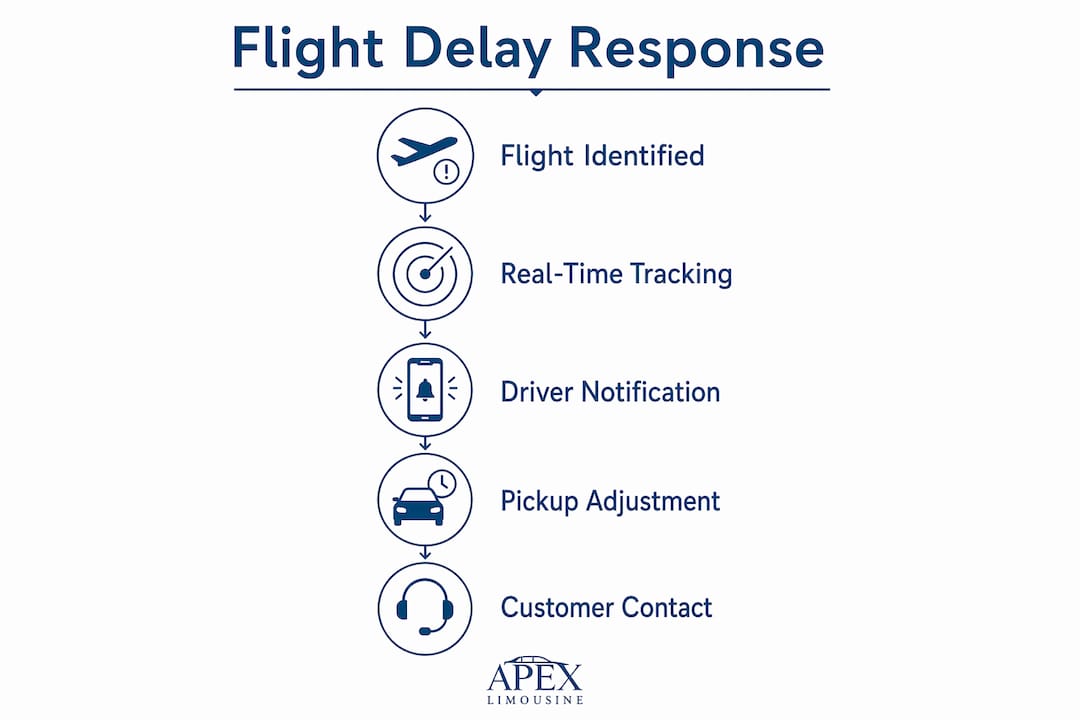
Premium limo services treat flight delays as a normal part of operations, not as exceptions. Luxury services build dispatch buffers around actual arrival time and do not penalize travelers for airline-caused delays. Your chauffeur moves when your plane moves.
The industry standard for complimentary wait time is 30 minutes for domestic flights and 60 minutes for international arrivals, with fees waived when a valid flight number is on file. Wait time itself starts after landing, not after your scheduled arrival. An airline delay does not count against your complimentary window.
Here is how the adjustment process works step by step:
- The system detects a delay and automatically pushes back the chauffeur's dispatch time.
- The dispatcher confirms the updated arrival window and monitors for further changes.
- The chauffeur receives a revised pickup time and routes to the terminal accordingly.
- If a gate change occurs, the driver receives an updated location before you deplane.
- For early arrivals, the system alerts the dispatcher, who contacts the chauffeur to accelerate the timeline.
Cancellations require your direct action. Failing to notify the limo service immediately about a cancellation or rebooking with a new flight number often results in a no-show charge equal to the full reservation cost. The automated system cannot detect a cancellation and assume you no longer need the car. You must call or message with the new flight number as soon as the airline confirms the change.
"When a flight is cancelled and a traveler books a new flight, the limo service needs the updated flight number immediately. Without it, the system has no data to track, and the chauffeur dispatches based on the original booking. The result is a no-show fee that is entirely avoidable with one phone call."
What should travelers provide to get the most from flight delay tracking?
Your role in the tracking process is smaller than you think, but the details you provide are critical. The entire automated system depends on one piece of information: your correct flight number.
Here is what to do before and during travel:
- Provide the exact flight number at booking. Do not substitute the departure time or airline name alone. The flight number is the unique identifier that links your reservation to live data.
- Update the service immediately if you rebook. A new flight means a new flight number. The old tracking data becomes useless the moment the airline assigns you a different flight.
- Request extra wait time for international arrivals. Customs bottlenecks and baggage delays are predictable. Ask for an extended wait window when booking so you are not charged standby fees while clearing immigration.
- Do not call for every minor delay. Automated tracking adjusts scheduling without you needing to report each update. If your flight number has not changed, the system already knows.
- Plan buffer time for terminal navigation. Large airports like Austin-Bergstrom International can add 15–20 minutes between landing and reaching baggage claim. Factor that into your pickup plan.
Pro Tip: Screenshot your flight confirmation and send it directly to your limo service at booking. It removes any chance of a transcription error on the flight number.
The benefits of a chauffeur service become most visible during disruptions. When your flight diverts or lands early, a professional dispatcher acts without waiting for your call. That responsiveness is built into the system, not added on request.
What challenges do limo services face when tracking flight delays?
Flight tracking works well for standard commercial flights, but several situations create real complexity for dispatchers.
Flight number changes are the most common problem. When an airline cancels a flight and reissues it under a new number, the original tracking link breaks. The system cannot follow a flight that no longer exists in the data feed. This is why traveler communication remains necessary even with full automation.
Private aviation arrivals require a completely different protocol. Private flights require tail numbers and FBO coordination for planeside pickups, not the commercial tracking APIs used for airline flights. If you arrive on a charter or private jet, you must notify the service in advance with the aircraft tail number and the FBO location.
Early arrivals create a different pressure. When a flight lands 25 minutes ahead of schedule, the chauffeur may still be en route. Premium services monitor for early arrivals and dispatch proactively, but a very early landing can still create a short wait.
Extended delays beyond the complimentary window require a direct conversation. If your flight is delayed by three hours, the service will hold your reservation, but standby fees may apply after the complimentary period ends. Knowing your provider's policy before you travel removes the surprise.
| Situation | Standard protocol | Traveler action needed |
|---|---|---|
| Routine delay, same flight number | Automatic dispatch adjustment | None |
| Flight cancellation or rebooking | System cannot auto-update | Call with new flight number immediately |
| Private aviation arrival | FBO and tail number coordination | Provide tail number and FBO at booking |
| Early arrival | Dispatcher alerts chauffeur to accelerate | None, but confirm pickup point in advance |
| Extended delay beyond wait window | Standby fees may apply | Confirm policy and authorize if needed |
Understanding how black car service differs from rideshare becomes clear in these edge cases. Rideshare apps have no dispatch buffer and no flight tracking. A rideshare driver cancels if you are not curbside. A professional limo service holds your reservation through the delay.
How does flight tracking improve the luxury airport transportation experience?
Accurate flight tracking removes the single biggest source of airport transfer stress: uncertainty. When your chauffeur is already positioned at baggage claim as you walk out, the entire arrival experience changes.
The practical benefits stack up quickly:
- No waiting at the curb. Your driver knows your actual landing time and positions accordingly.
- No extra fees for airline delays. Premium services waive delay charges when the flight number is on file, so an airline problem does not become your financial problem.
- Consistent chauffeur availability. Dispatchers who know actual arrival times can manage their fleet efficiently, which means your driver is not pulled to another job while waiting for a delayed flight.
- Meet-and-greet at baggage claim. Many premium services position the chauffeur inside the terminal with a name sign, not at the curb. Flight tracking makes this possible because the driver arrives at the right moment, not 45 minutes early.
- Stress reduction during disruptions. Knowing your ground transportation is already adjusted to your new arrival time removes one item from your mental checklist during a chaotic delay.
The gap between a luxury airport limo service and a generic car service shows up most clearly when things go wrong. Generic services expect you to manage the communication. Premium services manage it for you.
Key Takeaways
Real-time flight tracking through aviation APIs is the defining feature that separates professional limo services from generic car services, and providing your correct flight number at booking is the single most important action a traveler can take.
| Point | Details |
|---|---|
| Flight number is critical | Your flight number links your booking to live aviation data; without it, tracking is impossible. |
| Wait time starts at landing | Airline delays are not billed as wait time; complimentary windows of 30–60 minutes begin after touchdown. |
| Cancellations require your call | Automated systems cannot detect rebookings; call immediately with the new flight number to avoid no-show fees. |
| Private flights need different protocols | Charter arrivals require tail numbers and FBO coordination, not standard API tracking. |
| Premium services absorb delay disruptions | Luxury limo providers build dispatch buffers and waive airline-caused delay fees as standard practice. |
What I've learned after years of watching airport transfers go wrong
The most common mistake I see travelers make is assuming the limo service needs constant updates. They call three times during a two-hour delay to report the same information the dispatcher already has on screen. The automated system knows. If your flight number has not changed, you do not need to call.
The second mistake is the opposite: going completely silent when something major changes. A flight cancellation, a rebooking to a different airline, a diversion to a different airport. These are the moments when you absolutely must pick up the phone. The system tracks the flight you booked. It has no way to know you are now on a different plane.
What I find genuinely impressive about well-run limo services is the dispatch buffer concept. They do not send the chauffeur based on your scheduled arrival. They send based on actual touchdown data, then add time for deplaning, baggage, and terminal navigation. That buffer is invisible to you as a traveler, but it is the reason your driver is there when you walk out.
My recommendation: choose a provider that explicitly uses aviation API integration, not just a dispatcher watching a flight board. Ask directly. The answer tells you everything about how seriously they take the airport transfer side of their business.
— Jason
APEX LIMO's approach to airport transfers during delays
APEX LIMO integrates real-time flight monitoring into every airport pickup, so your chauffeur adjusts to your actual arrival time, not your scheduled one.

When your flight runs late, APEX LIMO's dispatchers track the updated touchdown time and reposition your driver without requiring a call from you. Complimentary wait time policies protect you from fees caused by airline delays, and the fleet includes executive chauffeur vehicles and a luxury SUV fleet suited for both solo travelers and groups. Book with confidence knowing your ground transportation moves when your flight moves.
FAQ
How does a limo service know my flight is delayed?
Professional limo services connect to aviation APIs like FlightAware or OAG, which provide real-time gate changes, taxi delays, and updated arrival times. These systems refresh every few minutes and are more accurate than consumer flight apps.
Do I get charged extra if my flight is delayed?
Standard industry policy waives delay fees when a valid flight number is provided at booking. Complimentary wait time begins after landing and typically covers 30 minutes for domestic flights and 60 minutes for international arrivals.
What happens if my flight is cancelled and I rebook?
You must contact your limo service immediately with the new flight number. Failing to notify the service of a cancellation or rebooking can result in a no-show charge equal to the full reservation cost.
Do I need to call my limo service every time the delay updates?
No. If your flight number stays the same, automated tracking adjusts your pickup schedule without any action from you. Only contact the service if your flight number changes or the flight is cancelled.
How does tracking work for private jet arrivals?
Private aviation arrivals require a different process than commercial flights. You must provide the aircraft tail number and the FBO location at booking so the service can coordinate a planeside pickup directly with the fixed-base operator.