

Reliable airport transfer service is defined as ground transportation that guarantees punctual pickup, real-time flight monitoring, and professional chauffeur conduct for every trip. For executives, this is not a convenience. It is a business requirement. A missed connection or a late arrival to a board meeting carries real financial and reputational consequences. Top-tier providers reach up to 99.8% punctuality, a standard that on-demand apps and taxis cannot match. Understanding why airport transfer reliability matters for executives starts with recognizing that every minute of travel time is also working time, and that time cannot be recovered once lost.
Why does airport transfer reliability matter for executives?
Reliability in executive ground transportation is the industry's term for consistent, on-time service delivery backed by operational infrastructure. It goes far beyond having a clean car waiting at the curb.
Elite executive airport transfer services maintain on-time performance rates exceeding 99.3% through real-time flight tracking and proactive vehicle staging. That number matters because it means a chauffeur is already repositioning before a flight lands early or diverts to a different terminal. Standard on-demand services offer no such guarantee, particularly during peak travel periods or bad weather.

The industry has taken notice. Corporate adoption of managed ground transportation increased 22% since 2024, and 62% of organizations now prioritize duty-of-care compliance and service reliability over cost. Duty-of-care is the legal and ethical obligation an employer holds to protect traveling employees from foreseeable harm. When an executive travels on behalf of a company, that obligation extends to every leg of the trip, including the ride from the airport.
Satisfaction ratings for chauffeured services rose to 4.09 on a 5-point scale in 2026, up from 3.80 in 2025. That improvement reflects a market shift: organizations are choosing providers based on operational performance, not just vehicle class.
What operational factors make an airport transfer reliable?
Luxury vehicles alone do not ensure reliability. Mature dispatch teams and flight monitoring infrastructure are the true differentiators. A provider without these systems is simply a car service. A provider with them is a logistics operation.
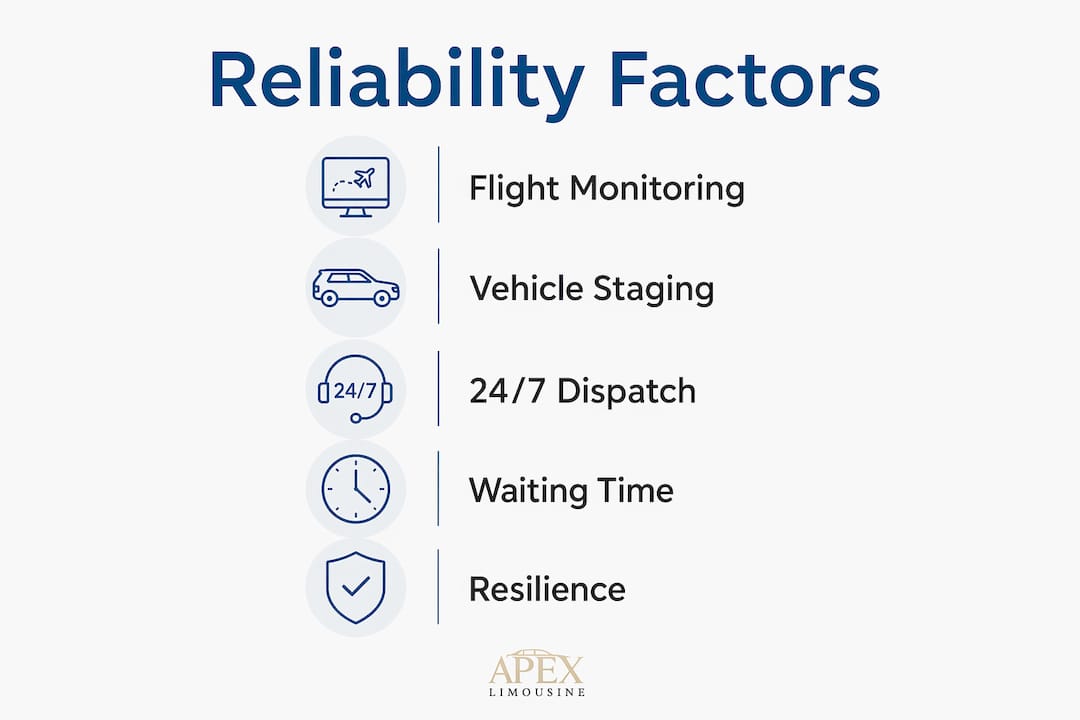
The core operational factors that separate reliable executive transfers from standard rides include:
- Real-time flight tracking. The chauffeur's dispatch team monitors departure and arrival data continuously, adjusting pickup times and staging locations automatically when flights change.
- Proactive vehicle staging. The vehicle is positioned at the correct terminal before the executive lands, not dispatched after the app receives a request.
- Professional meet-and-greet. Meet-and-greet services involve coordination with terminal concierge and porter logistics to remove the passenger's navigation burden entirely, not just holding a name board at arrivals.
- Fixed pricing and service guarantees. Executives travel on corporate budgets. Surge pricing and last-minute cancellations create both financial and logistical problems that fixed-rate agreements eliminate.
- Disruption management. When an itinerary changes, a reliable provider adapts without requiring the executive to make new arrangements mid-trip.
Executive airport transfer services typically provide 60 minutes of complimentary waiting time after arrival, with 24/7 availability and dedicated chauffeurs assigned to each booking. That waiting window is not a courtesy. It is a structural buffer that absorbs the unpredictability of commercial aviation.
Pro Tip: When evaluating a provider, ask specifically how their dispatch team handles a flight diversion to an alternate airport. The answer reveals whether their reliability is real or just a marketing claim.
How does transfer reliability affect executive productivity and reputation?
A missed meeting caused by a late pickup is not just an inconvenience. It signals organizational disarray to the client or partner waiting in the conference room. Ground transportation is a visible reflection of corporate professionalism, and it directly influences how guests and clients perceive the organization sending the executive.
The productivity impact runs deeper than punctuality. Chauffeurs act as butlers, concierges, and mobile assistants, reducing the logistical and navigational burdens that drain mental energy. An executive who handles their own navigation, luggage, and parking arrives at a meeting already depleted. An executive delivered by a professional chauffeur arrives focused.
The business case for dependable airport transportation also includes:
- Reduced cognitive load. Eliminating travel logistics from an executive's mental workload preserves decision-making capacity for high-stakes meetings.
- Reputation protection. Arriving on time and composed signals competence. Arriving late or flustered signals the opposite, regardless of the reason.
- Duty-of-care compliance. Organizations that fail to provide reliable transport for traveling employees expose themselves to legal and HR risk, particularly when travel involves international or overnight itineraries.
- Client impression management. When an executive arranges a transfer for a visiting client or partner, the quality of that service reflects directly on the host organization.
Centralized billing and detailed trip reporting transform ground transportation costs into measurable metrics. That transparency lets travel managers track on-time performance, spending, and duty-of-care compliance across an entire executive travel program.
How do executive transfers compare with rideshare or taxi alternatives?
The core difference between a managed executive transfer and an on-demand rideshare is predictability. Rideshare platforms dispatch drivers reactively, after a request is made. Executive transfer services position vehicles proactively, before the executive needs them.
During peak hours, adverse weather, or major events, rideshare availability drops and surge pricing activates. An executive heading to a 7:00 AM board meeting during a rainstorm faces real cancellation risk with on-demand apps. A managed transfer service has the vehicle staged and confirmed the night before.
Cheaper ad hoc services create hidden costs through lost executive time and recovery management overhead. When a rideshare cancels and an executive spends 20 minutes rebooking, that time has a dollar value. For a C-suite executive, that value is substantial.
The gaps between service categories are concrete:
| Feature | Executive transfer service | On-demand rideshare or taxi |
|---|---|---|
| Flight monitoring | Real-time, proactive | None |
| Meet-and-greet | Included, with porter coordination | Not available |
| Pricing | Fixed, pre-agreed | Variable, surge-dependent |
| Cancellation risk | Minimal, dedicated vehicle | High during peak periods |
| Waiting time buffer | Up to 60 minutes complimentary | Meter running or driver leaves |
| Disruption handling | Managed by dispatch team | Executive manages independently |
Pro Tip: Calculate the true cost of an alternative service by adding the executive's hourly rate to any delay or rebooking time. The price gap between rideshare and managed transfer often disappears entirely.
What criteria should executives use to select a reliable transfer provider?
Selecting a dependable executive transfer provider requires evaluating operational infrastructure, not just vehicle photos and star ratings. The right questions reveal whether a provider can perform under pressure.
- On-time performance metrics. Ask for documented punctuality rates. Providers with genuine reliability track this number and share it. A vague answer is a red flag.
- Flight monitoring capability. Confirm that the dispatch team monitors flights in real time and adjusts automatically. This is the single most important operational feature for airport transfers.
- 24/7 dispatch and disruption handling. Executives travel outside business hours. A provider without round-the-clock dispatch cannot handle early morning or late-night disruptions.
- Complimentary waiting time policy. Verify the waiting window after arrival. Sixty minutes is the industry standard for executive services. Shorter windows shift risk back to the traveler.
- Fixed pricing and transparent billing. Confirm that the quoted price is the final price. Ask whether centralized billing and trip reporting are available for corporate accounts.
- Chauffeur professionalism standards. Ask how chauffeurs are trained, vetted, and evaluated. Professional chauffeur service standards include background checks, client discretion protocols, and ongoing performance reviews.
Resilience under disruption is a more critical evaluation metric than initial service cost. A provider that handles itinerary changes without burdening the executive is worth more than a cheaper option that requires manual intervention every time a flight shifts.
Key Takeaways
Reliable executive airport transfers protect productivity, corporate reputation, and duty-of-care compliance by combining real-time flight monitoring, professional chauffeur conduct, and fixed-price service guarantees.
| Point | Details |
|---|---|
| Reliability is operational, not cosmetic | On-time performance above 99.3% requires dispatch infrastructure, not just a quality vehicle. |
| Duty-of-care drives corporate adoption | 62% of organizations now prioritize service reliability over cost for executive ground transport. |
| Hidden costs favor managed transfers | Rideshare delays and cancellations consume executive time worth far more than the price difference. |
| Meet-and-greet is a logistics function | Effective arrival service includes terminal coordination and porter management, not just a name board. |
| Resilience is the top selection criterion | Evaluate how a provider handles itinerary disruptions before committing to a corporate account. |
The reliability gap most executives don't see until it's too late
I've watched executives make the same mistake repeatedly. They book a rideshare for a 6:00 AM flight because it's faster to tap an app than to arrange a managed transfer. Then the driver cancels at 5:40 AM, and the executive is standing in a hotel lobby with two bags and a flight to catch.
The real cost of unreliable transport is never the fare. It's the meeting that starts without you, the client who notices you arrived flustered, and the mental energy you burned managing a logistics failure instead of preparing for the conversation that actually mattered. I've seen a single late arrival unravel weeks of relationship-building with a prospective partner.
What surprises most executives is that the operational gap between a managed transfer and a rideshare is invisible until it fails. Both options get you to the airport most of the time. The difference shows up in the 5% of trips where something goes wrong. A flight diverts. A terminal changes. A meeting moves up by an hour. A managed provider absorbs all of that. An on-demand app does not.
The executives I respect most treat ground transportation the same way they treat legal counsel or financial advice. They don't shop for the cheapest option. They select for reliability, discretion, and the ability to perform under pressure. That standard should apply to every airport transfer on the calendar.
— Jason
APEX LIMO executive transfers in Austin
APEX LIMO delivers executive airport transfer service in Austin built around the operational standards this article describes. Real-time flight monitoring, proactive vehicle staging, professional meet-and-greet, and fixed pricing are standard on every booking.

APEX LIMO's chauffeurs are trained to the same discretion and professionalism standards that corporate travel programs require. Whether you are traveling solo or arranging airport transfers for your team, APEX LIMO provides the operational infrastructure that makes reliability consistent, not occasional. Contact APEX LIMO to discuss a corporate account or book your next executive transfer in Austin.
FAQ
What makes an executive airport transfer reliable?
Reliability comes from real-time flight monitoring, proactive vehicle staging, and 24/7 dispatch support. Providers with documented on-time performance rates above 99.3% demonstrate genuine operational reliability.
How does transfer reliability affect executive productivity?
Unreliable transfers consume mental energy and create delays that compound through the day. A professional chauffeur removes logistical burdens so executives arrive focused and prepared for high-stakes engagements.
Why is rideshare a risk for executive airport travel?
Rideshare platforms dispatch reactively, offer no flight monitoring, and face high cancellation rates during peak periods or bad weather. These variables create unpredictable delays that managed executive transfers eliminate.
What is duty-of-care in executive ground transportation?
Duty-of-care is an organization's legal and ethical obligation to protect traveling employees from foreseeable harm. Reliable, managed ground transportation is a core component of meeting that standard for executive travelers.
How should executives evaluate a transfer provider's reliability?
Request documented on-time performance metrics, confirm real-time flight monitoring capability, and ask how the provider handles flight diversions or itinerary changes. Fixed pricing and a complimentary waiting time policy of at least 60 minutes are additional indicators of a mature service.