
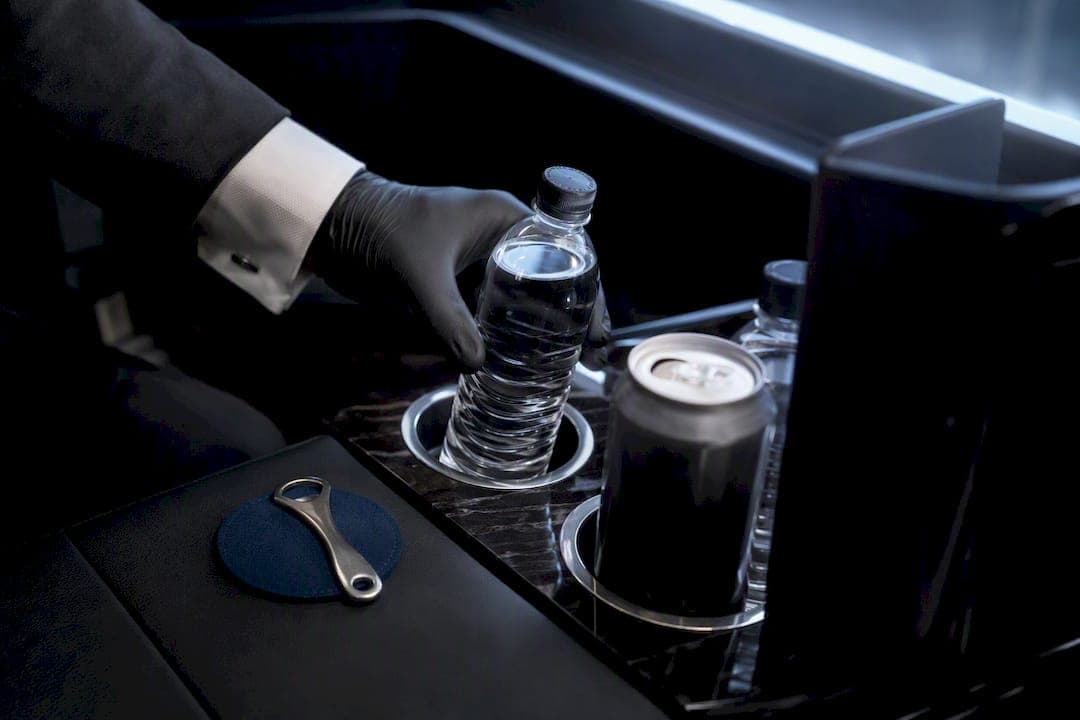
Yes, in most states you can drink in the back of a licensed limousine, but it depends entirely on the vehicle, the state, and the company. The exception generally requires a partition between driver and passengers, a for-hire license on the vehicle, and everyone drinking must be 21 or older. Skip any of those, and the "limo exception" disappears, leaving passengers exposed to the same open-container penalties as anyone drinking in a private car.
TL;DR:
- The legal exception for drinking in limousines mainly applies when the vehicle is properly licensed, has a functioning partition, and all passengers are over 21.
- State laws vary significantly, with some states explicitly allowing alcohol in hired vehicles, while others impose additional conditions or leave enforcement to local ordinances.
- Limousine companies often restrict or prohibit alcohol regardless of legal allowances, especially on prom trips or when minors are involved, and their policies should be confirmed in writing.
- Liability remains with sober chauffeurs operating under strict standards, but the risk of penalties or violations rises if a partition is broken or minors are found drinking.
- Verifying the specific alcohol and safety policies before booking and understanding the vehicle’s compliance with local laws are essential steps to avoid legal issues.
Table of Contents
- Why Limo Alcohol Policy Depends on a Legal Loophole
- Do Alcohol Laws for Limos Vary by State?
- What Alcohol Rules Do Limo Companies Set on Their Own?
- Who's Liable if Something Goes Wrong With Alcohol Onboard?
- What Should You Ask Before Booking a Limo With Alcohol Onboard?
- APEX LIMO's Perspective on Managing Alcohol Policy Safely
- Book a Compliant Limo Ride With Clear Alcohol Policies
- Where to Verify Limo Alcohol Laws and Safety Guidance
- Sources
- FAQ
Why Limo Alcohol Policy Depends on a Legal Loophole
Open-container laws exist to keep alcohol out of a driver's reach, but lawmakers recognized decades ago that a limousine passenger isn't the person steering the vehicle, so most states carved out a specific exception for hired, chauffeur-driven vehicles. NHTSA's guidance on open-container laws explains that these statutes target driver access to alcohol, not passenger consumption in a separated compartment. That distinction is the entire basis for legal drinking in a limo.
For the exception to hold, several conditions typically have to line up at once:
- The vehicle must be a licensed for-hire vehicle, not a private car with a hired driver.
- A physical partition must separate the driver's compartment from the passenger area.
- The driver cannot have direct access to open containers.
- Every passenger drinking must be 21 or older, with zero tolerance in most states if minors are on board.
Illinois offers one of the clearest statutory examples. Its open-container law explicitly permits alcohol consumption in the passenger compartment of a chauffeur-driven vehicle when a partition and other conditions are met. Officers still hold discretion here. A partition that's obviously nonfunctional, or a driver who can reach back for a bottle, gives an officer grounds to treat the ride like any other open-container violation. The exception isn't automatic just because you booked a limo. It's automatic only when the vehicle actually meets the legal definition.
Do Alcohol Laws for Limos Vary by State?
State law is where most confusion starts, and it's the single biggest reason to check before you book, especially for a trip that crosses state lines. Some states write the hired-vehicle exception directly into statute. Others leave it to local ordinance, and a few have no clear statewide carve-out at all, which pushes the decision down to city or county rules.
Washington state's alcohol code, RCW 66.44.250, takes a more conditional approach than Illinois, tying possession and removal of alcohol to specific circumstances rather than a blanket allowance. That's a useful contrast: two states, two different legislative approaches to the same basic idea. Laws also shift over time. Washington lawmakers have introduced bills in recent sessions that would adjust related alcohol-transport rules, a reminder that the code you read today may not be the code in force next year.
| State approach | What it typically means | Example |
|---|---|---|
| Full statutory exception | Alcohol allowed in partitioned, licensed for-hire vehicles by default | Illinois |
| Conditional or permit-based | Exception applies but with added conditions on possession or removal | Washington |
| Common practice, less codified | Widely allowed in the industry; verify local ordinance | California, New York, Texas, Florida |
| No clear exception | Treated like any open-container violation absent a specific carve-out | Varies by locality |
A few practical points follow from this patchwork:
- Always check the law of the pickup state, not your home state, since that's typically what governs enforcement.
- If your route crosses a state line, the exception in your departure state may not apply once you're in a different jurisdiction.
- Local city ordinances can be stricter than state law even where a statewide exception exists.
Austin-area trips fall under Texas's general allowance for hired vehicles, but that doesn't override any additional restrictions a venue, hotel loading zone, or event organizer might impose during stops.
What Alcohol Rules Do Limo Companies Set on Their Own?
State law sets the floor. Company policy sets the ceiling, and it's almost always tighter than what the law technically permits. A licensed for-hire vehicle with a partition doesn't guarantee alcohol is on the table. It just means the legal path is open if the operator chooses to allow it.
There's also a real distinction between bringing your own alcohol and buying it from the limo company. Industry guidance from the National Limousine Association treats these very differently. BYOB usually carries no licensing burden for the operator. Selling or serving alcohol onboard often requires a liquor license or caterer's permit, depending on the state, which is why many companies simply don't offer it directly and instead allow guests to bring their own.
Expect to run into some combination of these operator rules:
- A refundable damage or cleaning deposit tied specifically to alcohol service.
- A flat ban on alcohol for certain bookings, prom rentals being the most common example.
- ID checks at pickup for every passenger who plans to drink.
- Restrictions on glass containers, certain liquors, or excessive quantities.
- A requirement for extra liability insurance on longer or larger group bookings.
Pro Tip: Ask for the alcohol policy in writing before you pay a deposit, not after. A verbal "sure, that's fine" from a booking agent isn't the same as a clause in your rental agreement, and it's the written clause that protects you if something gets disputed later.
Who's Liable if Something Goes Wrong With Alcohol Onboard?
The driver's obligation doesn't bend just because passengers are legally drinking. Chauffeurs operate under a strict zero-BAC standard, and that rule doesn't loosen because the people in back are enjoying the exception. A sober, attentive driver is what makes the entire legal structure work in the first place.
Liability exposure runs in both directions. Operators carry commercial insurance that typically covers passenger injury, but coverage can get complicated fast if alcohol contributed to an incident, particularly if the company oversold the vehicle's compliance or ignored obvious red flags like visibly intoxicated minors. The Insurance Information Institute's data on alcohol-impaired driving underscores why insurers scrutinize these claims closely.
In practice, a few outcomes are common when things go sideways:
- A driver can lawfully eject a passenger who becomes disruptive or violent.
- A company can terminate the trip early if the vehicle no longer meets partition or capacity requirements.
- Citations can follow if the "limo exception" doesn't actually apply, such as a broken partition or an underage passenger holding a drink.
What Should You Ask Before Booking a Limo With Alcohol Onboard?
Run through this before you sign anything or pay a deposit.
- Confirm the pickup state and city both recognize a hired-vehicle open-container exception.
- Ask directly whether the vehicle has a functioning partition between driver and passengers.
- Find out if the company sells alcohol onboard or only permits BYOB.
- Ask about deposits, cleaning fees, and any ID-check procedure at pickup.
- Request proof of commercial insurance and any required alcohol-related permits.
- Get the alcohol policy written into the contract, not just described over the phone.
A five-minute conversation covering these six points will tell you more about a company's professionalism than any glossy photo of the vehicle interior.
APEX LIMO's Perspective on Managing Alcohol Policy Safely
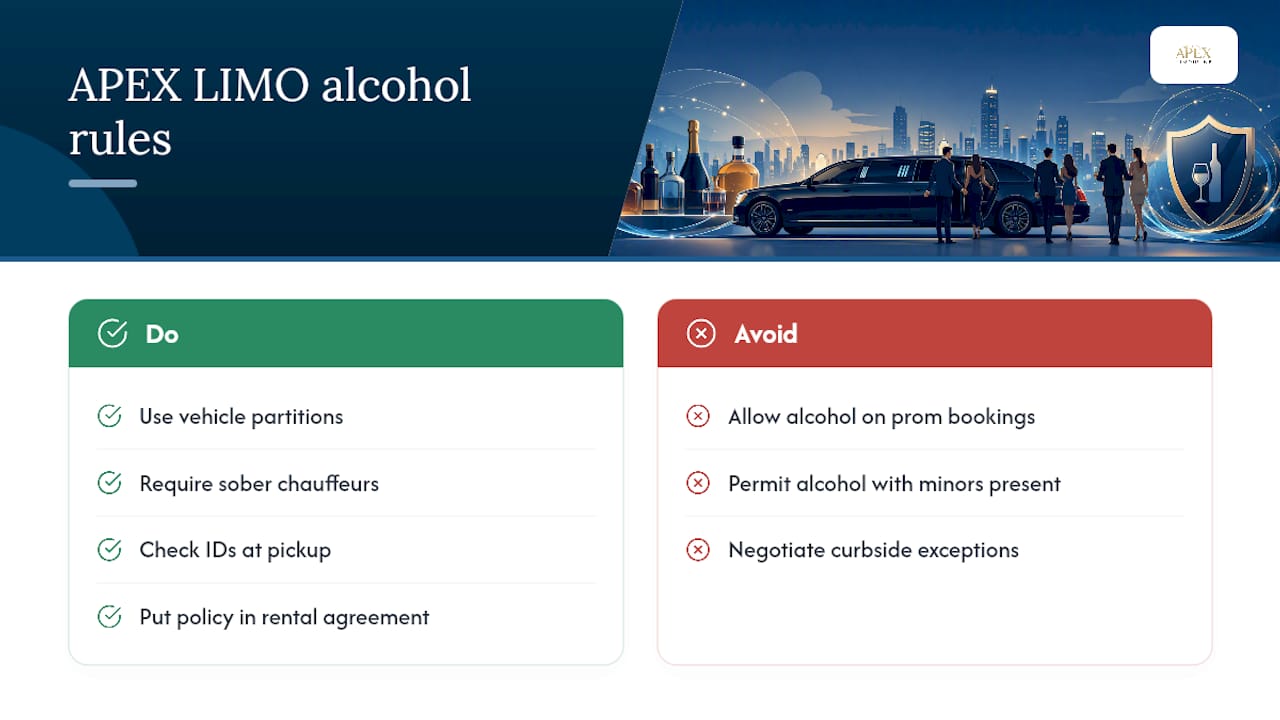
Operating in Austin, where bachelorette parties, weddings, and corporate outings routinely include alcohol, some limo companies treat compliance as non-negotiable rather than optional paperwork. Some companies offering alcohol service operate vehicles with partitions and expect chauffeurs to maintain a strict sober-driving standard regardless of what's happening in the passenger compartment.
ID checks may happen at pickup and alcohol policy details are often included in rental agreements rather than only verbal promises. Some companies do not permit alcohol on prom bookings or any trip where minors are present, with no exceptions negotiated at the curb.
— Jason
Book a Compliant Limo Ride With Clear Alcohol Policies
You've seen how much depends on the vehicle, the state, and the fine print of a rental agreement. Some Austin limo services remove that guesswork by running partitioned vehicles, sober chauffeurs, and written alcohol policies on bookings that involve alcohol.

That combination matters most for weddings, corporate outings, and nights out where guests plan to drink responsibly and legally. If your event doesn't fit the standard mold, from bachelorette parties to prom night, the team can walk through what's allowed before you commit to a deposit. Ready to lock in a date? Visit the Austin Limo Service page to check availability and get a straight answer on alcohol policy for your specific trip.
Where to Verify Limo Alcohol Laws and Safety Guidance
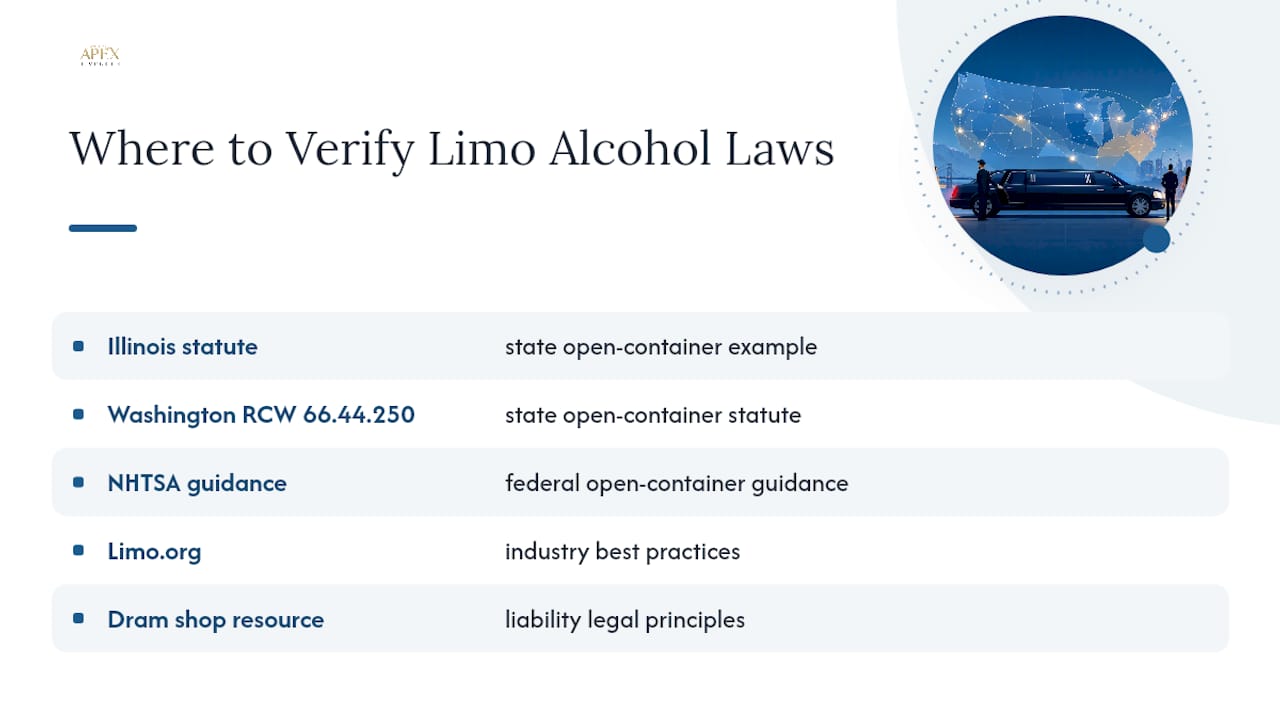
Check the Illinois open-container statute and Washington's RCW 66.44.250 for statutory examples, NHTSA's open-container guidance for federal context, and Limo.org for industry best practices. For questions on liability when alcohol service goes wrong, a dram shop liability resource covers the legal principles operators and passengers should understand.
This article is general information, not a substitute for advice from a qualified lawyer. Consult a qualified legal professional about your own circumstances before acting on anything here.
Sources
- Illinois Compiled Statutes — 625 ILCS 5/11-502
- NHTSA — Open container laws
- Limo
- Washington State Legislature — RCW 66.44.250
FAQ
Why Can You Drink in the Back of a Limo?
Most states exempt hired, chauffeur-driven vehicles from open-container laws because the driver has no access to alcohol in a partitioned compartment, and the statutory language in Illinois is a clear example of that carve-out.
Are Limos Allowed to Have Alcohol in Every State?
No. Some states codify a full exception, others attach conditions like Washington's approach under RCW 66.44.250, and a few leave it to local ordinance with no statewide guarantee.
Can You Bring Your Own Alcohol Into a Limo?
Usually yes, and BYOB is generally simpler for operators than selling alcohol onboard, since serving drinks directly often requires a liquor license or caterer's permit depending on the state.
Does the Driver Get in Trouble if Passengers Are Drinking?
Not if the vehicle is compliant and the driver stays sober and has no access to the alcohol. The chauffeur's zero-BAC obligation is separate from what legally drinking passengers do in the partitioned compartment.
Will a Limo Company Ever Refuse to Allow Alcohol?
Yes. Many operators, including APEX LIMO, decline alcohol service for bookings involving minors, such as prom trips, even in states where the legal exception would otherwise apply.