
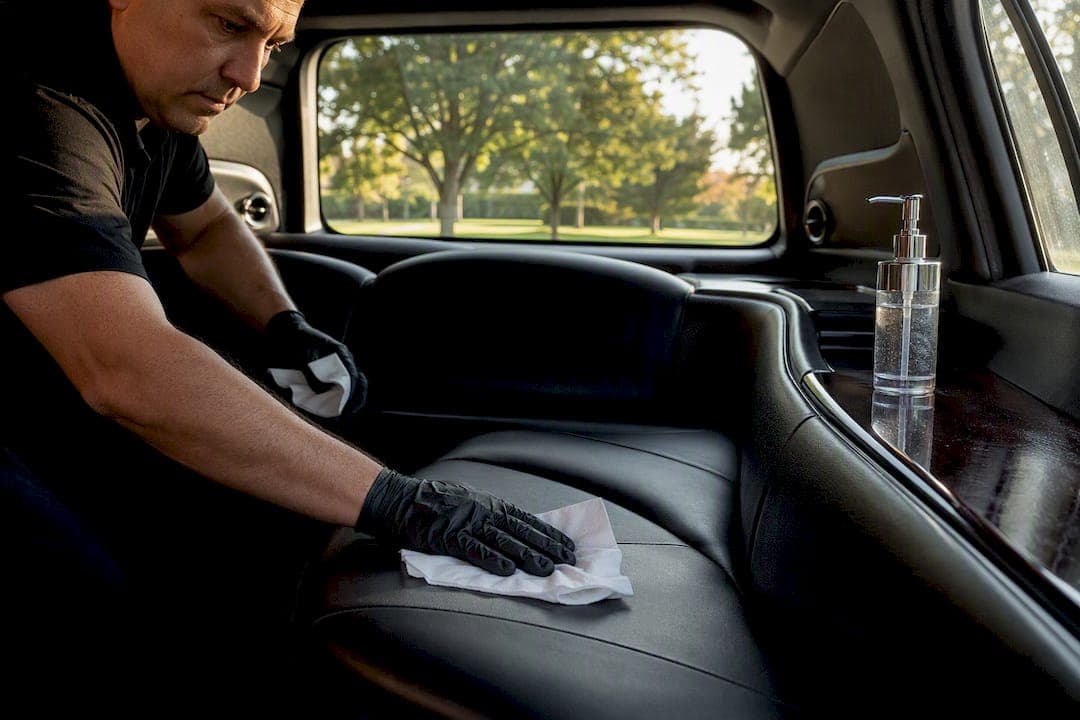
A complete limo sanitation policy has to cover six non-negotiables: written SOPs for every cleaning stage, a fixed cleaning schedule from pre-trip through monthly detailing, a clear biohazard response and fee protocol, driver screening and PPE rules, dated recordkeeping, and alignment with third-party training like SafeCleanRide or NLA-recommended protocols. If it's missing any of those, it's not a policy. It's a hope.
TL;DR:
- Only a documented, comprehensive sanitation policy with SOPs, detailed recordkeeping, and third-party training counts as a credible program; vague or informal routines are insufficient.
- Daily logs, disinfectant dwell time adherence, and biohazard incident documentation are essential for compliance proof during audits or disputes.
- Regular in-house audits, staff refresher training, and updating procedures based on new regulations or products are critical to maintaining effective hygiene standards.
- Proprietary equipment, EPA-registered disinfectants, and proper ventilation steps must be used and documented to ensure actual disinfection and prevent chemical odors.
- Clear client communication, signage, and strict interpretation of biohazard versus mess define safety boundaries and protect operators from legal or financial liabilities.
Table of Contents
- What Is a Limo Sanitation Policy, and Why Does It Need to Be Written Down?
- At-a-Glance Sanitation Checklist for Limo Operators
- Standard Operating Procedures: Step-by-Step Cleaning Workflows
- Regulatory Compliance and Recordkeeping Essentials
- Training, Certification, and Staffing Procedures
- Client-Facing Policies: Bookings, Communication, Signage, and Fees
- Approved Equipment, Cleaners, and Ventilation Best Practices
- Monitoring, Audits, and Continuous Improvement
- APEX LIMO: Operational Example and Author Insights
- Why This Policy Has to Be a Living Document, Not a Binder on a Shelf
- How APEX LIMO Puts These Standards Into Practice
- Sources
What Is a Limo Sanitation Policy, and Why Does It Need to Be Written Down?
A limo sanitation policy is the documented set of rules governing how, when, and by whom every vehicle in a fleet gets cleaned, disinfected, and inspected between passengers. It's different from a general cleaning checklist because it's built to survive an audit. Regulators, corporate clients, and insurance adjusters don't want to hear that your drivers "always wipe things down." They want dated logs, named responsible parties, and a chain of evidence showing the policy was followed.
The National Limousine Association worked with medical experts to formalize what had been a patchwork of driver habits into recommended hygienic protocols: hospital-grade disinfectant between trips, PPE and driver screening, hand sanitizer availability, and visible signage confirming daily deep cleaning. That's the industry baseline now, not an aspirational extra. Operators who skip the paperwork and just "do the cleaning" have no way to prove compliance when a client disputes a bill or a state inspector shows up unannounced.
At-a-Glance Sanitation Checklist for Limo Operators
Before you write a single SOP, you need a quick-reference version dispatchers and drivers can actually use between pickups. Here's what belongs on it.
Pre-trip inspection (before the vehicle leaves the lot):
- Check for visible trash, stains, or contamination on seats and floor mats
- Confirm sanitizing wipes, hand sanitizer, and gloves are stocked in the vehicle
- Wipe down the interior door handles and steering wheel if the vehicle sat overnight
Between-trip turnover (every passenger change):
- Disinfect exterior and interior door handles first
- Wipe down seat belts, buckles, and armrests
- Clean climate and entertainment controls, cupholders, and window/door frames
- Disinfect seat surfaces, prioritizing leather or vinyl over fabric
- Let disinfectant sit for its full dwell time before closing doors
- Crack windows for two to three minutes to ventilate before the next passenger boards
End-of-day and periodic deep cleaning:
- Full interior vacuum and trash removal after the last run
- Wipe all hard surfaces with hospital-grade disinfectant, not just high-touch points
- Weekly: upholstery spot-treatment and carpet shampoo on higher-mileage vehicles
- Monthly: professional detailing including steam cleaning and fabric protectant
Biohazard immediate response: Pull the vehicle from service immediately, glove up, isolate the area, and follow your written remediation SOP rather than attempting a quick wipe-and-go. Vomit, blood, or uncontrolled bodily fluids require documented handling, not improvisation.
Standard Operating Procedures: Step-by-Step Cleaning Workflows
A checklist tells your team what to do. An SOP tells them exactly how, in what order, and for how long. That distinction is what separates a policy that survives a client dispute from one that collapses the moment someone asks, "Can you prove that?"
Pre-trip SOP
Every driver logs a pre-trip inspection before pulling out of the lot, and this takes under three minutes when it's routine. The sequence matters: check top-to-bottom, and clean-to-dirty. Start with headliners and window frames, move to door panels and controls, then finish with floor mats and carpet. Cleaning dirty surfaces before clean ones just spreads contamination back upward.
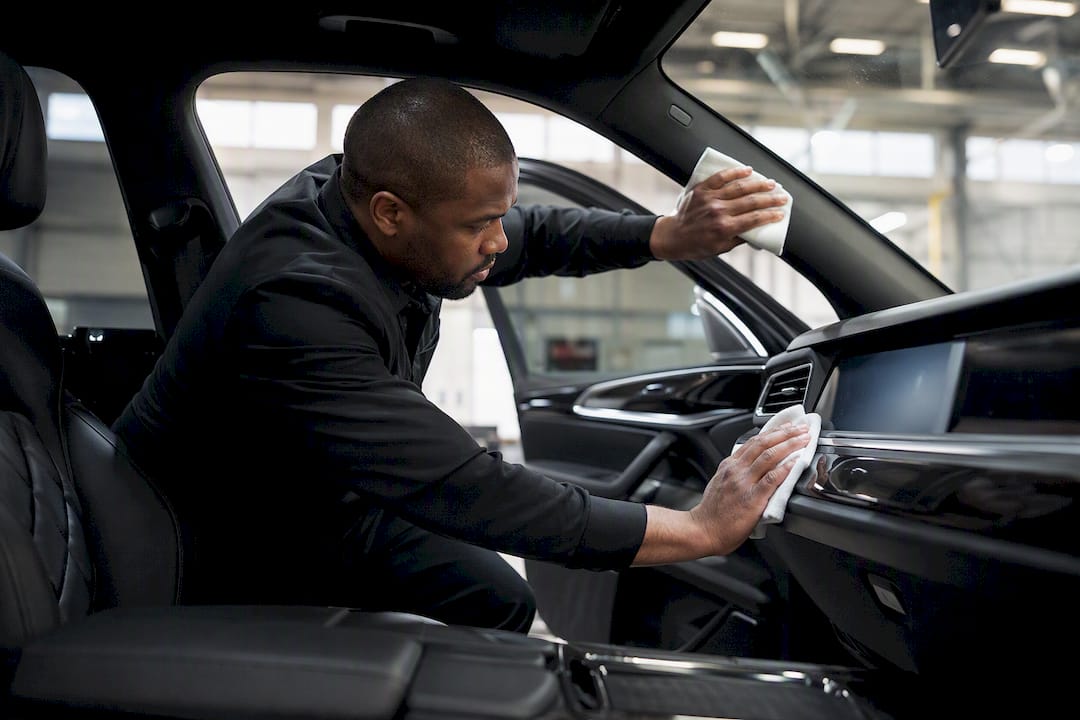
Log four things at minimum: date, time, driver name, and a pass/fail note on visible cleanliness. If something fails inspection, the vehicle doesn't leave until it's addressed. This single rule prevents the most common compliance failure auditors flag: a vehicle in service with a documented but unresolved issue.
Between-trip turnover SOP
This is where most operators either build trust or lose it. The NLA's GVN-approved protocols, as summarized by Black Car News, recommend roughly 30-minute post-trip disinfection cycles using hospital-grade products, with windows opened where practical to support airflow. Between-trip turnover should follow this order every time:
- Disinfect door handles, both interior and exterior
- Treat seat belts, buckles, and armrests, since these get the most hand contact after door handles
- Wipe down climate controls, entertainment panels, and cupholders
- Disinfect seating surfaces, working from the back of the vehicle forward
- Respect the dwell time printed on the product label, don't wipe it dry early
- Ventilate for two to three minutes before the next passenger boards
Dwell time is the step operators cut corners on most, and it's the one that actually determines whether the disinfectant worked. An EPA-registered product with a four-minute dwell time that gets wiped off after ninety seconds hasn't disinfected anything. It's just made the seat smell like chemicals for no benefit. Build the dwell time directly into your driver's turnaround script so it's not optional.
Pro Tip: Print the exact dwell time from your disinfectant's label onto a laminated card clipped to the visor. Drivers under time pressure will guess low unless the number is right in front of them.
End-of-day and weekly/monthly deep clean
At the close of each service day, every vehicle gets a full interior wipe-down covering surfaces the between-trip protocol doesn't reach: headliners, vents, seat backs, and floor wells. This is also when trash and debris get pulled completely, not just tidied.
Weekly, add upholstery spot-treatment and a carpet shampoo pass for higher-mileage vehicles. Monthly, bring in professional detailing for steam cleaning and fabric protectant application. Steam plus enzymatic upholstery treatment handles odor sources that wipes simply can't reach, particularly in fabric seats and carpet fibers where organic residue accumulates below the surface. Most fleet operators don't have steam equipment in-house, and that's fine. The policy should specify a named detailing partner or vendor, the contracted frequency, and where the invoice gets filed for audit purposes.
Biohazard remediation workflow
This is the part of your policy that protects you financially and legally, so it needs the most precision. Define, in writing, what counts as a biohazard: vomit, blood, urine, feces, or any uncontrolled bodily fluid. Anything short of that (spilled coffee, crumbs, minor stains) falls under standard cleaning, not the biohazard track.
When a biohazard incident occurs, the workflow should look like this:
- Remove the vehicle from active rotation immediately
- Driver dons gloves and, if available, a mask before approaching the affected area
- Isolate the area with a barrier or towel to prevent spread during transit back to base
- Document the incident with timestamped photos before any cleanup begins
- Determine in-house vs. professional remediation: minor, contained incidents on non-porous surfaces can often be handled in-house with EPA-registered disinfectant and full PPE; anything involving upholstery saturation, blood, or a client dispute over severity should go to a professional remediation service
- File the photos, incident report, and remediation invoice together in the vehicle's maintenance record
That documentation chain is what supports a cleanup fee if you charge one, and it's what protects you if a client challenges the charge later. Photos plus an invoice from a licensed remediation vendor are far harder to dispute than a driver's verbal account.
Regulatory Compliance and Recordkeeping Essentials
State-level limousine rules vary, but they consistently touch two things your sanitation policy needs to reference directly: vehicle condition standards and recordkeeping obligations. Minnesota's limousine rules, for example, require that windows, mirrors, lights, and interiors be kept clean and in good repair as a condition of the vehicle's permit, and the state's administrative rules tie this directly to inspection and audit processes. If your fleet operates across state lines or you're building a policy from scratch, pull your own state's equivalent language and quote it directly in your internal SOP document. It removes ambiguity about what "clean" legally means in your jurisdiction.
Beyond the vehicle condition standard itself, auditors and permit renewal boards typically want to see a specific set of retained records:
- Daily vehicle inspection logs, signed by the driver, noting pass/fail status
- Driver screening and background check documentation, updated per your hiring cycle
- Cleaning and disinfection logs, covering pre-trip, turnover, and end-of-day cycles
- Detailing invoices, from monthly or weekly professional service providers
- Training and certification records, for every driver and detailer on staff
A reasonable retention schedule is at least several months for daily logs and the full permit period for training certificates and detailing contracts, since renewal boards often ask for a full-cycle history rather than a snapshot. Store these digitally with timestamps, not in a shoebox of paper receipts. When a permit renewal or surprise audit hits, the operators who produce a clean digital folder in five minutes look categorically more credible than the ones scrambling through filing cabinets, regardless of whether their actual cleaning practices were equivalent.
Training, Certification, and Staffing Procedures
Your policy is only as good as the people executing it, and that means onboarding has to teach cleaning chemistry, not just "wipe here." New drivers and detailers should be walked through:
- Proper PPE use: when gloves are required, when a mask is added for biohazard response
- The chemistry basics of your approved disinfectants, including why dwell time isn't optional
- The exact turnover sequence, practiced hands-on before solo shifts
- How to log a cleaning cycle correctly, including what counts as a completed vs. incomplete entry
Third-party certification adds a layer of credibility your internal training can't replicate alone. SafeCleanRide built a training and testing certification program specifically for transportation hygiene, developed with input from medical experts and aligned with CDC guidance. Getting drivers or lead detailers certified through a program like this gives you an external, defensible standard to point to, not just "we trained them ourselves."
Refresh training at least periodically, and log every refresher the same way you log initial certification: date, name, and outcome. A one-time training session from three years ago doesn't hold up well if a client or regulator asks when staff last reviewed protocol.
Client-Facing Policies: Bookings, Communication, Signage, and Fees
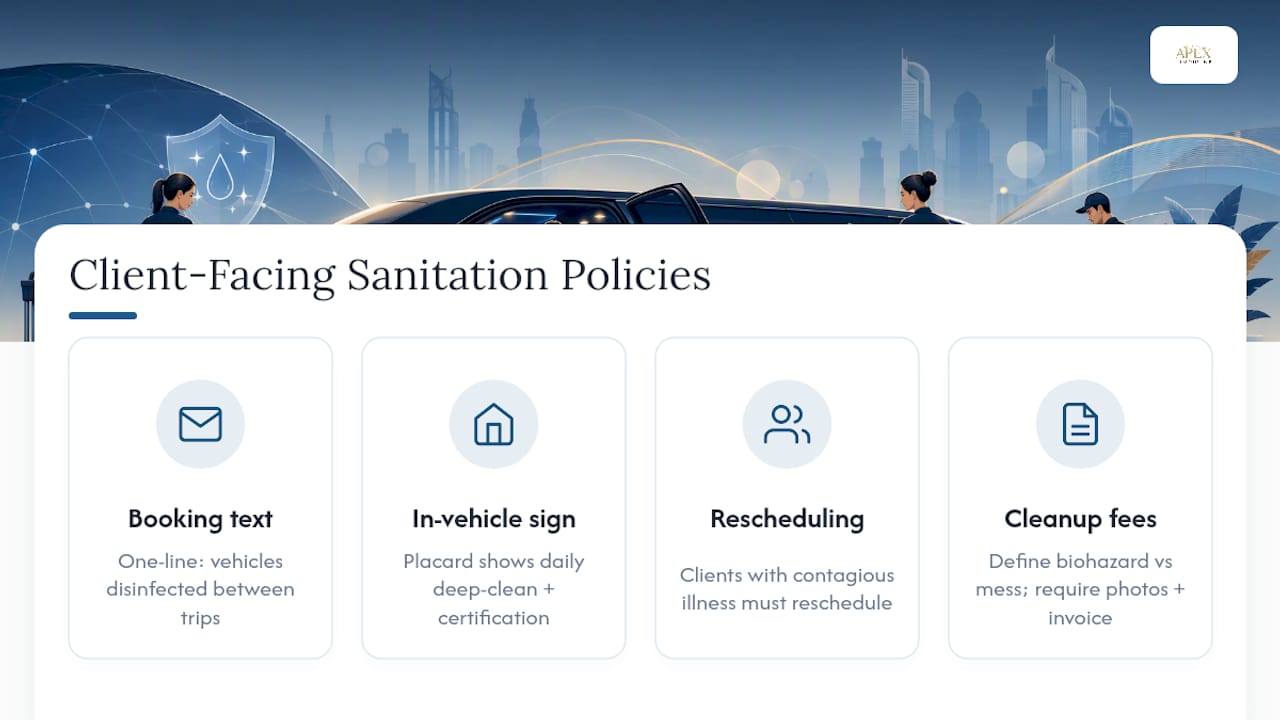
Clients rarely ask about your sanitation policy until something goes wrong, which is exactly why the language needs to be set before that happens. Booking confirmations should include a short line stating that vehicles are disinfected between every trip following documented protocols, and that clients experiencing contagious illness should reschedule rather than ride. This protects both the client and your other passengers, and it gives you cover if you need to decline a booking on health grounds.
In-vehicle signage matters more than most operators realize. A small placard noting the vehicle's daily deep-clean status, plus any certification seal like SafeCleanRide, does real work reassuring corporate and VIP clients who are comparing you against other luxury ground transportation options in a market where hygiene expectations have permanently shifted upward.
Your terms and conditions need airtight definitions, not vague language. Spell out exactly what counts as a "biohazard" (bodily fluids, uncontrolled waste) versus "excessive mess" (spilled food, minor stains), and state plainly that biohazard cleanup fees require photographic documentation and a professional remediation invoice before they're charged.
Pro Tip: Send your health-and-rescheduling language as a separate line item in the booking confirmation, not buried in a long terms paragraph. Clients skim confirmations, and this is the one line you actually want them to read.
Approved Equipment, Cleaners, and Ventilation Best Practices
Not every disinfectant on a shelf is appropriate for a vehicle interior, and picking the wrong one creates its own problems. Check that any product you stock carries an EPA registration number, and read the label for its exact dwell time. That number, not the marketing copy on the bottle, tells you how long the surface needs to stay wet for the product to actually work.
- Confirm EPA registration and dwell time on every disinfectant before adding it to the approved list
- Use steam cleaning for upholstery and carpet at least monthly, or outsource this step to a professional detailer if you lack in-house equipment
- Ventilate for two to three minutes after disinfecting and before boarding, this single habit prevents most chemical-odor complaints
- Consider HEPA filtration in vehicles running high passenger volume, particularly for airport transfer or event routes
The chemical-odor complaint is more common than operators expect, and it's almost always a ventilation failure rather than a product failure. A strong-smelling interior reads as unclean to passengers even when it's freshly disinfected, so build the ventilation step into the turnover SOP as a required stage, not an afterthought.
Monitoring, Audits, and Continuous Improvement
A policy that never gets checked against reality drifts fast. Run internal audits monthly at minimum, spot-checking a sample of vehicles against your written SOP and comparing actual practice to the logged records.
- Track cleaning log completion rates as your baseline compliance metric
- Monitor biohazard incident response times from report to resolution
- Log client sanitation complaints separately from general service complaints, so you can see patterns
- Review audit findings quarterly and update SOPs or retraining plans based on what actually broke down
If completion rates dip on a specific shift or route, that's a training gap, not a discipline problem, and the fix is usually a refresher session, not a write-up.
APEX LIMO: Operational Example and Author Insights
APEX LIMO builds sanitation into every booking across our Austin fleet, not as an add-on service but as a baseline standard our chauffeurs are trained to and audited against. Every vehicle, from sedans to full-size party buses, follows the same documented turnover and deep-clean cadence outlined above, and our driver screening process is built to catch issues before a chauffeur ever sits behind the wheel.
Jason, who oversees editorial coverage of operational standards for this publication, offers a few practitioner notes worth flagging: define "biohazard" narrowly and in writing before you ever need the definition in a dispute, because vague language is what turns a $300 cleanup fee into a chargeback fight. Balance dwell time against your schedule by building buffer minutes into turnaround estimates rather than skipping the wait. And treat chemical odor complaints as a ventilation fix first, product-swap second, since most operators change disinfectants when the real issue is a closed window.
Fleet size, years in service, and specific chauffeur certification counts to be added by the publisher.
Why This Policy Has to Be a Living Document, Not a Binder on a Shelf
I've watched operators treat their sanitation policy like a compliance checkbox: written once, filed away, referenced only when a state inspector calls. That approach fails the moment reality diverges from the paper, and reality always diverges eventually. A new disinfectant hits the market with a different dwell time, a client complaint surfaces a gap in your turnover SOP, or a state updates its permit language. If nobody's assigned to catch that drift, the policy quietly becomes fiction.
The operators who get this right treat the audit cadence as the real engine of the policy, not the initial document. Leadership buy-in matters here more than any single procedure, because a sanitation policy that ops managers actually enforce, revisit, and update based on what audits turn up is worth more than a beautifully written document nobody checks against.
— Jason
How APEX LIMO Puts These Standards Into Practice
Reading through this policy framework is one thing. Building it, training a fleet on it, and proving compliance under pressure is another. APEX LIMO runs this exact structure across every vehicle in our Austin fleet, and our chauffeurs are trained on the same turnover sequence, dwell times, and biohazard documentation process outlined above, whether they're handling a wedding party, a corporate transfer, or a late-night prom run where the risk of an incident runs higher.

If you're a corporate planner or event coordinator comparing transportation providers on more than just vehicle appearance, our executive chauffeur service page details exactly how sanitation, training, and vehicle condition standards get applied to every booking. Reach out to our operations team directly if you want to see how a documented, auditable sanitation policy holds up in practice before your next event.
Sources
Operators building or updating a sanitation policy should keep these resources bookmarked for ongoing regulatory and certification updates: