

Prom limo companies must hold verifiable credentials to protect passengers and keep the ride legal. That means a state-issued operating authority or carrier registration, commercial passenger-liability insurance, and drivers who have cleared background checks and hold the correct license class for the vehicle. Without those three things, you have no legal recourse if something goes wrong and no guarantee the vehicle has ever passed a safety inspection.
Here is what to confirm before you pay a deposit:
- Operating authority or registration number (active status, not expired)
- Certificate of Insurance (COI) naming the company and listing passenger-liability coverage
- Driver license class and background-check confirmation (CDL required for vehicles over a certain passenger capacity in most states)
TL;DR: Ask for the COI and operating number before you book. If a company hesitates, walk away.
Table of Contents
- Why prom limo credentials protect your child — and you
- The exact documents to request before you book
- How to verify credentials yourself, step by step
- Questions to ask before you book — a script you can use right now
- Red flags that signal an unlicensed or unsafe operator
- What prom limo bookings actually cost — and when to book
- What reputable limo companies actually do differently
- Key Takeaways
- The part of this conversation most parents skip
- APEX LIMO makes the credential check easy for Austin prom bookings
- Authoritative resources to verify credentials yourself
Why prom limo credentials protect your child — and you
Credentials are not paperwork for paperwork's sake. They create an accountability framework: a licensed operator can lose its authority to operate if it cuts corners, which gives it a concrete financial reason to maintain safety standards. An unlicensed operator has no such incentive and leaves you with no formal recourse after an incident.

Legitimate credentials protect parents from fly-by-night operators, and reputable companies provide written confirmation of those credentials as a standard part of the booking process. That last part matters: a professional operator does not make you chase documents. They send them.
The five credential categories that actually matter:
- Company-level operating authority: Confirms the business is registered to carry passengers for hire in your state. This is separate from a general business license.
- Passenger-liability insurance: Covers medical costs and damages if a passenger is injured. Standard auto insurance does not cover commercial passenger transport.
- Driver qualifications: A commercial driver's license (CDL) is required in most states when a vehicle carries more than a certain number of passengers. Background checks go beyond a clean driving record.
- Vehicle inspection records: A commercial vehicle inspection is not the same as a standard oil change. Look for a dated inspection report from a certified inspector.
- Written passenger policies: Alcohol policies, emergency procedures, and behavior rules. These protect the operator legally and set expectations for the group.
Proper licensing and certification create an accountability framework that incentivizes companies to maintain safety standards. Operators that invest in documentation and recurring audits have a strong incentive to stay compliant because losing operating authority quickly ends their business.
Pro Tip: Ask the company point-blank: "Can you email me your COI and operating authority number today?" A professional operator will send both within the hour. Delay or deflection is your answer.
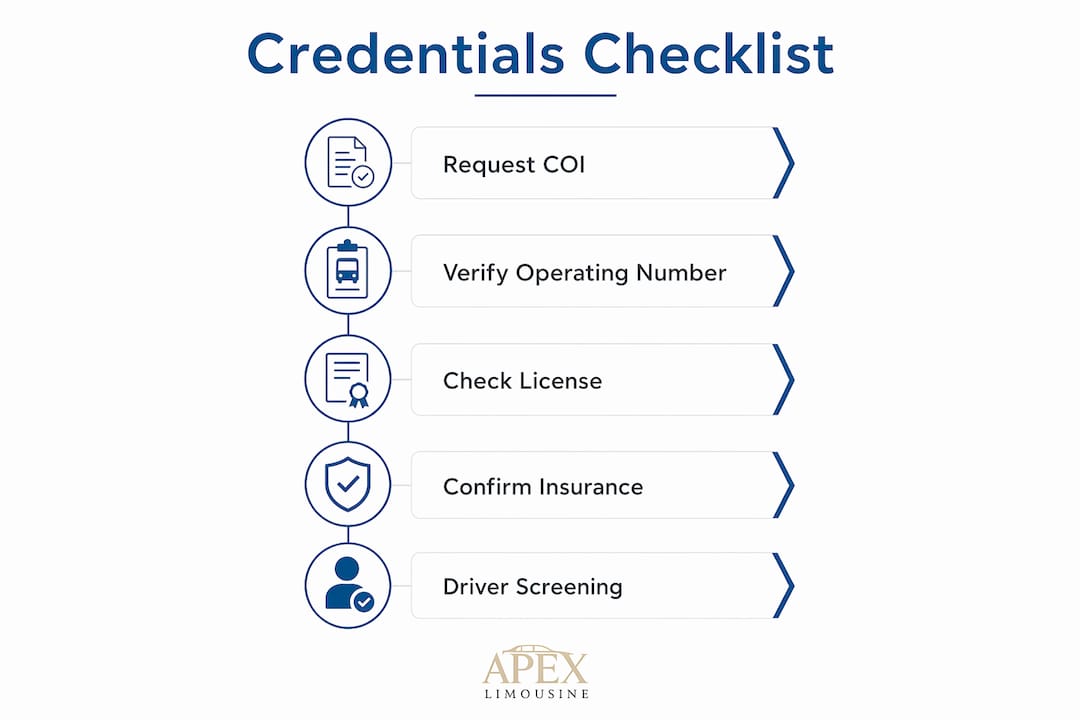
The exact documents to request before you book
Vague assurances are not credentials. Here is the specific paperwork to request, and what each document should actually show:
- Certificate of Insurance (COI): Should name the company (not a broker), list passenger-liability limits, show an active policy period, and name the insurer. Minimum liability limits vary by state, but higher is better for a full vehicle of teenagers.
- Operating authority or carrier registration number: The state-issued number that confirms the company is licensed to carry passengers for hire. Ask for the number so you can look it up yourself.
- Commercial vehicle registration for the assigned vehicle: Confirms the specific vehicle is registered as a commercial carrier, not a personal vehicle being rented informally.
- Recent commercial inspection report: Should show a dated inspection within the past year, the inspector's certification, and a pass result. Ask for the specific vehicle's report, not a generic company certificate.
- Driver license class and chauffeur certification: Confirm the assigned driver holds the correct license class for the vehicle's passenger capacity. In New Jersey, for example, limousine driver requirements include specific licensing and registration with the state.
- Written booking confirmation: Must name the specific vehicle (make, model, year, plate or VIN) and the assigned chauffeur, not just a vehicle "type."
Red flags on documents to watch for:
- Expired policy dates or inspection dates
- Business name on the COI does not match the company you booked
- "Broker" language anywhere in the confirmation without a named operator
- No vehicle VIN or plate number on the confirmation
- Generic insurance certificate with no passenger-liability line item
Pro Tip: Copy and paste this into an email: "Before I pay the deposit, please send me your COI, operating authority number, the commercial registration for the assigned vehicle, and the most recent inspection report for that vehicle. I also need written confirmation naming the vehicle and driver." Any professional company will respond without complaint.
How to verify credentials yourself, step by step
Getting documents is step one. Verifying them is step two. Here is the workflow:
-
Get the company's full legal name and operating/authority number. Ask verbatim: "What is your company's full legal name as registered with the state, and what is your operating authority or DOT number?" Write it down exactly.
-
Run a public carrier lookup. For interstate operations, search the FMCSA database using the DOT number. For intrastate (within-state) operations, search your state's passenger-carrier registry. Look for "Active" status. "Suspended" or "Revoked" means the company cannot legally operate.
-
Verify the COI against the legal name. The company name on the COI must match the legal name you just confirmed. Check the policy expiration date and confirm the insurer is a real, licensed carrier (you can verify insurers through your state's Department of Insurance website).
-
Confirm the assigned vehicle. Ask for the plate number or VIN. Cross-reference it with the commercial vehicle registration they provide. Ask when the vehicle last passed a commercial inspection and request that report.
-
Verify driver credentials. Ask what license class the assigned driver holds and when the company last ran a background check on that driver. Driver screening often requires more than a clean driving record. Fingerprint-based criminal checks and ongoing monitoring are commonly required in many jurisdictions.
Before you pay a deposit, confirm:
- Operating authority status is "Active" in a public lookup
- COI company name matches the registered legal name
- Vehicle VIN or plate is named in the booking confirmation
- Driver license class is appropriate for the vehicle's passenger count
- Background check scope includes criminal history, not just MVR
Verifying via public carrier searches and requesting a COI with matching company name and active authority status is stronger than screenshots or verbal assurances.

Questions to ask before you book — a script you can use right now
Call or email with these questions grouped by topic. A professional operator answers all of them without hesitation.
Company identity:
- "What is your full legal business name and state registration number?"
- "Are you the operator of the vehicle, or do you broker to a third party?"
Insurance:
- "Can you send me your COI today? What are your passenger-liability limits?"
- "Does your policy cover all passengers in the vehicle during the event?"
Vehicle:
- "What is the make, model, year, and VIN of the vehicle assigned to our booking?"
- "When did that vehicle last pass a commercial inspection?"
Driver:
- "What license class does our assigned driver hold?"
- "What does your background-check process include — MVR only, or criminal history as well?"
Backup and confirmation:
- "What is your backup plan if the vehicle has a mechanical issue the day of prom?"
- "When will you send written confirmation naming the vehicle and driver?"
Sample email script:
A professional operator sends everything within 24 hours. Evasive answers ("we're fully insured, don't worry") or delays beyond a day are a signal to keep looking. For a full list of questions to ask a prom limo company, that resource covers additional booking-specific scenarios.
Red flags that signal an unlicensed or unsafe operator
Warning: The single most dangerous sign is an operator who cannot produce a COI tied to their registered business name. No COI means no verified insurance. No verified insurance means your child rides unprotected.
Watch for these warning signs:
- Refuses or delays providing the COI. A legitimate operator has this document ready. Delay means the policy may not exist or may not cover passengers.
- Business name mismatch. The name on the COI, the website, and the booking confirmation should all match. Discrepancies suggest a broker arrangement or an unregistered operator.
- "Broker" language without operator credentials. If the confirmation says "vehicle to be assigned" or uses a third-party operator name you did not vet, demand that operator's credentials separately.
- No vehicle VIN or plate on the confirmation. You should know exactly which vehicle is picking up your group before the night of the event.
- Driver unknown until the night of the event. The assigned driver's name and license class should appear in your written confirmation 24–48 hours before prom.
- Cash-only payment or unusually low price. Prices well below market rates often signal an uninsured or unregistered operator cutting costs where it counts most.
If you encounter any of these, the recommended action is simple: ask for written proof. If they cannot provide it within 24 hours, book elsewhere. Prom bookings that skip the five-point verification (registration, insurance, inspection, CDL, backup vehicle) expose passengers to risks that no low price justifies.
What prom limo bookings actually cost — and when to book
Price varies more than most parents expect. The main drivers:
- Vehicle type and capacity: A stretch limousine for 6–10 passengers runs differently than a party bus for 20+. A stretch limo is best for groups of 6–10; larger groups typically move to a party bus configuration.
- Booking duration: Most companies require a 3–5 hour minimum for prom bookings.
- Prom-season demand: April and May are peak months. Prices rise and availability drops fast.
- Add-ons: Red carpet service, extra stops, and decorations add to the base rate.
For U.S. prom bookings, a 4–5 hour evening in markets like Orlando typically costs $900–$1,500 for stretch limousines or party bus configurations. Prices in major metro areas can run higher.
| Vehicle Type | Typical Group Size | Estimated U.S. Price Range (4–5 hrs) | Deposit Norm |
|---|---|---|---|
| Stretch limousine | Medium groups | $900–$1,500 | Moderate deposit |
| Party bus | Large groups | $900–$1,500+ | Moderate deposit |
| Luxury SUV | Small groups | Typically lower price ranges | Moderate deposit |
Timing: Book 8–12 weeks before prom. The best vehicles and most credentialed operators fill up first. A deposit secures your booking; get the receipt and written confirmation immediately.
Tipping: A 15–20% gratuity is customary for chauffeur service. Some companies build gratuity into the contract; confirm before the event so the driver is not shorted.
What reputable limo companies actually do differently
Safety is a system, not a single license. Auditable safety programs, maintenance logs, emergency training, and written passenger policies are what separate professional operators from amateurs. Here is what that looks like in practice:
- Scheduled maintenance logs: Oil changes, brake checks, and tire inspections on a documented schedule, not just when something breaks.
- Third-party commercial inspections: Annual or semi-annual inspections by a certified commercial vehicle inspector, separate from the operator's own maintenance records.
- Ongoing driver re-screening: Background checks run at hire and then periodically. Comprehensive driver screening goes beyond MVR checks and includes fingerprint-based criminal checks, multi-jurisdiction watch-list screening, and periodic drug testing.
- Written passenger policies: A signed acknowledgment from the group covering alcohol rules, behavior expectations, and emergency procedures.
- Backup vehicle policy in writing: A documented plan for mechanical failure, including what vehicle substitutes and how quickly.
- Industry association membership: Organizations like the National Limousine Association set professional standards and provide a baseline for member accountability.
- Higher-than-minimum insurance limits: Minimum state requirements are a floor, not a recommendation. Reputable operators carry limits well above the statutory minimum for a full passenger load.
Pro Tip: Ask the company: "How often do you re-screen your drivers, and what does that process include?" A professional operator gives you a specific answer — annually, fingerprint-based, drug testing included. A vague answer ("we check everyone") tells you the process is informal.
Brokered bookings add a layer of risk most parents do not anticipate. If the company you book does not own the vehicle, the subcontracted operator's credentials are what actually matter. Always ask whether the company owns or brokers the vehicle, and if brokered, demand the operator-of-record's COI and registration separately.
Key Takeaways
Prom limo credentials protect passengers, create legal accountability, and give parents a concrete way to verify safety before the night of the event.
| Point | Details |
|---|---|
| COI is non-negotiable | Request the Certificate of Insurance before paying any deposit; confirm it names the operator and lists passenger-liability coverage. |
| Verify status publicly | Look up the company's operating authority or DOT number in a public registry; "Active" is the only acceptable status. |
| Driver screening matters | Confirm the assigned driver holds the correct license class and that background checks include criminal history, not just MVR. |
| Get the vehicle in writing | Written confirmation should name the specific vehicle (VIN or plate) and the assigned driver at least 24–48 hours before prom. |
| APEX LIMO | Provides commercial insurance documentation, CDL-trained chauffeurs, and vehicle-specific written confirmation for Austin prom bookings. |
The part of this conversation most parents skip
Most parents ask one question: "Are you licensed and insured?" The operator says yes. The parent books. That is the gap.
"Licensed" can mean a general business registration that has nothing to do with passenger-carrier authority. "Insured" can mean a commercial auto policy that explicitly excludes passengers for hire. Neither answer tells you what you actually need to know, and most operators are not lying — they genuinely believe their registration and policy are sufficient when they may not be.
The verification steps in this article exist because the documents tell a different story than the sales call. A COI with a company name that does not match the booking confirmation is a real thing that happens. A vehicle with no commercial inspection on record showing up to carry ten teenagers is a real thing that happens. The parents who catch these problems are the ones who asked for the paperwork.
Prom is one night. The credential check takes 20 minutes. That is the trade.
APEX LIMO makes the credential check easy for Austin prom bookings
Parents booking prom transportation in Austin deserve a company that sends the paperwork before you have to ask. APEX LIMO provides commercial insurance documentation, a named vehicle with VIN on every booking confirmation, CDL-trained chauffeurs with verified background checks, and a written backup plan — the full checklist this article covers, handled before you sign anything.

Asking for these credentials is standard and reasonable. Any credentialed operator expects the question. If you are ready to confirm availability and get your verification packet, request a free quote and APEX LIMO will send the documentation alongside it. For parents who want to review the full safety approach before booking, the prom limo safety features guide covers what to look for in the vehicle itself.
Authoritative resources to verify credentials yourself
Use these official and industry resources to confirm what a limo company tells you:
- FMCSA SAFER System (safer.fmcsa.dot.gov): Look up any carrier with a DOT number to confirm active operating authority for interstate operations.
- Your state's passenger-carrier registry: Most state DMV or transportation department websites maintain a searchable database of licensed passenger carriers. Search "[your state] passenger carrier license lookup."
- State Department of Insurance: Verify that the insurer named on the COI is licensed to operate in your state.
- National Limousine Association (limo.org): Member directory and industry standards reference.
- Better Business Bureau (bbb.org): Check complaint history and accreditation status for the company.
| Resource | What It Confirms | How to Access |
|---|---|---|
| FMCSA SAFER System | DOT number, active/suspended status, interstate authority | safer.fmcsa.dot.gov |
| State carrier registry | Intrastate passenger-carrier license, registration status | State DMV or transportation department website |
| State Dept. of Insurance | Insurer license validity | State insurance commissioner website |
| National Limousine Association | Industry membership, professional standards | limo.org |
| Better Business Bureau | Complaint history, accreditation | bbb.org |
Save the operator's COI and your written booking confirmation to your phone before prom night. If anything goes wrong, those two documents are what you need. For a deeper look at the vetting process, the parent's guide to vetting limo companies walks through the full workflow with additional state-specific context.