

What is a prom transportation contract?
A prom transportation contract is a formal legal agreement between a licensed transportation provider and a parent or guardian that documents every detail of prom night service. It covers the vehicle type, service window, full itinerary, pricing breakdown, passenger conduct rules, and liability terms. Think of it as two documents in one: a booking confirmation and a binding safety contract.
The agreement protects everyone at the table. Parents get written proof of exactly what they paid for. The provider gets clear expectations from the group. Students get a structured, accountable ride rather than a vague arrangement that falls apart at 11:00 PM. Without a signed contract, there is no legal recourse if the driver shows up late, the vehicle is wrong, or the price changes at the last minute.
Here is what a complete prom transportation agreement typically covers:
- Service window: Exact start and end times, not approximate
- Vehicle details: Make, model, capacity, and any amenities confirmed in writing
- Full itinerary: Every stop, address, and arrival time listed explicitly
- Pricing: Total cost, deposit amount, overtime rates, and any additional fees
- Passenger conduct rules: Zero-tolerance policies for alcohol and drugs
- Liability terms: Who is responsible for what, and under what circumstances
- Cancellation and refund policy: Deadlines, deposit forfeiture rules, and reschedule options
- Signature requirements: Parent or guardian over 18, plus student initials or signatures
What every prom limo contract should include
A well-written contract puts the important numbers in writing rather than referencing vague terms like "standard rates." If you see that phrase anywhere in the paperwork, ask for a line-item replacement before signing.
The core clauses to look for:
- Service start and end times: Stated explicitly, with overtime rates calculated per 15 or 30 minutes
- Vehicle type and licensed driver: Confirmed vehicle make or model, and CDL driver assignment
- Pickup and drop-off locations: Every address, including photo stops, restaurants, the venue, and the return destination
- Passenger limit: Maximum headcount, with a note that unregistered passengers may not board
- Deposit and payment schedule: Amount due at booking, final balance deadline, and accepted payment methods
- Cancellation terms: Refund eligibility windows and conditions for rescheduling
- Damage and cleaning fees: Responsibility for interior damage, excessive mess, or lost items
- Overtime policy: Hourly or fractional rate, and how it is triggered
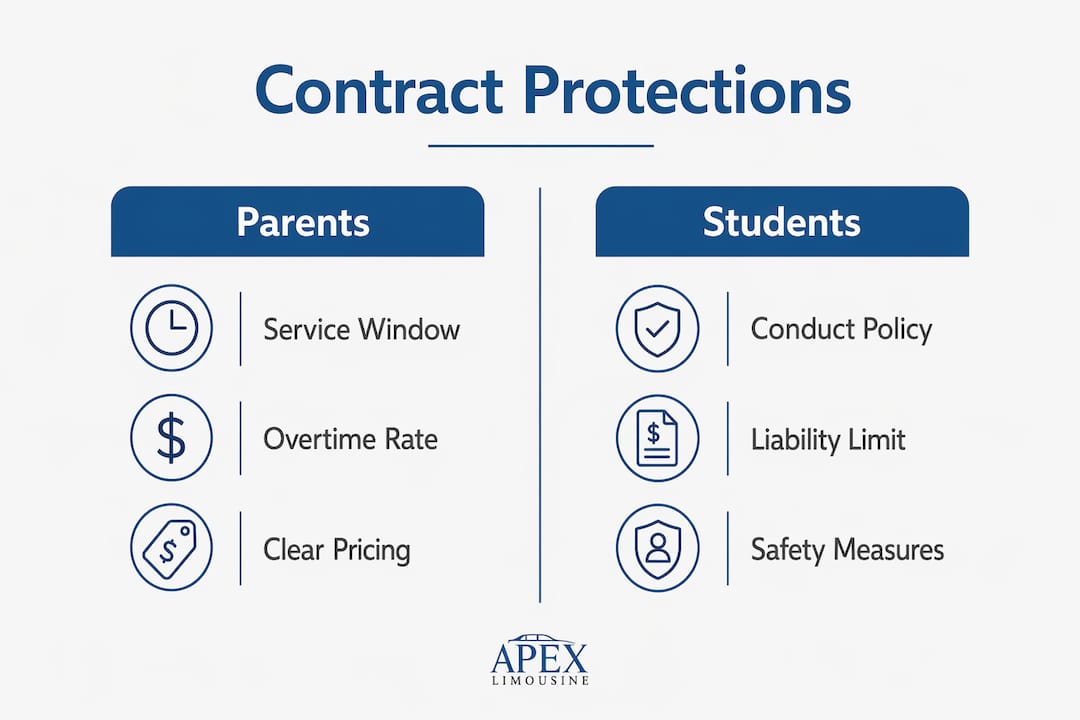
The table below shows how these elements map to the parties they protect most directly.
| Contract Clause | Protects | Why It Matters |
|---|---|---|
| Service window with overtime rate | Parent | Prevents surprise charges at end of night |
| Passenger limit | Provider and students | Keeps vehicle legal and safe |
| Full itinerary with addresses | Both parties | Eliminates confusion about stops |
| Deposit and cancellation terms | Provider | Covers scheduling costs if group cancels |
| Conduct and zero-tolerance policy | Students and parents | Authorizes chauffeur to enforce safety rules |
| Liability and insurance clause | Both parties | Defines legal responsibility for incidents |
Pro Tip: Ask the company to replace any phrase like "standard rates apply" with the actual dollar figure. Vague language in a contract almost always favors the provider, not you.
Pricing packages for prom transport typically reflect event duration. Junior prom runs around 6 hours; senior prom often runs 10–12 hours, with the base price covering the vehicle, chauffeur, and fuel. Gratuity (typically 18–20% of the base fare), tolls, and overtime are usually billed separately, so read the quote carefully before comparing providers.
How contracts address safety and liability on prom night
The safety provisions in a prom limo service agreement go well beyond standard rental paperwork. Contracts must be signed by a parent or guardian over 18 and initialed or co-signed by student passengers, which creates a paper trail that assigns responsibility clearly before anyone gets in the vehicle.

Zero-tolerance drug and alcohol policies are standard in professional contracts. They authorize the chauffeur to inspect bags, refuse boarding to any passenger who appears intoxicated, and terminate service entirely if violations occur mid-trip, dropping the group at a safe location. That authority is not optional; it is written into the agreement and acknowledged by every signer. Organizations like Stop-DWI and Power to the Parent both recommend this clause as a baseline for any prom transportation agreement.
Here is what the safety section of a solid contract should address:
- Commercial liability insurance: Certificate naming the specific vehicle, not just the company
- CDL-licensed driver: Confirmation that the assigned driver holds a Commercial Driver's License for passenger transport
- Bag inspection rights: Chauffeur authority to check bags before departure
- Service termination clause: Right to end the trip for policy violations, with no refund
- Emergency contact protocol: Parent or guardian phone numbers on file with the driver
- Registered passenger list: Only named passengers may board; no additions on the night
Professional limo services carry CDL drivers and commercial liability insurance that informal on-demand ride-share apps do not require. During peak prom hours, surge pricing on those apps can triple the cost, and availability is unpredictable. A signed contract with a licensed operator locks in the price, the vehicle, and the driver weeks in advance. That is a fundamentally different level of reliability, especially for a group of teenagers on one of the busiest nights of the spring.
Liability limitations in the contract also protect parents. If a student violates the conduct policy and the chauffeur terminates service, the contract establishes that the provider fulfilled its obligation. Conversely, if the provider fails to show or sends an unlicensed vehicle, the written terms give the family legal standing to seek a refund or pursue a claim. For more on what separates professional operators from informal alternatives, the prom limo safety guide from APEX LIMO breaks it down clearly.
Logistics coordination: how a contract prevents night-of chaos
Prom night transportation is nothing like a standard airport transfer. Multi-stop itineraries with specific timing and addresses require explicit written confirmation of every segment, because a missed photo stop or a wrong drop-off address can fracture the entire evening.
The contract is the logistics document. Every stop, every arrival window, and every address should appear in writing before you pay the deposit. Here is how to structure the coordination:
- Book by end of february: Fleet availability at reputable companies fills up fast; waiting until april often means older vehicles or splitting the group across multiple rides
- List every stop with an address: Pre-prom photos, dinner reservation, venue arrival, and after-prom return, each with a target time
- Build in buffer time: Photo sessions run long. Add 15–20 minutes of cushion between stops
- Share a master schedule: Give the driver, the lead parent, and the school coordinator the same written timeline
- Confirm final passenger count: Do this 7–14 days before the event, when the final balance is typically due
- Check for road closures: One week out, verify the route near the venue for construction or event conflicts
- Keep contact info accessible: Driver's cell number, lead parent's number, and the company's dispatch line should all be in every parent's phone
Reputable companies require non-refundable deposits of 25–50% at booking, with the final balance due 7–14 days before the event. That payment schedule is also a logistics tool: it forces the group to confirm headcount, finalize addresses, and lock in the itinerary well before prom night, rather than scrambling the week of. Coordinating event logistics across multiple families is similar to planning any large group event, and the same principle applies whether you're arranging wedding weekend transportation or a prom shuttle service: written confirmation of every detail is what keeps the night on schedule.
Expert insights on choosing a reputable prom transportation service
A prom limo service agreement is only as good as the company behind it. The contract protects you legally, but the company's credentials determine whether the vehicle actually shows up on time, in the right condition, with a qualified driver.
Before paying any deposit, verify three things directly:
- DOT number: Look it up through the Federal Motor Carrier Safety Administration to confirm the company is registered and in good standing
- Commercial vehicle registration: The specific vehicle should be registered for passenger-for-hire service, not just personal use
- CDL driver assignment: Ask specifically about the driver assigned to your booking, not whether the company employs CDL drivers in general
- Commercial liability insurance certificate: Request a copy naming the vehicle. A professional operator can email this within an hour; hesitation is a red flag
- Better Business Bureau profile: Check bbb.org for complaint history and accreditation status
A vehicle can look polished and still lack commercial registration. That gap matters because an unregistered vehicle operating as prom transport has no commercial insurance coverage. If something goes wrong, your family has no protection. The NHTSA teen driving safety guidance for prom season reinforces this point: professional, vetted transportation is one of the most direct ways parents can reduce risk on prom night.
Pro Tip: Ask the company for the assigned driver's CDL number and verify it through your state's DMV database. This takes five minutes and confirms the driver is licensed for passenger transport, not just a standard vehicle.
Limo etiquette matters too. Students should know the rules before they get in: no standing through sunroofs while the vehicle is moving, no tampering with the sound system or lighting controls, and no food or drinks that can stain the interior. These are not just courtesy guidelines; violating them can trigger damage fees or service termination clauses in the contract.
Choosing a professional prom transportation service means more than booking a nice vehicle. It means selecting a company that carries commercial insurance, employs CDL-licensed drivers, and puts every detail of your night in writing before you pay a dollar. The contract is the proof that all of that is in place.
For parents booking in Austin, APEX LIMO's professional chauffeur service covers all of these standards: commercially licensed vehicles, vetted drivers, and written agreements that spell out every stop, price, and policy before the deposit clears. Knowing what a professional prom chauffeur actually means, in terms of licensing, training, and accountability, is the clearest way to tell a legitimate operator from one that just has a nice website.

Key Takeaways
A prom transportation contract is a legally binding agreement that protects students, parents, and providers by putting every service detail, safety rule, and pricing term in writing before prom night.
| Point | Details |
|---|---|
| Contract covers all key details | Service window, vehicle, itinerary, pricing, conduct rules, and liability must all appear in writing. |
| Book by end of february | Fleet availability fills quickly; late booking forces premium pricing or inferior vehicles. |
| Deposits run 25–50% at booking | Final balance is typically due 7–14 days before the event; cancellation terms vary by provider. |
| Verify CDL and commercial insurance | Confirm the assigned driver's license and request an insurance certificate naming the specific vehicle. |
| Zero-tolerance policies are enforceable | Signed contracts authorize chauffeurs to terminate service for alcohol or drug violations, with no refund. |