
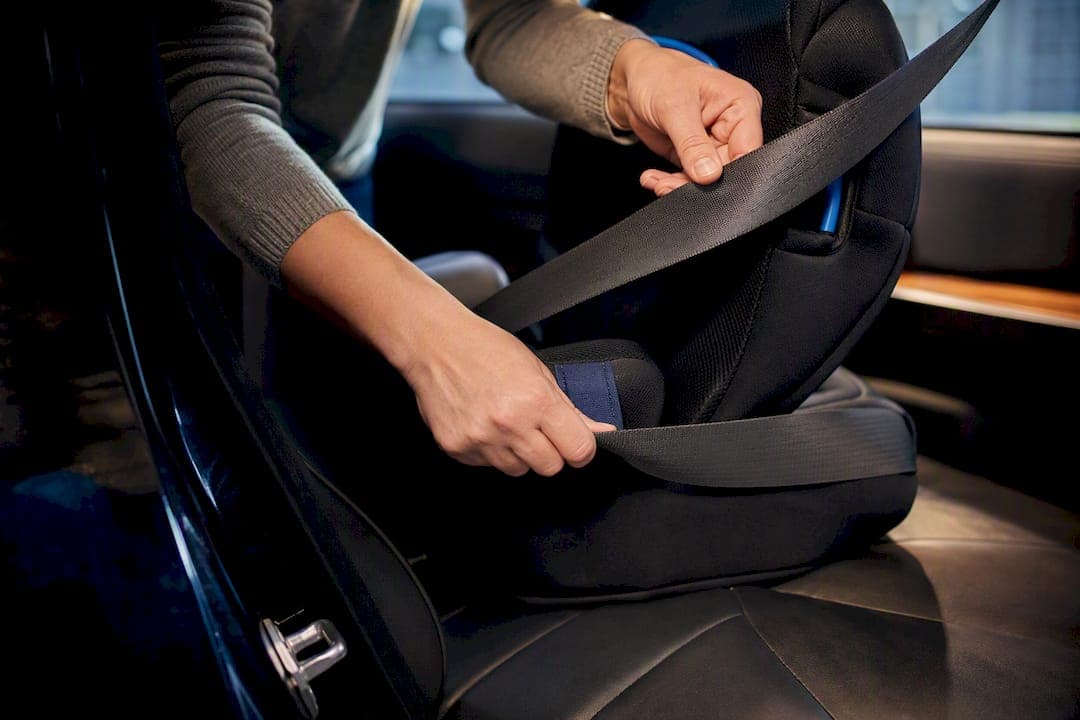
Yes, safety experts recommend using an age-appropriate car seat in a limo even in states where commercial vehicles are legally exempt from child-restraint laws. The safer move is to confirm seat availability and vehicle type when you book, or plan to bring your own seat. Installation quality and vehicle fit, not the paperwork, determine whether your child is actually protected.
TL;DR:
- Parents should confirm with limo providers whether they stock or can provide appropriate car seats for their child's age and size during booking.
- States may exempt limousines from child-restraint laws, but safety experts agree parents should always verify that seats are properly installed and fit the vehicle securely.
- Matching the right seat type to the vehicle is crucial, with sedans, SUVs, and vans offering more reliable installation options than stretch limos with side-facing benches.
- Checking the installation yourself using the one-inch rule and harness snugness is essential before departing, regardless of chauffeur assistance.
- Bringing your own car seat provides greater control over safety, seat condition, and proper installation, reducing liability risks.
Table of Contents
- Do Limos Have Car Seats? What Companies Typically Offer
- Car Seat Laws for Limos: State Rules and Commercial Exemptions
- Which Car Seats and Limo Vehicles Actually Work Together
- How to Book a Limo With a Car Seat
- Installation Checklist Before You Leave the Curb
- What a Responsible Limo Provider Should Offer, and Red Flags to Avoid
- Liability and Insurance: Who's Responsible if Something Goes Wrong
- What Actually Matters Here, and What Doesn't
- Booking a Family-Friendly Ride With APEX LIMO in Austin
- A Few More Places to Check Before You Travel
- Sources
Do Limos Have Car Seats? What Companies Typically Offer
Most limousine companies either stock car seats or will arrange one for an added fee, but there's no industry standard, so practices differ by operator and by region. Some companies bundle a seat into family packages; others charge a fee depending on seat type and rental duration. What matters most is what happens before you even get in the car.
Reputable operators ask for your child's age and weight at the time of booking, not at pickup. That single question determines whether they stage an infant carrier, a convertible seat, or a booster, and providers that collect this information upfront tend to have fewer last-minute scrambles because the right seat and the right vehicle are already matched before the chauffeur leaves the lot.
Here's what to expect from a well-run provider:
- Seat type and fee disclosed clearly during booking, not as a surprise add-on
- A request for your child's age, weight, and height before dispatch
- Sanitizing between uses and periodic checks for seat expiration dates
- Chauffeurs who can install the seat, though some companies only hand it off and expect the parent to install it
That last point trips up a lot of families. Ask directly whether the driver installs the seat or simply provides it. The answer changes how much time you need to budget at pickup.
Car Seat Laws for Limos: State Rules and Commercial Exemptions
Child-restraint law in the United States is a patchwork, and limousines often fall into a gray area. Many states exempt limousines and other for-hire commercial vehicles from the same child-restraint requirements that apply to private cars, but the exemption language and its limits vary by state.
Some states carve out exceptions for taxis and livery vehicles specifically; others apply exemptions more broadly to any commercial passenger vehicle. Provider guides that survey state-by-state differences point to states like Texas, New York, and Arizona as examples where limousine exemptions or specific requirements diverge noticeably.
Here's the catch parents often miss:
- A legal exemption doesn't erase your practical responsibility. If a crash occurs, "the law allowed it" offers little comfort and often little legal protection.
- Company policy can be stricter than state law. Many operators require seats for young children regardless of what state statute permits.
- Insurance carriers may expect standard child-restraint use as a matter of due diligence, exemption or not.
Safety guidance consistently separates the legal question from the safety question: what's legally permitted and what's actually safe for your child are two different things. Check your state DMV or the National Highway Traffic Safety Administration for the exact rule where you live, but don't let a lawful exemption talk you out of using a restraint.
Which Car Seats and Limo Vehicles Actually Work Together
Not every seat fits every limo, and this is where a lot of bookings go wrong. Matching the right restraint to the right vehicle class matters as much as having a seat in the car at all.
Seat types, ranked by ease of use in a limo:
- Rear-facing infant seats install fastest and travel well since many click into a base secured ahead of time.
- Convertible seats work for a wider age range but need more space and a proper anchor point, so vehicle choice matters more.
- Forward-facing seats with harnesses are straightforward in a standard bench seat but tricky in vehicles with unusual seat angles.
- Boosters are the simplest to place almost anywhere with a working lap-and-shoulder belt.
Vehicle compatibility is the bigger variable. Executive sedans and SUVs offer forward-facing bench seats with standard seatbelts or LATCH anchors, making them the most dependable choice for car seat installation. Sprinter vans handle multiple seats well because of their width and multiple standard seating rows, which makes them a strong pick for larger families or group events with several kids in tow. Stretch limos with side-facing benches are frequently the wrong choice because the bench geometry and lack of a proper forward-facing anchor point make secure installation difficult or impossible.
When picking a seat for limo travel, favor models that install with a standard vehicle seatbelt rather than requiring a specific LATCH configuration, since not every limo has accessible lower anchors. Compact convertible seats also travel easier if you're juggling luggage or multiple children.
How to Book a Limo With a Car Seat
Booking early and giving the dispatcher specific details is what separates a smooth pickup from a stressful one.
- Call or book online with child specifics ready: age, weight, height, and how many seats you need. If it's an airport run, include flight number and arrival time so the chauffeur can track delays.
- State your vehicle preference. Ask for a sedan, SUV, or Sprinter rather than a stretch limo if you have a young child needing a car seat.
- Ask direct questions: What seat models do they carry? Are chauffeurs trained to install them? How are seats sanitized between rides, and how do they track expiration dates?
- Confirm 24 hours ahead when possible, and mention it again the morning of your trip if it's an early booking.
- Build in extra time at pickup. Installation, even by an experienced chauffeur, takes a few extra minutes you don't want to rush.
Installation Checklist Before You Leave the Curb
Never assume a seat is safe just because it's buckled in. Run through this quickly before pulling away.
- Confirm it's the right seat for your child's current age, weight, and height, not just what happened to be available.
- Check the installation method. LATCH anchors or a seatbelt, either works, but make sure it's actually locked, not just resting in place.
- Do the one-inch test. Grab the seat at the belt path and try to move it side to side and front to back. If it shifts more than an inch, it's not tight enough.
- Check harness snugness with the pinch test: you shouldn't be able to pinch excess webbing at the shoulder.
- Confirm the chest clip sits at armpit level, not on the belly or near the neck.
If any of these checks fail, don't just accept it. Ask for a different vehicle, request the chauffeur's help re-installing it, or use your own seat if you brought one.
Pro Tip: Keep both doors open while you check the installation, not just the one you're working from. It gives you room to lean in and actually see the belt path and anchor points instead of guessing in a cramped back seat.
What a Responsible Limo Provider Should Offer, and Red Flags to Avoid
A provider worth trusting collects your child's age and weight before dispatch, keeps a variety of age-appropriate seats in rotation, sanitizes and checks expiration dates regularly, and trains chauffeurs to help with installation when asked. Industry associations recommend documenting seat condition and driver training as standard operating practice, not an occasional courtesy.
Watch for these red flags:
- Dispatch can't confirm what seat models they actually have on hand
- The chauffeur resists letting you inspect or double check the installation yourself
- The only vehicle offered is a stretch limo with side-facing bench seating and no alternative
APEX LIMO trains chauffeurs on child passenger safety procedures and keeps its Austin fleet, including sedans, SUVs, and vans, in the kind of condition its safety-focused prom transportation guidance describes for younger passengers too.
Liability and Insurance: Who's Responsible if Something Goes Wrong
Liability in a limo car-seat scenario splits three ways: the provider's duty to supply a functioning, appropriate seat, the chauffeur's role in installation if they perform it, and the parent's responsibility to verify the setup before departure. None of these parties fully absorbs the risk on their own.
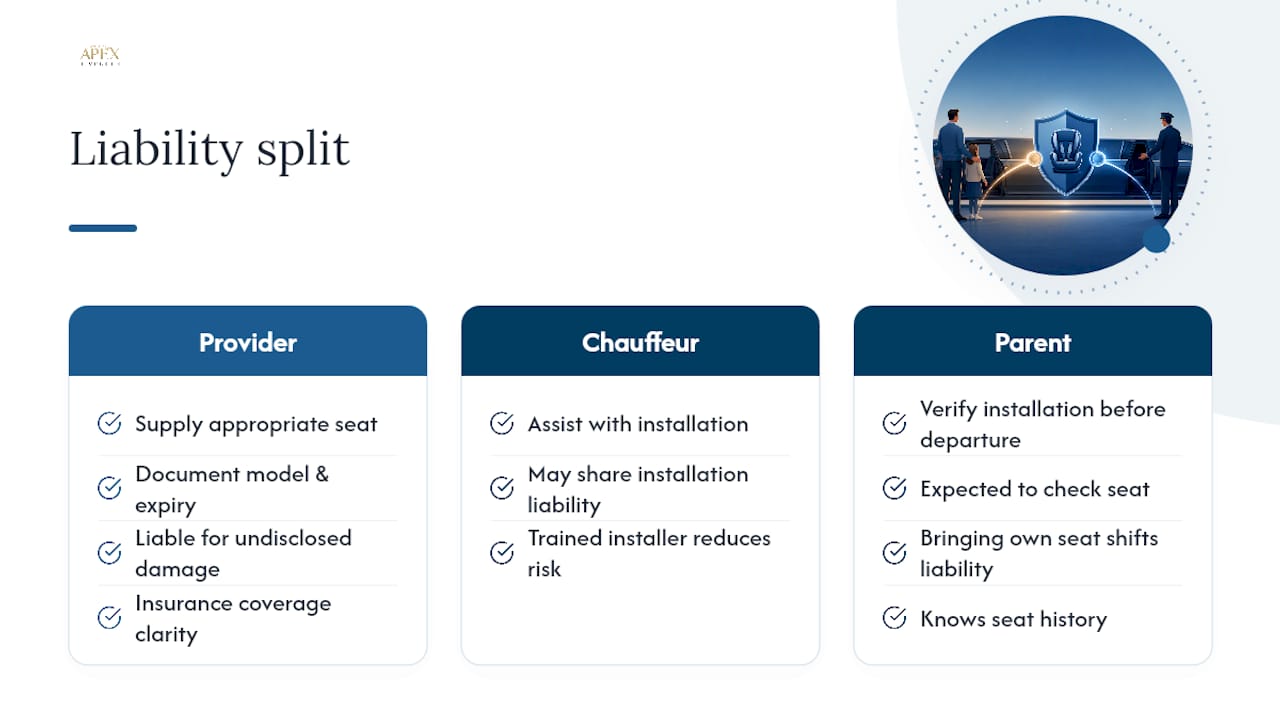
Risk-management guidance for limousine operators recommends that companies log seat model, manufacture or expiry date, and the last time it was sanitized. An expired seat, or one that's been in a prior collision, is a liability the operator owns if they hand it over without disclosure. That documentation trail matters if there's ever an incident, both for the company's insurance claim and for a parent's own peace of mind.
Parents carry responsibility too. Courts and insurers generally expect a parent to make a reasonable effort to check that a seat is properly installed, even when a chauffeur assisted. Bringing your own seat shifts more of that liability burden onto you in a good way: you know its history, its expiration date, and exactly how it installs. It also sidesteps any question about whether a rental seat was sanitized or previously damaged.
If a company's insurance policy excludes child passenger incidents, or if they're vague about it when asked, treat that as a serious warning sign. A provider confident in their equipment and training should have no trouble answering a direct question about coverage.
What Actually Matters Here, and What Doesn't
The conventional advice on this topic spends too much time on the legal exemption question and not enough on the two things that actually decide outcomes: vehicle choice and installation quality. A parent who books a stretch limo because "it looked luxurious online" and skips the one-inch belt-path test has done more to endanger their child than any state exemption ever could.

Here's what I'd prioritize if I were a parent booking this week. First, pick the vehicle class, sedan, SUV, or Sprinter, before you pick the seat. Second, give the dispatcher real numbers: age, weight, height, not vague descriptions. Third, treat the chauffeur's installation as a starting point, not a finished product. Check it yourself every time, no exceptions.
The gap between what limo companies advertise and what actually protects your child is smaller than people assume, but it's not zero. A seat that's merely present in the vehicle isn't the same as a seat that's correctly installed for your specific child. That distinction is where most of the real risk hides, and it's the one thing worth double checking before the car pulls away from the curb.
— Jason
Booking a Family-Friendly Ride With APEX LIMO in Austin
APEX LIMO gives Austin families a straightforward way to lock in the right vehicle and the right seat before the day of the event, instead of hoping it works out at pickup. Whether you're heading to the airport, a wedding, or a family outing, our team asks for your child's age, weight, and seat preference at booking so the correct restraint and vehicle class, sedan, SUV, or van, are ready before the chauffeur arrives.

When you reserve, give us the details that matter: your child's age and weight, how many seats you need, your pickup and drop off times, and whether you're bringing your own seat or need one provided. Our chauffeurs are trained to assist with installation and will walk through the setup with you before you leave, not after you've already pulled away. If you have questions about vehicle options or want to confirm seat availability ahead of your date, reach out to our team directly. You can check vehicle options and book your Austin ride here and get your family's transportation locked in with the right seat waiting.
A Few More Places to Check Before You Travel
For state-specific legal details, check your state DMV or NHTSA installation guidance. For vehicle options built around multiple car seats, see how Sprinter van layouts handle larger families, or browse Reliant Transportation's booking resources for family travel.
Sources
- Limousine Car Seats: Do You Need One? (Skyline Chicago)
- Baby Car Seat Limo Service NYC | All Comfort Limo
- Limo
- Risk Insights-Child Car Seats in Limousines (Northbridge Insurance PDF)