

The fastest way to prevent pickup chaos is to build a transportation manifest and name one person as the day-of transport lead before you book a single vehicle. Event pickup staging means coordinating passenger pickups, vehicle queuing, timing, routing, and chauffeur procedures so guests move smoothly from curb to seat. APEX LIMO and accessibility guidance from sources like SF.gov both treat this as a planning task, not a day-of improvisation.
TL;DR:
- Having a designated transport lead and clear communication plan helps prevent delays and confusion during guest pickup and drop-off.
- Accurate site assessment and zone mapping are essential to identify accessible routes, space limitations, and vehicle class suitability, reducing last-minute errors.
- Matching vehicle types to passenger priority and building buffer time into schedules minimizes bottlenecks and ensures smooth flow even with delays.
- Integrating accessible loading points into the initial plan and verifying them early ensures dignified guest experiences without last-minute rushes.
- Proper staffing, signage, equipment, and contingency responses are critical to maintaining safety, order, and efficiency across all phases of event transportation.
Table of Contents
- What Is Event Pickup Staging? A Quick Checklist Before You Book Vehicles
- Site Assessment and Pickup Zone Design
- Building the Transportation Manifest and Communication Plan
- Assigning Vehicle Roles and Managing Staging Timing
- Making Accessible Loading Part of the Plan From Day One
- Day-Of Operations and Contingency Planning
- Loading and Unloading Procedures That Keep Everyone Safe
- Coordinating With Event Security and Crowd Control
- Signage and Wayfinding That Actually Get Guests to the Right Spot
- Staff Roles and Responsibilities in the Staging Process
- Equipment and Supplies Every Staging Area Needs
- Jason's Perspective: Lessons From High-Touch Luxury Event Transport
- How APEX LIMO Can Help You Staff and Stage Your Next Event
- Sources
What Is Event Pickup Staging? A Quick Checklist Before You Book Vehicles
Before you commit to a fleet size or a shuttle schedule, run through this in five to ten minutes. It catches the mistakes that turn a clean pickup plan into a curbside jam.
- Confirm the venue's actual pickup entrances, which staging areas are permitted, and whether no-idling or permit rules apply.
- Group passengers by movement type and headcount: VIPs, hotel shuttle riders, vendors, and staff each need different handling.
- Name a day-of transport lead and a backup contact who can make real-time calls.
- Decide between a looped shuttle and fixed pickup windows, then set buffer minutes around each one.
- Verify accessible loading exists near the venue and map the accessible route from that point.
Pro Tip: Run this checklist against the venue's own site map, not a generic template. A loading dock that looks fine on paper often has a six-foot clearance problem that only shows up in person.
Site Assessment and Pickup Zone Design
Walk the property before you plan a single route. Map every entrance, service drive, loading dock, hotel canopy, and alternative staging point, and label each one with GPS coordinates or a plain curb description your drivers can radio back to. A Sprinter van requires a different pull-up length than a stretch limo, so measure actual pull-up space and turning radius at each spot to decide which vehicle classes can physically use it.
- Confirm venue rules, required permits, and security access weeks ahead, not the morning of.
- Separate staging or holding areas from release points so vehicles queue out of sight and pull forward only when called.
- Match vehicle classes to available space: sedans and SUVs can often use tighter curb cuts than a 32-foot coach.
- Flag any point where guest movement, vendor deliveries, and equipment freight might cross paths.
Treating those movement types independently prevents them from colliding at a single loading point, which is often where entire schedules unravel in the first hour. A step-by-step event logistics guide makes this same case: separating movement categories into distinct staging lanes keeps bottlenecks from cascading into the rest of the evening.
Building the Transportation Manifest and Communication Plan
A manifest is the single document that keeps chauffeurs, guests, and your on-site team reading from the same page. Every published event planner car service checklist points to the same core fields, and skipping any of them is where confusion creeps in.
- Passenger name or role, exact pickup time and window, and a labeled pickup point.
- Vehicle class and vehicle ID, plus a direct driver phone number.
- Flight numbers or hotel details for arrivals, since those change the timing math.
Give one person, the transport lead, final authority over day-of adjustments. Splitting that decision across three coordinators is how a fifteen-minute delay turns into a stalled queue of limousines. Build in two confirmation checkpoints, one at 24 hours and one at two hours before the event, and keep a live channel open (a group text or radio net works) for last-minute changes. Coordinating event transportation well starts with tight confirmation windows and a single point of contact, which cuts down the back-and-forth that eats into buffer time. On the guest side, a short text with a map pin and a description of the vehicle ("black Suburban, plate ending 4471") does more to reduce confusion than a lengthy printed itinerary ever will.
Assigning Vehicle Roles and Managing Staging Timing
Not every vehicle in your fleet should do the same job. Sedans and SUVs handle VIP pickups where discretion and speed matter. Sprinter vans work best for group shuttles moving guests in batches of ten to fourteen. Full-size coaches make sense for large parties moving as one block, like a wedding party transferring from ceremony to reception.
- Match vehicle class to passenger volume and priority, not just to what happens to be available that day.
- Build headways (the gap between vehicle arrivals) around realistic boarding time, not an optimistic guess.
- Add buffer minutes to every window rather than adding more vehicles to compensate for uncertainty.
Good transportation planning works backward from the event's actual start time rather than forward from when vehicles happen to be free, prioritizing buffer time over raw vehicle count. A shuttle loop needs a defined length, a holding point where vehicles wait between runs, clear signage marking the loop route, and a realistic turnaround estimate based on actual traffic, not a straight-line map distance.
Pro Tip: Time one full loop yourself during a quiet period before the event. The number you get almost always runs longer than what a mapping app estimates once you account for passenger boarding.
On staging protocol, set clear idling rules, a defined release command so drivers know exactly when to pull forward, and a quick-swap procedure for when a vehicle needs to rotate out for fuel, a break, or a mechanical check.
Making Accessible Loading Part of the Plan From Day One
Accessible loading can't be an afterthought you handle if someone asks. It has to be part of the initial site assessment, alongside entrances and staging zones. Accessible pickup points should sit outside the main flow of vehicle traffic and connect directly to an accessible route into the venue, per accessibility guidance for event sites.
- Check for existing accessible loading signage and curb ramps during your first venue walkthrough, not the week of the event.
- Confirm pull-up clearance is sufficient for a wheelchair-accessible vehicle or determine if temporary measures are needed.
- Brief chauffeurs specifically on accessible pickup procedures and assign an escort when a guest needs one.
- Confirm venue obligations and route details directly with venue management or local accessibility guidance rather than assuming they're covered.
Many venues simply don't mark accessible routes clearly, which means the burden falls on your team to verify and communicate them. Treating this as a planning line item rather than a same-day scramble protects both your timeline and your guests' dignity.
Day-Of Operations and Contingency Planning
Run the day in four phases: pre-arrival staging, managed arrivals, departures, and load-out. Each phase has its own rhythm, and trying to manage them with one undifferentiated plan is where things fall apart.
- Pre-arrival staging. Vehicles hold at designated points, engines off where rules require it, drivers confirmed and briefed.
- Managed arrivals. Vehicles release from staging on a call from the transport lead, one at a time or in a controlled loop.
- Departures. Run these in waves for scheduled group exits, or as a continuous loop for events with rolling end times like concerts.
- Load-out. Final vehicle accounting, driver check-out, and confirmation everyone assigned to depart actually did.
Flight delays, traffic backups, and mechanical issues are the three contingencies that show up most often, so pre-assign a response to each before the event starts rather than improvising in the moment. Keep one or two backup vehicles pre-positioned near the venue, not parked across town, so a swap doesn't break the guest flow, an approach that large-event transportation guides recommend specifically for high-volume situations where a single delay can ripple through an entire loop.
Pro Tip: Assign contingency responses to specific people by name during your pre-event briefing. "Someone will handle it" is not a plan when a limo breaks down twenty minutes before doors open.
Close the night with a debrief: reconcile billing and overtime, log any incidents, and note what staging adjustments would help next time. That fifteen-minute conversation is what makes your third event smoother than your first.
Loading and Unloading Procedures That Keep Everyone Safe
The actual moment a guest steps into or out of a vehicle is where most minor incidents happen, usually from rushing rather than from equipment failure. Chauffeurs should come to a full stop, engage the parking brake, and open doors themselves rather than letting guests self-serve, particularly for stretch limos and SUVs with higher door thresholds.
Stagger loading so one vehicle finishes boarding and clears the pickup point before the next pulls forward. Trying to load two vehicles side by side at a single-lane curb is a common cause of the pileups that stall an otherwise well-planned event. For formal wear, heels, or mobility aids, a chauffeur's brief assist at the door prevents the kind of fall that turns a wedding into an emergency room visit.
Unloading follows the same logic in reverse. Guests exit on the curb side whenever possible, never into moving traffic, and the vehicle doesn't pull away until the door is fully closed and the chauffeur has visually confirmed the area is clear. For large parties exiting a coach, have a staff member or chauffeur physically direct foot traffic away from the vehicle's blind spots.
Build in a few extra seconds per passenger for loading and unloading in your timing math. It looks like nothing on paper, but multiplied across forty guests, it's the difference between a shuttle loop that holds its schedule and one that slowly bleeds minutes until it's twenty behind by the third run.
Coordinating With Event Security and Crowd Control
Pickup staging doesn't happen in isolation from the rest of the event's security plan, and treating it that way creates friction right when guests are most visible. Loop in venue security and any hired crowd control staff during your site assessment, not the morning of the event, so everyone agrees on where vehicle traffic and pedestrian traffic are supposed to separate.
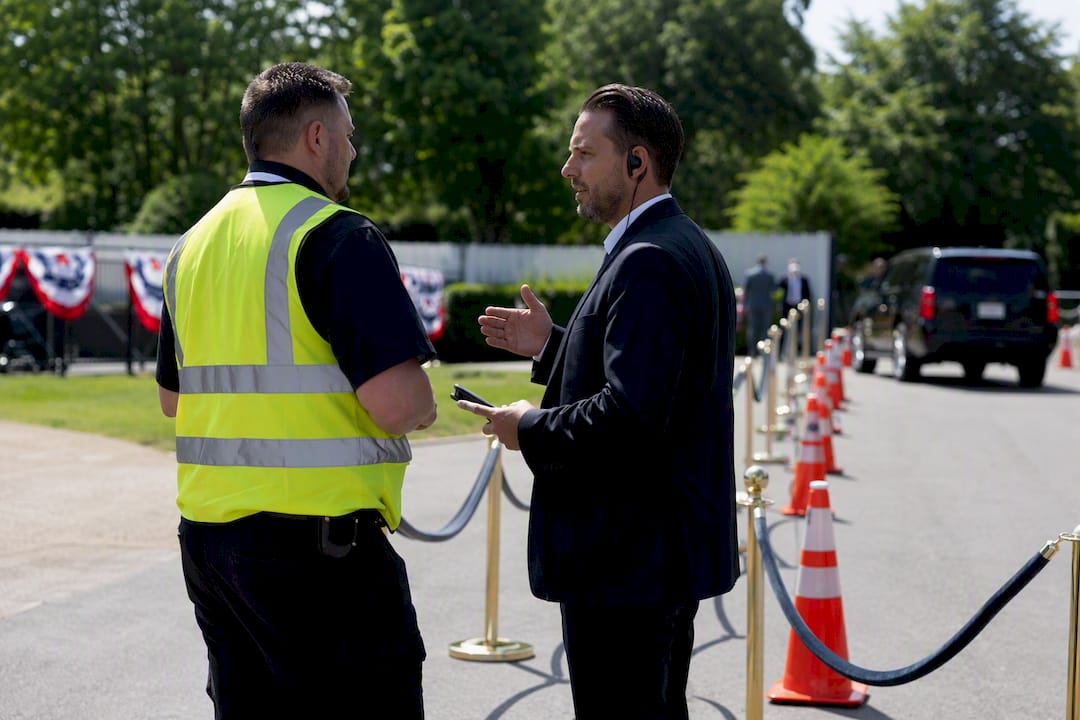
Security teams typically manage the crowd side: queuing guests in an orderly line, preventing people from wandering into the vehicle lane, and controlling access points so only ticketed or credentialed guests reach the staging area. Your transport lead manages the vehicle side. The two roles need a shared radio channel or a physically stationed liaison so a security hold doesn't leave three limos idling with no idea why.
For larger events, especially concerts or corporate functions with hundreds of departing guests at once, security's crowd control decisions directly affect your loop timing. If security is holding a crowd back from a specific gate, your vehicles need to know before they pull into a queue with no passengers waiting. Share your staging map with the security lead ahead of time and mark exactly where vehicle lanes and pedestrian lanes are supposed to stay separated. A quick quarter-hour walkthrough together, comparing your staging plan to their crowd flow plan, catches conflicts that would otherwise surface as a shouting match at the curb during peak departure.
Signage and Wayfinding That Actually Get Guests to the Right Spot
Good signage does the work your transport lead can't do in person for every single guest. Place clear, high-visibility signs at every decision point a guest might hit: the venue exit, any fork in the walkway, and the staging area itself. A sign that simply says "Pickup" isn't enough when there are three separate zones for VIPs, shuttle riders, and rideshare guests.
Color-code or number your zones and repeat that coding on guest-facing texts and printed materials so someone can match what's on their phone to what's in front of them. A folding A-frame sign works for a single-entrance venue; a large event with multiple exits needs directional arrows at each junction, not just a sign at the final destination.
Staff holding signs with a vehicle description or a guest's name matter more at night or in a large crowd than any printed placard, since a human waving is easier to spot from fifty feet away than static text. For accessible pickup points specifically, signage should be visible from the accessible route itself, not just from the main pedestrian path, since a guest who can't easily backtrack needs to see the sign the first time.
Staff Roles and Responsibilities in the Staging Process
Pickup staging runs on people as much as on vehicles, and unclear roles are one of the fastest ways to lose control of a queue. The transport lead holds final decision authority: rerouting a vehicle, approving a delay, or calling in a backup. That person needs to be reachable at all times and should not also be responsible for another major event function, since split attention during a bottleneck is how small problems become big ones.
Below the transport lead, zone captains or dispatchers manage individual pickup or staging points, radioing status updates and calling vehicles forward when a spot clears. Chauffeurs handle their own vehicle, passenger safety, and adherence to the release sequence rather than freelancing their own timing. A signage or wayfinding staffer, even just one person per major junction, redirects confused guests before they wander into a vehicle lane.
Write these roles down and assign them by name before the event, not verbally on the day. A one-page staffing sheet with names, roles, and radio channel assignments handed out at the pre-event briefing prevents the common failure where three people all assume someone else is managing the VIP queue.
Equipment and Supplies Every Staging Area Needs
A staging area without the right equipment forces staff to improvise, and improvisation under time pressure is where mistakes happen. Two-way radios are the backbone of the operation, giving zone captains, the transport lead, and drivers a shared channel that works when cell service gets congested during a large event.
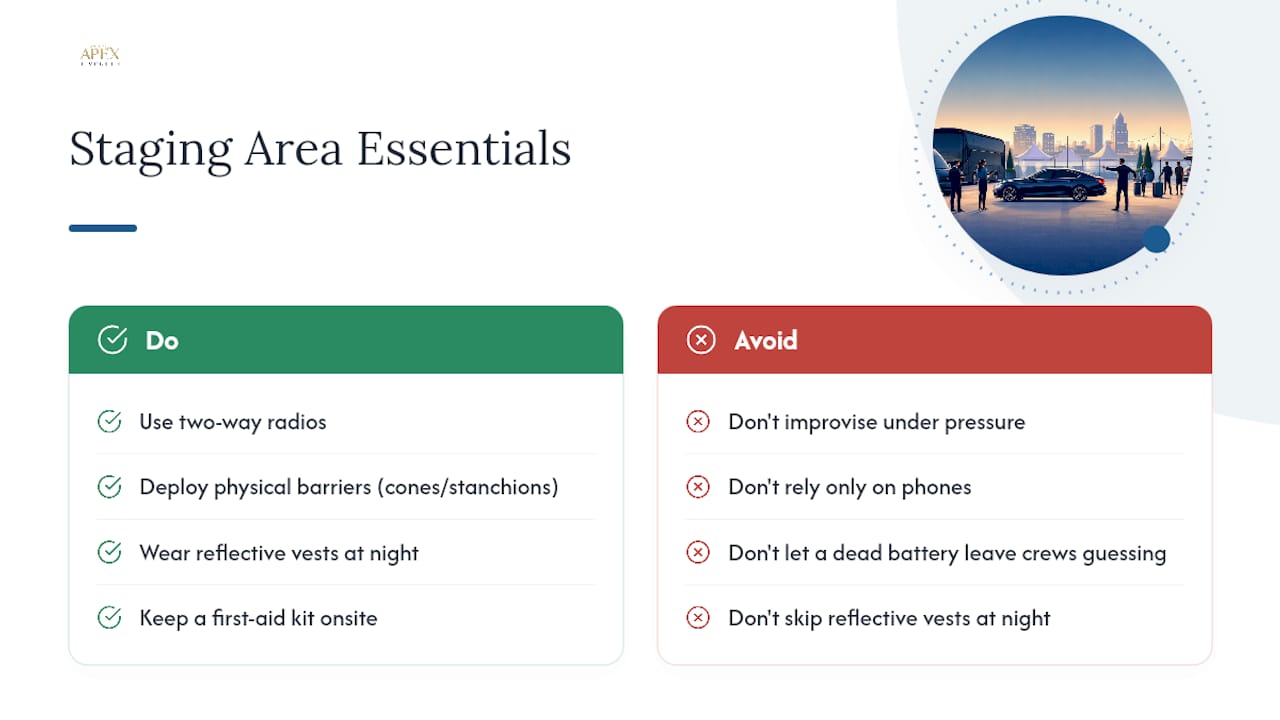
Physical barriers, whether rope-and-post stanchions or simple cones, mark the boundary between the vehicle lane and pedestrian space and give security something concrete to reference. Reflective vests for staff working near active traffic aren't optional at night, and a basic first-aid kit at the staging point covers minor incidents without requiring a trip back to a main event office.
Printed backup copies of the transportation manifest matter too, since a phone battery dying or a signal dropping shouldn't leave a zone captain guessing which vehicle goes where. Round out the kit with flashlights for after-dark events, extra signage in case a sign gets knocked over, and a clipboard or tablet for the transport lead to log real-time changes as they happen.
Jason's Perspective: Lessons From High-Touch Luxury Event Transport
Years spent coordinating transportation for weddings, proms, and corporate events at APEX LIMO have made one thing clear: the events that run smoothly are choreographed, not improvised. Three lessons stand out consistently. First, manifest clarity beats vehicle count every time. Second, a single transport lead with real authority prevents the small delays that compound into visible chaos. Third, treating accessible loading as a first assessment item, not a fallback, changes how guests experience the entire event. The rest is discipline in applying it consistently.
— Jason
How APEX LIMO Can Help You Staff and Stage Your Next Event
Building a manifest, staffing a transport lead, and holding backup vehicles in reserve is a lot to manage on top of everything else on your event day, which is exactly the workload APEX LIMO absorbs for planners across weddings, proms, and corporate events. Rather than assembling a patchwork of independent drivers, you get a customizable fleet, from sedans to Sprinters to full coaches, paired with chauffeurs trained specifically on staging protocol, accessible pickups, and real-time adjustments.
APEX LIMO's approach to event transportation is built around the same choreography this guide describes: a coordinated manifest, one point of contact, and vehicles staged and ready before guests ever reach the curb, following advice on how to manage VIP hospitality transport at sports venues. If you're planning a wedding, prom, or corporate event and want a transport partner who handles staging as a core discipline rather than an afterthought, request a staging consultation with APEX LIMO and get a custom quote built around your venue's actual layout.
Sources
- Event Planner Car Service Checklist | Artisan Chauffeur & Concierge
- How to Coordinate Event Transportation | Luxeride
- Event Transportation Planning Guide: Shuttles, VIP Transfers and Logistics Tips
- Sf