
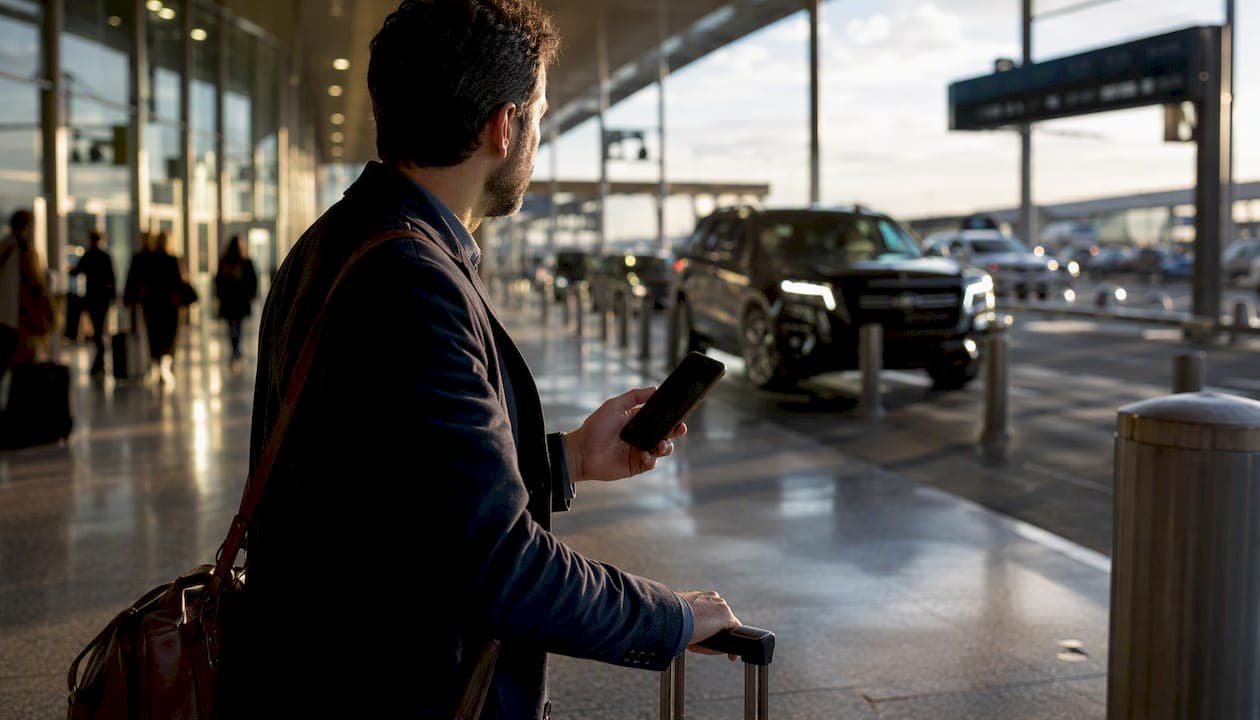
When you land, do one thing before anything else: open your booking confirmation and verify your meeting point, driver name, and vehicle details. That single action prevents the most common arrival failure, which is walking to the wrong exit and missing your driver entirely.
Here is what to confirm the moment you have a signal:
- Flight number and terminal confirmed with your provider
- Meeting method: in-terminal arrivals hall (driver holds a name board) or curbside/curb exit
- Driver name and mobile number
- Vehicle make, color, and last three plate characters
- Dispatcher/support line (save it separately from the confirmation)
- Free waiting window (how many minutes before fees start)
For international arrivals, add one more step: you must clear U.S. Customs and Border Protection procedures in the Federal Inspection Area before you can exit into the public arrivals area where your driver waits. Budget time for that.
Pro Tip: Turn on mobile data or roaming the moment the aircraft door opens. Screenshot your booking confirmation, driver photo, and vehicle plate before you land so you have them offline. A dead battery or no signal at baggage claim is the second most common reason travelers miss their driver.
Key Takeaways
A smooth airport transfer comes down to one thing confirmed before you land: your exact meeting point, in writing, with driver details saved offline.
| Point | Details |
|---|---|
| Confirm meeting point before landing | Verify in-terminal vs. curbside pickup, driver name, and vehicle plate from your offline confirmation. |
| Budget realistic time for customs | International arrivals at major U.S. airports typically take 50 minutes from landing to vehicle. |
| Understand your waiting-time policy | Providers who track flights start the free window from actual landing; those who don't use scheduled arrival time. |
| Follow the fallback sequence | If you can't find your driver: stay put, call the driver, then call dispatch before moving or accepting other rides. |
| APEX LIMO for managed arrivals | APEX LIMO offers in-terminal meet-and-greet, flight tracking, and verified chauffeurs for stress-free Austin airport transfers. |
Table of Contents
- What to confirm in your booking before you fly
- How to get from the aircraft to your driver, step by step
- Where do drivers actually wait for you?
- How to verify your driver and vehicle before you get in
- Waiting-time policies and how fees actually work
- What to do if you cannot find your driver
- Airport curbside rules, cell-phone lots, and accessibility
- Your arrival checklist and realistic timeline
- Why a professional chauffeured transfer reduces arrival stress
- What I've seen go wrong at arrivals, and how to avoid it
- APEX LIMO handles your arrival end-to-end, from flight tracking to your door
- Sources
What to confirm in your booking before you fly
Getting this right before departure means you arrive with a plan, not a question. Pull up your confirmation at least 24 hours before your flight and check every field below.
Booking fields to verify and save offline:
- Scheduled arrival time and flight number (your provider needs the flight number to track delays)
- Terminal and specific meeting point: arrivals hall, curbside door/exit number, cell-phone lot, or parking bay
- Driver name, mobile number, and photo if provided
- Vehicle make, model, color, and license plate
- Dispatcher or 24/7 support line (different from the driver's cell)
- Waiting-time policy: how many free minutes, when the clock starts, and the fee structure after
- Any special requests: wheelchair assistance, infant seat, oversized luggage, or multi-vehicle group transfer
Why flight tracking matters more than most travelers realize:
Providers who monitor flights in real time can adjust pickup timing when your flight runs early or late, which directly prevents unnecessary waiting charges and missed pickups. Meet-and-greet services that use live flight monitoring typically publish explicit waiting-time policies, often around 60 free minutes for international arrivals, because they can actually honor them. A provider who does not track flights is guessing.
Learn how the airport transfer booking process works so you know exactly which fields to confirm and which terms to watch for.
How to save and present your confirmation:
- Screenshot the full confirmation including meeting point, driver name, and vehicle plate.
- Save a PDF copy to your phone's local storage (not just a cloud link).
- Screenshot the vehicle photo separately if your provider sends one.
- Note any landmark or door number for outside pickups.
Special requests need explicit confirmation, not just a note in a text box. If you need wheelchair assistance, an infant seat, or have oversized luggage, call or message your provider directly and get written confirmation that the request is logged. For group transfers requiring multiple vehicles, confirm the coordination plan: who leads, which vehicle boards first, and whether drivers communicate with each other.
Pro Tip: If your provider offers in-terminal meet-and-greet, confirm it with this exact phrase: "Is in-terminal arrivals hall meet-and-greet included in my booking?" A vague "we'll be there" is not the same as a driver standing inside with your name on a board.
How to get from the aircraft to your driver, step by step
The sequence below applies to most U.S. airports. Follow it in order and you will know exactly when to move, when to pause, and where to stand.
International arrivals
- Deplane and follow signs to passport control. Do not exit the secure area yet.
- Complete CBP entry procedures. CBP requires all international arriving passengers to clear the Federal Inspection Area before entering the public arrivals zone. Pre-cleared flights are an exception.
- Collect checked baggage from the carousel assigned on the arrivals board.
- Clear customs and proceed through the exit doors into the public arrivals area or International Arrivals Meeting Area.
- Pause before exiting. Check your phone for driver messages, confirm your meeting point, and reply to any driver texts before you walk out.
- Proceed to your meeting point (arrivals hall, curb exit, or designated pickup lane).
Domestic arrivals
- Deplane and collect baggage if checked. No customs or CBP step.
- Check your phone as soon as you have signal, before leaving the baggage claim area.
- Confirm the meeting point and proceed directly.
Arrival timing reference
TSA guidance on screening and traveler processing also affects how quickly passengers move through the airport, particularly when secondary screening or prohibited items cause delays. Build that buffer into your booking.
When to call versus message your driver:
- Message first if you are still inside the terminal (quieter, leaves a record).
- Call if you have been waiting more than five minutes at the agreed point with no contact.
- Always call dispatch, not just the driver, if you cannot reach the driver within two attempts.
Where do drivers actually wait for you?
Meeting-point confusion causes more missed pickups than late flights. Here is how each option works and when providers use each one.
In-terminal arrivals hall (meet-and-greet): The driver enters the terminal and stands in the public arrivals area holding a sign with your name. This is the most reliable method for groups, travelers with heavy luggage, or anyone unfamiliar with the airport. Reputable meet-and-greet providers use real-time flight tracking so the driver is already inside when you clear customs, not circling the parking lot. Booking language to look for: "in-terminal meet-and-greet," "arrivals hall pickup," or "driver inside terminal."

Curbside pickup: The driver waits at a designated curb exit outside the terminal. You must exit the building and be ready at the curb before the driver pulls up, because unattended vehicles are prohibited. SFO explicitly states that curbsides are for active pickup and drop-off only, and drivers must use the Cell Phone Waiting Lot rather than leaving vehicles unattended. Booking language: "curbside pickup," "meet outside Door X," or "call when you exit."

Designated ride-hail and TNC zones: Many U.S. airports now route app-based pickups to specific lanes away from the main curb. These are usually marked on the airport map and signposted inside the terminal. Your driver will send a location pin or plate number when they arrive.
Cell-phone waiting lots and short-term parking: Airport curbside enforcement at major U.S. airports is strict. Chicago O'Hare (ORD) prohibits curbside waiting entirely, offers a Cell Phone Lot, and directs pickups through the Multi-Modal Facility. Minneapolis-St. Paul (MSP) similarly prohibits unattended vehicles on terminal roadways and recommends cell-phone lots. Your driver may be parked there and will pull to the curb only when you confirm you are outside and ready.
Booking wording that tells you where to stand: "Driver inside arrivals hall with name board" = go to the public arrivals area inside the terminal. "Curbside pickup — call on exit" = exit the building first, then call. "Meet at Door X / Exit Y" = find that specific numbered door on the terminal map. "Cell phone lot — text when ready" = your driver is parked offsite; text them and wait at the curb.
Pro Tip: For any outside pickup, confirm the specific door or exit number AND the vehicle plate before you leave the terminal. A plate number is faster to spot than a color in a crowded pickup lane.
How to verify your driver and vehicle before you get in
This step takes 30 seconds and matters every time, not just when something feels off.
Verification checklist:
- Driver's name matches your confirmation exactly
- Driver photo (if provided) matches the person in front of you
- Vehicle make, model, and color match your confirmation
- Last three characters of the license plate match
- Company logo, ID card, or uniform visible
- Booking reference or confirmation number matches when you ask
How to ask safely: Before opening the door, say: "Can you confirm the booking name and destination?" A legitimate driver will answer immediately. If the details do not match, do not board. Step back, call your dispatcher, and wait at the agreed point.
If your provider sent a vehicle photo and it does not match what is in front of you, treat that as a mismatch. Call dispatch before getting in. Mis-hails in busy arrivals areas are not rare, and a quick call takes less than a minute.
Using screenshots as proof: Your offline screenshot of the driver photo and plate is your reference. If the driver's app shows a different plate than your confirmation, that is worth a call to dispatch before you load luggage.
Pro Tip: If you cannot spot your driver in a crowded arrivals hall, message them and ask them to send a quick photo next to their name board or vehicle plate. Most professional chauffeurs will do this without hesitation.
Waiting-time policies and how fees actually work
Free waiting windows vary by provider and booking type, typically ranging from 15 to 60 minutes depending on whether the booking is domestic or international and whether the provider tracks your flight. Understanding how that window is measured prevents surprise charges.
How the clock starts:
- Providers who track flights start the free window from your actual landing time, not your scheduled arrival. That means a 45-minute delay does not cost you anything extra.
- Providers who do not track flights often start the clock from the scheduled arrival time. A 30-minute delay can eat half your free window before you have even cleared customs.
Common fee structures after the free window:
- Per-15-minute increments (most common for professional chauffeur services)
- Flat fee per additional 30 minutes
- Hourly rate applied retroactively from the original pickup time
The "45-minute rule" question: This phrase appears in some provider terms and in traveler forums, but it is not a universal airport policy or industry standard. Some providers use 45 minutes as their free waiting window for international arrivals; others use 60 minutes or more. Always check your specific confirmation. Do not assume any standard applies unless it is written in your booking.
How flight tracking prevents charges: IATA's passenger-handling guidance informs how airlines and airports schedule arrivals and slot constraints, which is why accurate flight numbers matter. When your provider has your flight number and uses live tracking, they can see your actual wheels-down time and adjust the pickup window accordingly. That one field in your booking, the flight number, is what separates a provider who charges you for a delay from one who absorbs it.
For practical tips on tracking flight delays for limo service, the process is straightforward once you know which tools providers use.
Example fee scenario: Your international flight lands 35 minutes late. Provider A tracks flights and starts your 60-minute free window from actual landing: no charge. Provider B does not track and started the clock at your scheduled arrival: you have used 35 of your 45 free minutes before you have cleared passport control.
What to do if you cannot find your driver
Stay calm and work through this sequence in order. The worst outcome comes from wandering the terminal or accepting a ride from an unsolicited driver.
- Stay at the agreed meeting point. Do not move to a different exit or level until you have made contact.
- Call the driver directly. Use the number in your confirmation, not a number texted to you after landing from an unknown contact.
- Send a text with your exact location. Include the terminal name, exit number or door, and a nearby landmark ("outside Door 4, next to the baggage carousel sign").
- Call the dispatcher or 24/7 support line. This is the most effective step if the driver does not answer within two attempts. Dispatch can locate the driver, send a replacement, or authorize a rebooking.
- Go to the airport information desk. Staff can confirm official taxi ranks, verified ground transportation options, and help you reach your provider if your phone is dead.
- Use official taxi ranks or known ride apps only if dispatch cannot resolve the situation within a reasonable time. Do not accept rides from anyone who approaches you unsolicited in the arrivals hall.
Safety reminders:
- Unsolicited drivers in arrivals halls are common at busy airports and are not vetted. Decline politely and walk to the official taxi rank or ride-hail zone.
- Ask the airport information desk for the verified taxi dispatch number if you need a fallback.
- Never share your booking confirmation or personal details with an unsolicited driver.
Documenting for a refund or rebooking: Take time-stamped screenshots of your call log, messages, and your location at the agreed meeting point. Note the exact time you arrived and how long you waited. Most reputable providers will process a refund or rebooking when you can show you were at the correct location and made contact attempts within the free window.
Airport curbside rules, cell-phone lots, and accessibility
Curbside and parking rules
U.S. airports enforce no-unattended-vehicle rules consistently, and the fines are real. SFO's curbside policy is explicit: curbsides are active pickup and drop-off only, with a Cell Phone Waiting Lot available for free parking up to 60 minutes (closed 1:00 a.m.–5:00 a.m.). ORD prohibits curbside waiting entirely and routes pickups through the Cell Phone Lot and Multi-Modal Facility. MSP enforces strict federal security directives that prohibit parked or unattended vehicles on terminal roadways.
The practical effect: your driver is almost certainly not sitting at the curb when you land. They are in a cell-phone lot or short-term parking and will pull to the curb only when you confirm you are outside and ready. This is normal and correct behavior, not a sign that something went wrong.
Cell-phone lot basics: Drivers park for free (time limits vary by airport, up to 60 minutes at SFO) and wait for your "I'm outside" text. When you text, they pull to the designated curb. Your job is to be ready at the curb before they arrive, because they cannot wait with the engine running.
Accessibility and ADA considerations
If you need wheelchair assistance, mobility device transport, or help with medical equipment, two separate requests are required: one with your airline and one with your transfer provider.
- Airline request: Contact the airline at least 48 hours before departure to request wheelchair assistance from the gate through baggage claim. Airlines are required under the Air Carrier Access Act to provide this at no charge.
- Transfer provider request: Confirm in writing that your chauffeur knows about the mobility need and that the vehicle can accommodate your device (power wheelchair dimensions vary significantly).
- Medical equipment: Oxygen concentrators, CPAP machines, and similar devices need explicit confirmation that the vehicle has power access or adequate storage.
Pro Tip: If you need in-terminal assistance coordinated between your airline and your transfer provider, contact both at least 48 hours before landing and ask each to confirm the specific meet-and-greet location. A chauffeur waiting at the wrong door while a wheelchair attendant waits at the gate is a fixable problem, but only if both parties have the same information.
Your arrival checklist and realistic timeline
Quick arrival checklist
- Turn on mobile data or roaming as soon as the aircraft door opens
- Open your booking confirmation and verify meeting point and driver details
- Complete CBP and customs procedures (international arrivals)
- Collect all checked baggage before exiting baggage claim
- Confirm driver details and send a "landed, heading to you" message
- Proceed to the agreed meeting point (do not exit the terminal before confirming for in-hall pickups)
- Verify driver and vehicle before boarding
Timeline by arrival type
These ranges account for typical TSA and CBP processing times at major U.S. airports. Peak travel periods (holidays, summer weekends) push times toward the higher end. When your provider tracks your flight, the buffer is a safety net rather than a hard requirement, because they adjust to your actual landing time. When they do not track, the buffer is mandatory.
For domestic arrivals, 30 minutes is usually enough. For international arrivals, especially at high-volume airports like JFK, LAX, or ORD, 90 minutes is a conservative and reasonable minimum.
Why a professional chauffeured transfer reduces arrival stress
The difference between a stressful arrival and a smooth one often comes down to three things: whether your driver is inside the terminal or circling a parking lot, whether your provider tracked your flight, and whether the waiting-time policy is written down or improvised.
APEX LIMO's airport transfer service addresses all three directly. Chauffeurs are verified and trained, vehicle options range from executive sedans to SUV stretch limos for groups with oversized luggage, and confirmations include explicit meeting points and waiting-time terms. For frequent travelers, membership options reduce per-trip coordination overhead.
How these features translate on arrival:
- In-terminal meet-and-greet means your chauffeur is inside with your name on a board, not texting you from a cell-phone lot
- Flight tracking means a delayed flight does not automatically incur a waiting fee
- Written waiting-time policies mean no negotiation at the curb about what is owed
- Vehicle variety means a group of six with four checked bags has a vehicle that actually fits them
For corporate travel managers coordinating group pickups, the corporate airport transfer best practices guide covers passenger manifests, multi-vehicle coordination, and pre-arrival communication in detail.
Pro Tip: Check your confirmation for the phrase "in-terminal meet-and-greet" or "arrivals hall pickup." If it says "curbside" or "call on exit," your driver will not be inside the terminal. Both are legitimate options, but they require different actions from you on arrival. Know which one you booked.
What I've seen go wrong at arrivals, and how to avoid it
The most common arrival failure is not a late flight or a traffic jam. It is a traveler who exits the wrong door because their confirmation said "arrivals" without specifying inside or outside, and a driver who is standing 50 feet away in the right place. Both parties wait. Neither calls for eight minutes. The driver gets a no-show flag; the traveler gets a cab.
Clear booking language that explicitly states "in-terminal meet-and-greet" versus "curbside pickup" is the single most effective way to prevent this. When I see a missed pickup, the confirmation almost always used vague language like "we'll meet you at arrivals." That phrase means nothing actionable.
The second most common issue is travelers who do not save their confirmation offline. Airport Wi-Fi is unreliable, international roaming does not always activate instantly, and a dead battery at baggage claim is not hypothetical. The fix takes two minutes before you board: screenshot everything, including the driver photo and plate.
For travelers with tight connections, early morning flights, or groups, a pre-booked chauffeured transfer with explicit in-terminal meet-and-greet is the only option that removes the coordination variable entirely. Everything else requires you to manage the handoff in real time, often with limited signal and a full luggage cart.
APEX LIMO handles your arrival end-to-end, from flight tracking to your door
The stress of a missed pickup or a surprise waiting fee is avoidable when the provider does the work before you land. APEX LIMO offers verified chauffeurs, in-terminal meet-and-greet for travelers who want a driver inside the arrivals hall, and explicit waiting-time policies built into every booking.

Vehicle options cover solo executive travelers through large groups: executive sedans for business arrivals, stretch limousines for groups or special occasions, and personal chauffeur service for travelers who want flexible, hourly coverage. Every booking includes a dispatcher line, driver contact details, and a confirmation you can screenshot and use offline.
Ready to book a transfer where the driver is already inside waiting when you clear customs? Contact APEX LIMO's dispatch team or reserve your vehicle directly at Austinapex.
Sources
The claims in this guide draw from official airport and government sources. When airport-specific curb or parking rules affect your pickup, check the airport's own ground transportation page directly. For waiting-time policies, your transfer confirmation is the authoritative source.
Official sources referenced in this guide:
- Passenger Pick Up & Drop Off | San Francisco International Airport
- Cbp
- Tsa
- Iata
- Drop Off & Pick Up | Chicago O’Hare International Airport (ORD)
- Meet and Greet Airport Transfer — Complete Guide
When to check which source: Use airport websites for curb, parking, and cell-phone lot rules specific to your terminal. Use your transfer confirmation for waiting-time policies, driver contact details, and meeting-point specifics. Government pages (CBP, TSA) apply to all U.S. airports and do not vary by terminal.