

Airport transfer booking is the advance reservation of a confirmed vehicle and driver to transport travelers directly between an airport and a specified destination at a fixed price. Unlike taxis or rideshares, airport transfers are pre-arranged managed services with a confirmed vehicle, driver, and fare before you ever leave home. Understanding how the airport transfer booking process works removes the guesswork from ground transportation and puts you in control of your arrival or departure. This guide walks you through every stage, from selecting your vehicle to the moment your driver meets you at the terminal.
What are the essential steps in the airport transfer booking process?
The airport transfer booking process follows a clear sequence. Each step builds on the last, and skipping one creates problems at pickup.
Step 1: Choose your transfer type and vehicle class. Start by deciding whether you need a private transfer or a shared shuttle. Private transfers give you a dedicated vehicle and direct routing. Shared shuttles cost less but stop at multiple locations. Once you choose the transfer type, select a vehicle class that fits your group size and luggage. A solo traveler with one bag fits comfortably in a sedan. A family of four with checked luggage needs an SUV or minivan.

Step 2: Enter your flight and trip details. A complete transfer reservation requires your flight number, passenger count, luggage count, pickup address, drop-off address, and a contact phone number. Every one of these six data points matters. Missing even one can cause a mismatch between your driver and your actual arrival.
Step 3: Select your pickup timing. For arrivals, most services use your flight's scheduled landing time as the baseline and adjust from there. For departures, schedule your pickup by adding the airline's recommended check-in window (typically 2–3 hours before departure) plus a buffer for peak traffic. Booking too close to your flight time is the most common and most avoidable mistake travelers make.
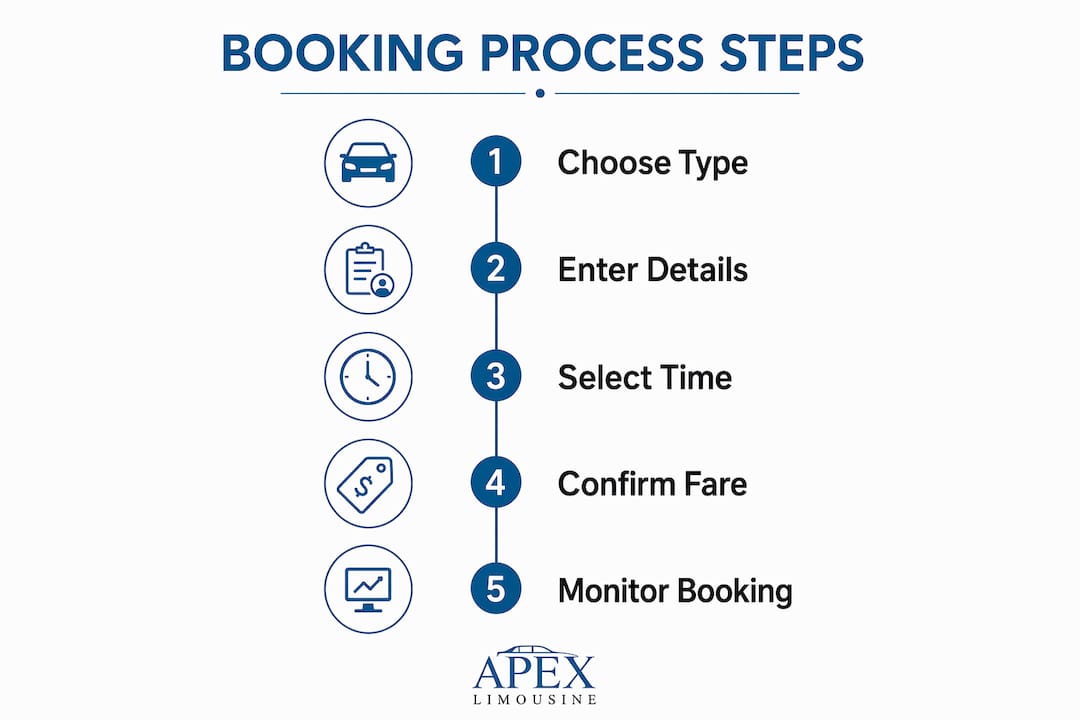
Step 4: Confirm your fare and receive written confirmation. After entering your details, the platform calculates a fixed fare. Review it carefully before paying. Your written confirmation must include the pickup address, terminal, flight number, vehicle type, total fare with gratuity, and cancellation policy. Save this document. You will need it if anything changes.
Step 5: Monitor your booking and communicate changes. Most reputable services send reminders before your trip. If your flight changes, update your booking immediately. Services with flight tracking handle minor delays automatically, but a flight number change or rebooking requires you to contact the provider directly.
Pro Tip: Book standard transfers at least 24–48 hours in advance. For peak travel periods or special vehicle requirements, book 3–7 days ahead to guarantee availability.
What details must you provide when booking to avoid delays?
Accuracy in your booking details is the single biggest factor in whether your transfer goes smoothly. Vague or incomplete information leads to wrong vehicles, missed pickups, and unexpected charges.
The six details every booking requires:
- Flight number. This is not optional. The service uses your flight number to track your arrival and adjust pickup timing. Without it, the driver has no way to monitor delays or early landings.
- Correct terminal. Large airports have multiple terminals, and wrong terminal information causes missed pickups. Confirm your terminal at the time of booking, then verify it again 24 hours before travel.
- Passenger count. The number of passengers determines the vehicle size. Arriving with more people than listed can mean your driver shows up in a vehicle that physically cannot fit your group.
- Luggage count. Bags take up space. A sedan holds two standard suitcases. An SUV holds four or more. Underreporting luggage leads to the same problem as underreporting passengers.
- Exact pickup and drop-off addresses. Street-level addresses with building names or hotel names prevent confusion. "Downtown Austin" is not an address. "701 Brazos Street, Austin, TX 78701" is.
- Your contact phone number. Your driver needs a way to reach you if you are delayed in customs or if the pickup location has changed.
Pro Tip: Always demand a fixed all-inclusive price in writing before confirming your booking. This protects you from surprise fees for tolls, parking, and waiting time that some services add after the fact.
A common mistake is assuming the service already knows your terminal because you provided a flight number. That assumption is wrong. Specifying the terminal separately is the only way to guarantee your driver waits in the right location.
How does flight tracking improve your airport transfer experience?
Flight tracking is a standard feature in professional airport transfer services. It uses live airline and airport data feeds to continuously update driver dispatch and arrival times in real time. The result is a pickup that adjusts to your actual landing, not your scheduled one.
Without flight tracking, a driver dispatched for a 2:00 PM landing arrives at 2:00 PM regardless of whether your flight lands at 1:40 PM or 3:15 PM. With flight tracking, the system detects the change and adjusts driver arrival automatically without any phone call from you. That single feature eliminates the most stressful part of airport pickups.
| Scenario | Manual coordination | Flight tracking |
|---|---|---|
| Flight lands 30 minutes early | Driver may not be there yet | Driver arrival adjusted automatically |
| Flight delayed 90 minutes | Traveler must call provider | System updates dispatch in real time |
| Gate change at same terminal | No adjustment possible | Driver notified through live data feed |
| Missed connection, new flight | Traveler must rebook manually | Traveler contacts provider to update flight number |
The table above shows where manual coordination breaks down. Flight tracking handles the first three scenarios without any action from you. The fourth scenario, a full rebooking, still requires a direct call because the flight number itself changes. Knowing this distinction saves you from assuming the system covers everything.
For executive airport transfers, flight tracking is not a luxury feature. It is a baseline expectation. Any service that cannot confirm it offers real-time flight monitoring is relying on manual coordination, which puts the burden back on you.
What variations and optional features should you know about?
Airport transfer services offer more options than most travelers realize. Choosing the right combination of features at booking time prevents surprises at the airport.
Pickup style: Meet & Greet vs. curbside. Meet & Greet service places your driver inside the terminal, often at the arrivals gate with a name sign. This is the right choice for families with children, first-time visitors to a city, and travelers who are unfamiliar with the airport layout. Curbside pickup costs less but requires you to find the correct pickup zone, which varies by airport and can be a significant walk from baggage claim.
Private vs. shared transfers. Private transfers dedicate the vehicle entirely to your party. You go directly to your destination with no stops. Shared shuttles combine multiple passengers heading in the same general direction. Shared options cost less but add 20–45 minutes to your travel time depending on the route.
Vehicle class options:
- Sedan: Best for 1–2 passengers with standard luggage. Clean, efficient, and the most common choice for solo business travelers.
- SUV: Handles 3–4 passengers with full luggage sets. The right choice for families or travelers with oversized bags.
- Minivan or van: Accommodates groups of 5–7 passengers. Ideal for corporate teams or large families traveling together.
- Executive or luxury vehicle: Adds premium interior features and is the standard for corporate clients and special occasions.
Special requirements. Accessibility needs, child car seats, and pet transport all require advance notice at booking. These are not add-ons you can request at the curb. Providers need time to prepare the right vehicle configuration.
Cancellation policies and fare transparency. Pre-booking through a verified platform gives you documented receipts, clear cancellation terms, and a confirmed fare. Street-hail options offer none of these protections. Always read the cancellation window before confirming. Most services offer free cancellation up to 24 hours before pickup, but peak-season bookings often have stricter terms.
Timing for peak travel seasons. Holiday weekends, major events, and summer travel periods reduce vehicle availability fast. Booking 3–7 days in advance during these windows is not overcautious. It is the only way to guarantee the vehicle class you need.
Key Takeaways
The airport transfer booking process works best when you provide accurate details, book in advance, and confirm flight tracking and fare transparency in writing before your trip.
| Point | Details |
|---|---|
| Book early | Standard transfers need 24–48 hours notice; peak periods require 3–7 days. |
| Provide six key details | Flight number, terminal, passenger count, luggage count, addresses, and contact number are all required. |
| Confirm terminal separately | Large airports have multiple terminals; always specify yours to avoid missed pickups. |
| Verify flight tracking | Choose a provider that adjusts driver arrival automatically for delays and early landings. |
| Get the fare in writing | A fixed all-inclusive price prevents surprise charges for tolls, parking, and waiting time. |
What I have learned from watching travelers get this wrong
Most travelers treat airport transfer booking like ordering a pizza. They fill in the basics, hit confirm, and assume everything will work out. The ones who end up stranded at baggage claim are almost always the ones who skipped a detail they thought was minor.
The terminal field is the most underestimated part of the booking form. I have seen travelers provide a perfect flight number and still get a missed pickup because they left the terminal blank or entered the wrong one. At a major hub like Dallas/Fort Worth or Chicago O'Hare, the wrong terminal puts your driver a 20-minute shuttle ride away from where you are standing. That gap costs you the pickup.
The second thing I tell every traveler is to ask one direct question before confirming any booking: "Does your service use real-time flight tracking?" If the answer is vague or the agent pivots to something else, that is your answer. Manual coordination means you carry the burden of communicating every delay. Real-time flight tracking technology means the system does that work for you.
My last piece of advice is about vehicle selection. Travelers consistently underestimate their luggage. They book a sedan for two people and then remember they each checked two bags. The math does not work. Count your bags before you book, not after.
— Jason
APEX LIMO makes airport transfer booking straightforward
Travelers who want a reliable, professionally managed transfer in Austin do not need to piece together the process on their own. APEX LIMO handles every stage, from real-time flight tracking to confirmed fixed pricing, so you arrive without stress.

APEX LIMO's executive chauffeur service covers Austin-area airport transfers with trained chauffeurs who know Austin-Bergstrom International Airport's terminals, traffic patterns, and peak-hour routes. For groups or travelers with full luggage sets, the luxury SUV fleet accommodates up to six passengers with room for bags. Pricing is fixed and confirmed in writing before your trip. Booking takes minutes online, and your confirmation includes every detail the process requires.
FAQ
How far in advance should I book an airport transfer?
Book standard airport transfers at least 24–48 hours before your trip. During peak travel seasons or when you need a specialty vehicle, book 3–7 days in advance to guarantee availability.
What happens if my flight is delayed?
Services with real-time flight tracking adjust your driver's arrival automatically when your flight is delayed or lands early. If your flight number changes entirely due to a rebooking, contact your provider directly to update the reservation.
What is the difference between Meet & Greet and curbside pickup?
Meet & Greet places your driver inside the terminal with a name sign, which is ideal for families and first-time visitors. Curbside pickup requires you to find the designated pickup zone outside the terminal on your own.
Why do I need to specify my terminal if I already gave my flight number?
Flight numbers confirm your airline and route, but large airports have multiple terminals that different airlines use. Specifying your terminal separately is the only way to guarantee your driver waits in the correct location.
Is a fixed price better than a metered fare for airport transfers?
A fixed all-inclusive price protects you from unexpected charges for tolls, parking, and waiting time. Always confirm the total fare in writing before your booking is complete.