

Airport transfer services are defined as pre-arranged or on-demand transportation between an airport and a traveler's destination, covering everything from shared shuttles to private chauffeur vehicles. When you compare airport transfer service options, the decision comes down to four factors: cost, reliability, convenience, and the friction involved in getting from the terminal to your final stop. Fixed pricing, meet-and-greet protocols, and flight tracking are the features that separate a stress-free arrival from a costly scramble. This guide gives you a clear framework to evaluate every major transfer type and choose the one that fits your trip.
What are the main types of airport transfer services?
Five distinct categories cover the airport transfer market, and each one serves a different traveler profile.
Private pre-booked chauffeur transfers offer a fixed quote, a named driver waiting at arrivals, and flight tracking built into the booking. Private chauffeur services cost 20–40% more than standard taxis but eliminate surge pricing risk entirely. For travelers arriving late at night or with a tight connection, that price premium often pays for itself.

Metered and fixed-rate taxis work well for solo travelers on predictable routes. Paris CDG charges a fixed fare of €56 to central Paris; Rome FCO fixes at €55. Outside major European capitals and Scandinavian cities, card payment acceptance is inconsistent, and late-night availability drops sharply.
Rideshare apps offer the lowest base fares in many US metro areas, but pricing is variable. During peak demand or bad weather, surge pricing can multiply fares by 2–3x, often pushing the total above what a pre-booked chauffeur would have charged. Scheduled rideshare options reduce but do not eliminate that risk.
Shared shuttles split the cost across multiple passengers, making them one of the cheapest airport shuttle options available. The trade-off is time: shared routes involve multiple stops, and your drop-off comes last if you are the furthest passenger.
Public transport carries the lowest fare, typically $4–$17.50 depending on the city, but it also carries the highest friction for anyone with heavy luggage, children, or an unfamiliar route.
| Transfer type | Typical price range | Fixed pricing | Meet and greet | Surge risk |
|---|---|---|---|---|
| Private chauffeur | $75–$120+ | Yes | Yes | None |
| Metered taxi | $45–$100 | Varies by city | No | Low |
| Rideshare app | $38–$95+ | No | No | High |
| Shared shuttle | $15–$35 | Yes | No | None |
| Public transport | $4–$18 | Yes | No | None |
How to compare airport transfer services for your specific needs
The right transfer type changes based on four variables: your arrival time, your luggage volume, your group size, and how far your destination sits from the airport.
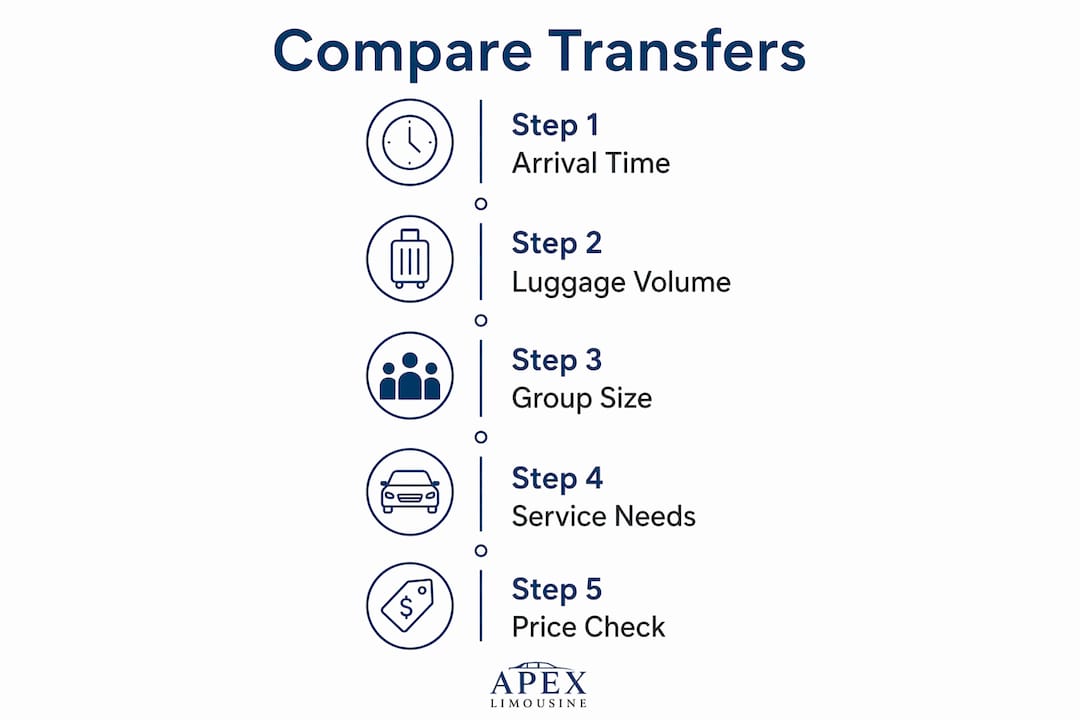
Arrival time is the most underrated factor. A daytime arrival at a major hub gives you access to every option. A 1:00 AM landing narrows the field fast. Taxis thin out, rideshare surge pricing spikes, and public transport may have stopped running entirely. Fixed-price pre-booked transfers are the only category that performs consistently at any hour.
Luggage volume eliminates public transport for most travelers faster than price does. Dragging two checked bags through three train connections is a physical cost that rarely shows up in fare comparisons. Travelers often underrate the time and effort of intermodal connections, which can offset the cheaper base fare of multimodal transit entirely.
Group size shifts the math on private transfers. A family of four paying $90 for a private vehicle splits to $22.50 per person, which undercuts a shared shuttle once you add luggage fees and waiting time.
- Calculate your group cost per person, not the total fare. Private transfers often win at three or more passengers.
- Check your arrival time against local transport schedules. Confirm whether trains or buses run at your landing time.
- Measure the full door-to-door distance, including any walk from a train station to your hotel.
- Confirm your luggage count before ruling out public transport or choosing a vehicle class.
- Ask whether your destination is central or suburban. Taxis and rideshares struggle with non-central drop-offs where demand is low.
Pro Tip: Price the "cost of failure" before you book the cheapest option. If a no-show or surge event forces you into a last-minute taxi at 2:00 AM, the extra cost can exceed what a pre-booked fixed-rate service would have charged for the entire trip.
How do you research and book the best airport transfer?
Booking the right transfer starts with collecting comparable quotes across categories, not just picking the first result.
Start by pulling quotes from at least two transfer categories for your specific route and arrival time. Pre-booked fixed-rate services eliminate surge pricing risk and add predictability that rideshare scheduled options cannot match. Aggregator platforms let you compare multiple providers side by side, but always cross-check the final price on the provider's own site to confirm no fees were omitted.
Reading reviews requires a specific filter. Look for comments about on-time pickup, driver communication, and what happened when a flight was delayed. A service with a 4.9/5 Trustpilot rating built on those specifics tells you far more than a generic five-star score. Avoid services where most reviews mention only the vehicle rather than the driver's behavior.
Timing your booking matters. Prices for pre-booked transfers are typically stable regardless of when you book, but rideshare and taxi availability tightens during major events or holidays. Book private transfers at least 24 hours in advance. For peak travel periods, 48–72 hours is safer.
| Booking approach | Price stability | Surge risk | Meet and greet | Flight tracking |
|---|---|---|---|---|
| Pre-booked private transfer | High | None | Yes | Yes |
| Aggregator platform | Medium | Varies | Varies | Varies |
| Rideshare app (scheduled) | Low | Yes | No | No |
| Airport taxi rank | Medium | Low | No | No |
Confirm three things before finalizing any booking: the exact pickup location inside the terminal, the waiting time policy if your flight is delayed, and the cancellation terms. Private airport transfers typically include 60 minutes of complimentary waiting after landing to cover luggage claim and immigration delays. That waiting window acts as built-in insurance against the unpredictable parts of any arrival.
Common mistakes travelers make when choosing airport transfers
The most expensive mistake is selecting the cheapest base fare without accounting for the full trip cost.
- Ignoring last-mile costs. A train fare of $10 sounds cheap until you need a $25 taxi from the station to your hotel. Last-mile connections frequently close the price gap between public transport and private transfers.
- Underestimating surge pricing. Rideshare fares during peak demand or adverse weather can reach 2–3x the base rate, sometimes exceeding the cost of a pre-booked chauffeur.
- Overlooking meet-and-greet policies. Without a named driver at arrivals, you navigate an unfamiliar airport alone with luggage. This friction is invisible in a price comparison but very real on arrival.
- Choosing the wrong vehicle size. A standard sedan booked for four passengers with four large suitcases creates a problem at the curb. Confirm vehicle capacity before you pay.
- Not verifying the pickup point. Large airports have multiple terminals and separate rideshare pickup zones, often a 10-minute walk from baggage claim.
Pro Tip: Always identify a backup transfer option before you travel. Know the taxi rank location and have a rideshare app installed even if you have a pre-booked transfer. One cancellation at midnight without a plan B is a situation worth avoiding entirely.
How does your traveler profile affect the best transfer choice?
Your travel circumstances define which transfer type delivers the best value, not the price tag alone.
- Solo traveler, light luggage, daytime arrival. A rideshare app or metered taxi covers this scenario well. Base fares are low, surge risk is minimal during off-peak hours, and the flexibility suits a single passenger.
- Family or group with heavy luggage. A private transfer for groups is the practical choice. The per-person cost drops with group size, and a larger vehicle handles luggage without the stress of multiple taxi trips.
- Business traveler with a tight schedule. Fixed pricing and airport transfer reliability are non-negotiable. A no-show or surge event can derail a morning meeting. Pre-booked chauffeur services with flight tracking protect against that outcome.
- Budget traveler with flexible timing. Public transport or a shared shuttle fits if your arrival is daytime, your luggage is light, and your destination is near a transit hub. Factor in the full door-to-door time before committing.
- Late-night arrival in an unfamiliar city. Pre-booked private transfer is the only category that guarantees a driver is waiting regardless of the hour. The meet-and-greet service removes navigation stress at the worst possible time.
Key Takeaways
The most reliable airport transfer choice balances fixed pricing, meet-and-greet service, and flight tracking against your group size, arrival time, and full door-to-door cost.
| Point | Details |
|---|---|
| Fixed pricing eliminates surprise costs | Pre-booked private transfers lock in your fare regardless of traffic or demand spikes. |
| Surge pricing changes the math | Rideshare fares at peak times can exceed a pre-booked chauffeur's fixed rate. |
| Last-mile costs are often hidden | A cheap train fare can become expensive once you add a taxi from the station to your hotel. |
| Group size favors private transfers | Four passengers splitting one private vehicle often pay less per person than a shared shuttle. |
| Backup plans prevent worst-case scenarios | Always know the taxi rank location and have a rideshare app ready as a contingency. |
What I've learned from watching travelers get this wrong
Most travelers approach airport transfers the same way they shop for flights: they sort by price and pick the lowest number. That works for flights because the product is standardized. It fails for transfers because the variables are not.
The travelers I see struggle most are the ones who booked a rideshare for a 1:00 AM arrival during a major event weekend. The app shows a reasonable estimate at booking time. By the time they land, clear customs, and collect luggage, surge pricing has tripled the fare. They pay it because there is no alternative at that hour. A pre-booked fixed-rate transfer would have cost less and included a driver holding a sign at arrivals.
The second pattern is the public transport optimist. The math looks great on paper: $8 train versus $70 private car. Then the train runs every 30 minutes, the last connection requires a $30 taxi, and the whole trip takes 90 minutes with two heavy bags. The "savings" evaporated, and the experience was exhausting.
My honest advice: price the full trip, not the first leg. Include waiting time, connection costs, and the realistic cost of a plan B if something goes wrong. Fixed-price, meet-and-greet transfers are not a luxury for most travelers. They are the option that removes the most risk for a predictable price. Budget travelers can still use public transport wisely, but only after doing the full math, not just the headline fare.
— Jason
APEX LIMO's airport transfer service in Austin
Travelers arriving at Austin-Bergstrom International Airport have a clear option for stress-free ground transportation with APEX LIMO.

APEX LIMO provides fixed-rate executive airport transfers with flight tracking and professional meet-and-greet service included on every booking. Vehicles range from executive sedans to larger options suited for groups and corporate teams. There are no surge pricing surprises, and the chauffeur monitors your flight in real time so the pickup adjusts automatically to your actual landing time. For business travelers, families, and anyone arriving late at night in Austin, APEX LIMO delivers the predictability that other transfer categories cannot. Book directly at austinapex.com to confirm your rate and vehicle before you travel.
FAQ
What is the cheapest airport transfer option?
Public transport carries the lowest base fare, typically $4–$18 depending on the city, but last-mile taxi connections often close the price gap with private transfers. Shared shuttles are the next most affordable option with fixed pricing and no surge risk.
How does surge pricing affect rideshare airport transfers?
During peak demand or bad weather, rideshare fares can increase 2–3x the base rate, sometimes exceeding the cost of a pre-booked private chauffeur. Scheduling a rideshare in advance reduces but does not eliminate that risk.
What does meet-and-greet mean for airport transfers?
Meet-and-greet means a named driver waits for you at the arrivals hall with a sign, handles your luggage, and guides you directly to the vehicle. Private chauffeur services include this as standard; taxis and rideshares do not.
How far in advance should I book an airport transfer?
Book pre-booked private transfers at least 24 hours ahead, and 48–72 hours before any peak travel period or major local event. Rideshare and taxi options can be arranged on arrival, but availability and pricing are less predictable.
Are private airport transfers worth the extra cost?
For late-night arrivals, groups, or business travelers, the fixed pricing, waiting time allowance, and flight tracking built into private transfers deliver value that offsets the higher base fare. For solo daytime travelers with light luggage, a taxi or rideshare often covers the need at lower cost.