

If your limo runs past the contracted end time, you'll pay overtime, typically billed in 15, 30, or 60 minute increments at your hourly rate, sometimes at 1.5 times that rate. Say you booked a typical stretch limo for a few hours and your event runs late. Under common 30 minute increment policies, the overage rounds up to the next half-hour block, charged proportionally based on the hourly rate. Operators using 15-minute increments will bill differently, potentially resulting in a lower or similar charge.
A few things decide your final bill:
- Whether overtime starts the instant you pass your end time or after a grace period
- The billing increment your contract specifies
- Whether the rate stays flat or jumps to 1.5×
- Whether you've already hit your minimum booked hours (a separate issue from overtime)
Overtime kicks in immediately once your booked hours end, according to guidance from the Limo price guide, and many companies bill it in 15 or 30 minute chunks at the same hourly rate you already agreed to. Before you book anything, get the overtime rate, increment, and grace period in writing.
Key Takeaways
Overtime charges depend on three variables you control before booking: the billing increment, the overtime rate, and how much buffer time you add to your reservation.
| Point | Details |
|---|---|
| Overtime starts at your booked end time | Charges typically begin the moment your contracted hours expire, sometimes after a short grace period. |
| Increment size changes your risk | A 30 or 60 minute increment can round a small overage into a full extra charge block. |
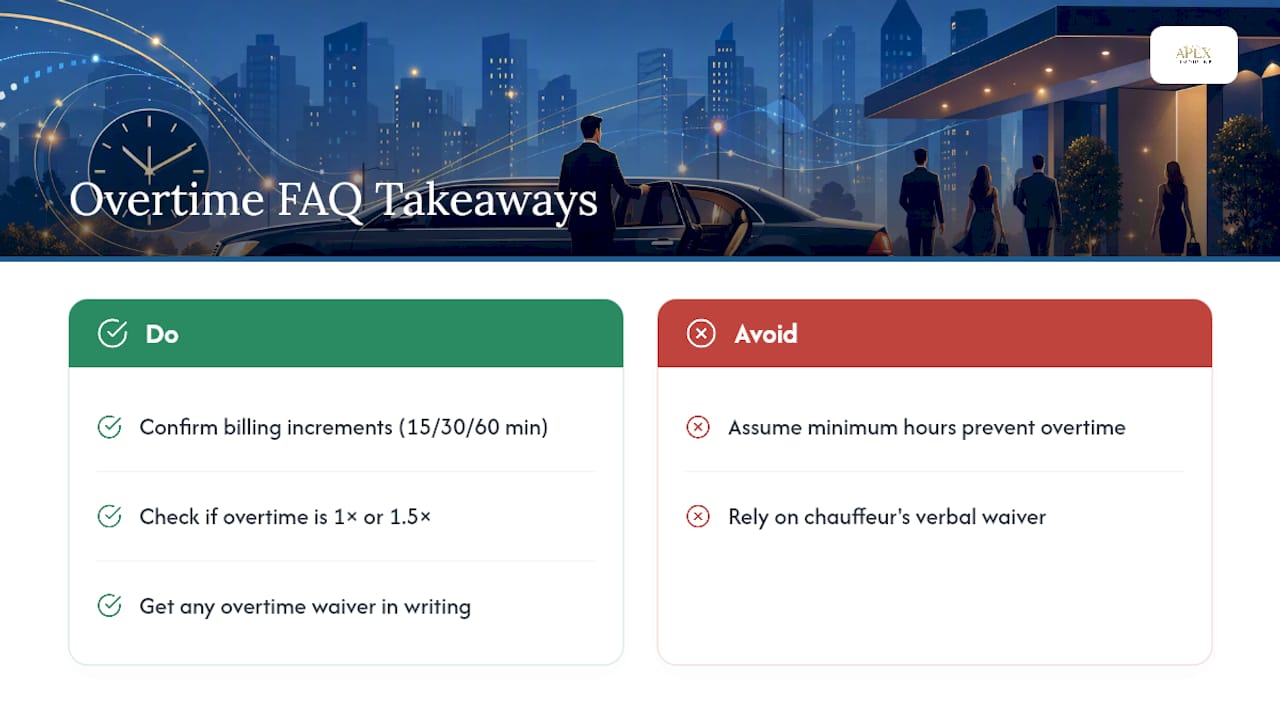
| Minimums don't prevent overtime | Meeting your minimum booked hours has no bearing on overtime once you exceed your end time. |
| Get terms in writing | A written quote should list the overtime rate, increment, grace period, and included fees. |
| APEX LIMO provides written rate clarity | Its Austin bookings include a documented overtime rate, increment, and authorization process before the event. |
Table of Contents
- How Overtime Charges for Limo Rentals Are Calculated
- Billing Increments, Overtime Rates, and Minimum Hours
- When Limos Commonly Run Into Overtime
- How to Avoid Surprise Overtime Charges
- Contract Terms to Verify Before You Book
- What a Reputable Operator's Overtime Policy Looks Like
- Why the "Just Ask for a Flat Rate" Advice Misses the Point
- Book Austin Transportation With Overtime Terms in Writing
- Frequently Asked Questions
- Sources
How Overtime Charges for Limo Rentals Are Calculated
Most limo contracts calculate overtime by dividing the hourly rate by the billing increment, then multiplying by the number of increments over. Rounding rules affect costs and can cause surprises. For example, a 40 minute overage rounded in 15 or 30 minute increments will lead to different total charges based on the hourly rate and increment size.
That last example is the one that catches people off guard. A 30 minute increment policy can turn a modest overage into a full hour's payment, since operators round up rather than down. Some companies build in a five or ten minute grace period before the clock starts; others start billing the second your booked time expires. The Limo price guide notes that wait time and increment rules vary enough between operators that the same overage can cost drastically different amounts depending on who you booked with. Always ask whether your grace period is written into the contract or just a verbal promise from the sales rep.
Billing Increments, Overtime Rates, and Minimum Hours
Increment size alone changes your exposure to overtime costs. A 15 minute increment structure caps your worst-case overage cost at a quarter-hour rate; a 60 minute increment structure can round a 5 minute overage into a full extra hour.
- 15 minute increments: Lowest risk per overage, common for wedding and prom bookings.
- 30 minute increments: Middle ground, used widely across the industry, including on operator policy pages like Santos Limousine, which bills weddings in half-hour blocks but other services in full-hour blocks.
- 60 minute increments: Highest risk per overage, more common for corporate or point-to-point charters.
Operators sometimes charge overtime at 1.5 times the base hourly rate rather than the flat rate, especially during peak demand windows like prom season or New Year's Eve, when every extra hour of vehicle time has a real opportunity cost for the fleet.
Minimum booking hours are a separate mechanism from overtime. You can satisfy a four-hour minimum and still owe overtime the moment you cross your booked end time, as pricing guides for hourly limo rentals point out. Meeting the minimum doesn't buy you any cushion on the back end. Layer in gratuity (typically a percentage added automatically), fuel surcharges, tolls, and parking fees, and the base hourly rate you were quoted often understates your real total cost.

When Limos Commonly Run Into Overtime
A few scenarios account for most overtime charges, and none of them are exotic:
- Airport pickups where baggage claim drags on or a flight lands late. Delays here rarely feel like your fault, but the clock usually still runs.
- Weddings, proms, and concerts that simply run past schedule, toasts stretch, sets get extended, photos take longer than planned.
- Extra stops added on the fly, plus wait time for a passenger who isn't ready when the car arrives.
- Traffic and accidents that eat into your booked hours without adding any extra time to your contract.
Pro Tip: Wait time often gets billed separately from overtime, and past a certain threshold, usually around 15 minutes, some operators convert your entire point-to-point quote into hourly billing. Ask specifically how your contract treats waiting versus overtime, since the two can produce very different final numbers for the same delay.
How to Avoid Surprise Overtime Charges
Most overtime surprises are preventable with a little planning before you sign anything.
- Round your time estimate up, not down. If you think the event runs four hours, book four and a half. The cost of extra buffer time booked in advance is almost always lower than paying overtime rates after the fact.
- Request a written quote that itemizes the overtime rate, the billing increment, the grace period, and exactly which fees are included versus billed separately.
- Ask who can authorize extra time on the day of the event and how that authorization gets recorded, verbally to the chauffeur, by text, or through a formal add-on charge.
- Track your flight if you're arranging an airport pickup, and confirm your pickup window in writing rather than relying on a rough estimate. A practical guide on tracking flight delays for limo pickups covers this in more detail, and general advice on managing airport delay scenarios applies just as well to limo pickups as it does to taxis.
- Pre-book standby hours if your event carries real overrun risk. Paying for an extra 30 to 60 minutes up front is usually cheaper than paying overtime rates after the fact, and it guarantees the vehicle stays available.
Pro Tip: A lower quoted hourly rate can end up costing more overall once minimums, overtime rules, and add-on fees are factored in, so compare total projected cost, not just the base rate, before you book.
Contract Terms to Verify Before You Book
Before you sign anything, confirm these items in writing:
- Overtime rate (same as base rate, or 1.5×)
- Billing increment (15, 30, or 60 minutes)
- Grace period, if any, before overtime charges start
- Minimum booked hours and how that interacts with overtime
- Which fees are included (gratuity, fuel surcharge, tolls, parking) and which are billed separately
- Payment method for overtime (cash to the chauffeur, card on file, invoiced after the trip)
- Who is authorized to approve additional time on the day of your event
Ask these questions directly, in an email or text you can keep for your records:
- "What's your overtime rate, and is it billed in 15, 30, or 60 minute blocks?"
- "Is there a grace period before overtime charges kick in?"
- "If we run long, who can authorize the extra time, and how will I be charged?"
A solid contract spells out the overtime rate, the increment, and who's authorized to approve extra time, and that clarity protects you as much as it protects the operator. If a company tells you the chauffeur can simply "waive" overtime on the spot, get that policy in writing too, verbal promises don't hold up when a bill shows up different from what you expected. Some operators require overtime to be paid in cash to the chauffeur that night; others pre-authorize a card on file and settle after the trip. Either way, request a final itemized receipt so you have something concrete if a charge needs disputing.
What a Reputable Operator's Overtime Policy Looks Like
A reputable limo operator puts the overtime rate, the billing increment, the grace period, and the authorization process in a single document you receive before your event, not something you're told about for the first time when the meter runs long.
APEX LIMO structures its Austin bookings around exactly that kind of clarity:
- A written rate sheet showing the hourly rate, overtime rate, and increment before you book
- A defined process for who can approve extra time on-site
- Chauffeurs trained to communicate timing issues proactively rather than let a bill escalate silently
- An itemized final receipt after every trip
For example, if a wedding is booked for several hours with a 30 minute overtime increment and the reception runs slightly past the contracted end time, the overage rounds up to the next half-hour block charged at the hourly rate, resulting in an additional charge calculated proportionally. Keep your contract and request that itemized receipt before the chauffeur leaves. It's the easiest way to confirm the math matches what you agreed to.
Why the "Just Ask for a Flat Rate" Advice Misses the Point
The common advice you'll find elsewhere is to simply ask for a flat rate and avoid hourly billing altogether. That's incomplete. Flat rates for point-to-point trips still convert to hourly billing the moment your itinerary changes, a late flight, an extra stop, a passenger who isn't ready. The real fix isn't avoiding hourly structures. It's understanding exactly how your specific operator rounds, when their clock starts, and who can authorize an extension.
What gets underestimated is how much the billing increment alone changes your financial exposure. Two operators quoting the identical hourly rate can produce wildly different overtime bills for the same 20 minute delay, purely because one rounds in 15 minute blocks and the other in 60. Renters compare hourly rates side by side and assume that's the whole picture. It rarely is.
If you take one thing from this, prioritize getting the increment and grace period in writing before you compare a single dollar figure between quotes. The rate matters less than the rounding rules attached to it.
Book Austin Transportation With Overtime Terms in Writing
APEX LIMO puts its overtime rate, billing increment, and grace period in writing before you book, so you're comparing real numbers instead of guessing at fine print. For weddings, proms, and corporate events across Austin, that clarity means no chauffeur improvising a cash charge at 11 p.m. because the reception ran long. Whether you need a stretch limousine for a wedding party or a Chrysler 300 for a smaller group, every quote spells out exactly what happens if your event runs past its scheduled end time. Request a written quote for your event date and confirm the overtime terms before you commit, it takes a few minutes and it's the single best way to protect your budget.
Frequently Asked Questions
What are overtime charges on a limo rental? Overtime charges are fees billed once you exceed your contracted rental end time, typically calculated in 15, 30, or 60 minute increments at your hourly rate or a higher multiplier.
How much are limo overtime fees usually? It depends on your hourly rate and increment size. A $150/hour limo billing in 30 minute blocks would charge $75 for any overage rounded up to that half-hour mark, even a 5 minute delay.
Is limo overtime billed at a higher rate than the base hourly rate? Sometimes. Many operators bill overtime at the same hourly rate you already agreed to, while others charge 1.5 times that rate, particularly during high-demand periods.
Does hitting my minimum booked hours protect me from overtime? No. Minimum hours and overtime are separate contract terms. You can meet your minimum and still owe overtime the moment you exceed your booked end time.
Can a chauffeur waive overtime charges on the spot? Get any waiver in writing. Verbal assurances from a chauffeur don't override the payment terms in your signed contract, and disputes are easier to resolve with documentation.
Sources
Cross-check any quote against a general industry limo price guide and a breakdown of contract, insurance, and fee basics. Operator terms vary, so read the actual contract excerpt an operator sends you rather than assuming standard industry practice applies.
- Limos
- Limousine service basics: contracts, insurance, and fees — Grand Limousine
- Chicago hourly limo rental cost guide (2026 rates) — All Star Limo Service