

What is a corporate transportation RFP?
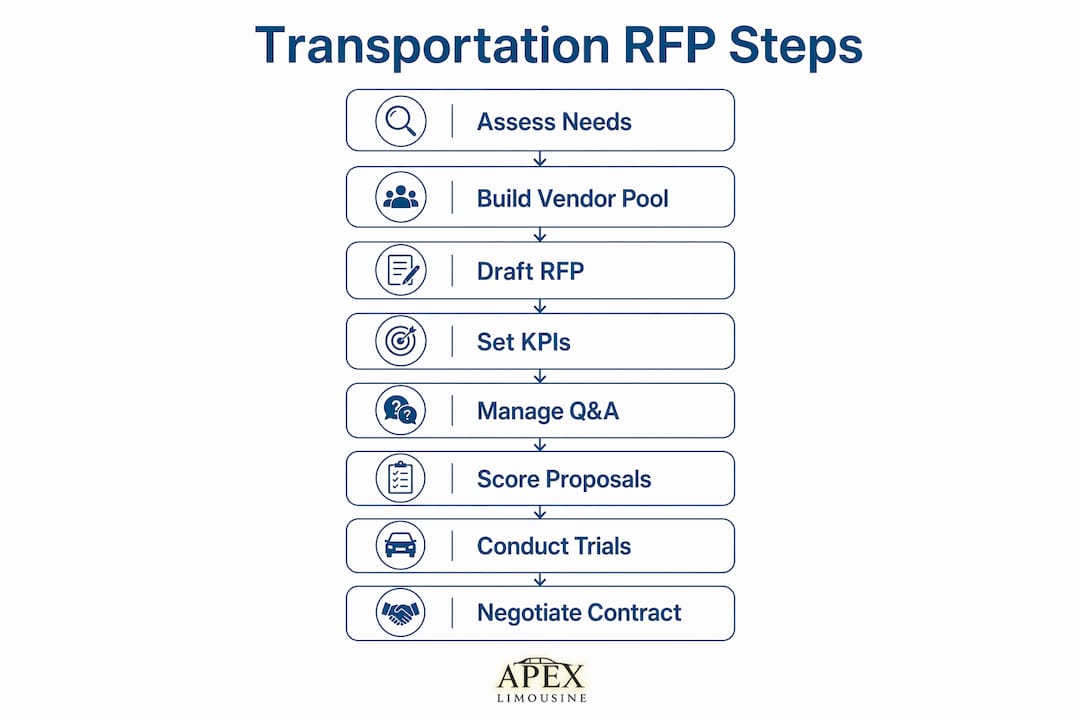
A corporate transportation RFP, or request for proposal, is a formal procurement document companies send to ground transportation vendors to solicit competitive, standardized proposals covering pricing, service levels, technology, compliance, and operational capabilities. It is not a price sheet request. It is a structured process that forces vendors to show their full hand.
Understanding where an RFP fits among related procurement tools matters. An RFI (request for information) collects general market data. An RFQ (request for quotation) asks for pricing on a defined scope only. An RFP combines both: it defines the scope, requests pricing, and asks vendors to explain exactly how they will deliver the service. Most corporate transportation procurements use the RFP format because price alone rarely tells the whole story.
The typical RFP cycle spans several weeks, evaluating three to five vendors, with resulting contracts running one to three years. That contract duration is why getting the selection right matters so much. A poorly chosen vendor at year one becomes an operational headache by year two.
- RFI: Gathers vendor capability and market data, no pricing commitment
- RFQ: Requests pricing only on a clearly defined, narrow scope
- RFP: Combines scope definition, pricing, and a full service delivery proposal
- Contract duration: Corporate ground transportation contracts often span multiple years, reflecting a significant commitment for operational continuity.
- Vendor pool: A manageable number of vendors are evaluated per cycle to ensure a thorough assessment process.
The RFP standardizes vendor responses so procurement, finance, travel, and HR stakeholders can compare offers on consistent criteria rather than sorting through inconsistent sales pitches. That comparability is the whole point.
Key components every corporate transportation RFP must include
A well-built corporate transportation proposal covers seven core areas. Miss one and you will likely discover the gap in the form of an invoice dispute or a service failure six months into the contract.
- Scope of service and program objectives: Define the types of trips covered, geographic markets, passenger categories (executives, clients, employees), and any event or airport transfer requirements. Vague scope language is the single fastest path to scope creep.
- Fleet and vehicle requirements: Specify vehicle classes, minimum age of fleet, capacity requirements, and any accessibility or branding standards. A vendor with a mixed fleet of aging sedans is a different animal from one running late-model SUVs and sprinter vans.
- Pricing structure including accessorial charges: Request base rates, hourly rates, and a complete accessorial schedule covering wait time, cancellations, fuel surcharges, tolls, and after-hours fees. Accessorial charges are where unexpected costs hide.
- Insurance and compliance documentation: Require proof of commercial auto liability, general liability minimums, workers' compensation, and any duty-of-care certifications relevant to your industry. For executive travel, this is non-negotiable.
- Technology integration and booking platform capabilities: Ask vendors to describe their booking platform, mobile app, real-time tracking, and integration capabilities with travel management systems like Concur or Egencia. A vendor who cannot integrate with your existing stack creates manual work for your team.
- Service level agreements (SLAs) and performance metrics: Define on-time performance thresholds, response time for reservations, escalation procedures, and reporting cadence. Leaving SLAs vague means you have no contractual basis for holding a vendor accountable.
- Account management and reporting expectations: Specify dedicated account manager requirements, monthly reporting formats, and review meeting frequency. The quality of account management often determines whether a vendor relationship succeeds or quietly deteriorates.
How to prepare and issue a transportation RFP step by step
The process works best when you treat it as a project with defined phases, not a document you send and wait on. Each step builds on the last.
Step 1: Assess current needs and define objectives

Pull your last 12 months of transportation spend, trip volume, and any service complaints. Identify gaps between what you have and what the business actually needs. If you are planning corporate events or executive retreats, factor those specific use cases into your scope before writing a single word of the RFP.
Step 2: Build your vendor pool
Start with five to eight vendors. That range gives you competitive pricing and enough diversity to surface real differences in service capability. You will shortlist to three to four for detailed evaluation later, so the initial pool needs to be broad enough to make that cut meaningful.
Step 3: Draft the RFP document
Open with a welcome letter that explains your company, the program scope, and the evaluation timeline. Be specific about what you want vendors to submit and in what format. Ambiguity in the document produces ambiguity in the proposals, which makes your evaluation harder.
Step 4: Establish and communicate KPIs upfront
Communicating KPIs to vendors before they submit, including on-time definitions, reporting expectations, and service thresholds, reduces confusion and produces better proposals. Vendors who know exactly what they will be measured on can demonstrate how they meet those standards. Vendors left guessing fill the gaps with marketing language.
Step 5: Set the RFP timeline and stick to it
A realistic timeline looks like this:
- RFP issuance to vendors
- Vendor question period (typically 5–7 business days)
- Written responses to all questions distributed simultaneously
- Proposal submission deadline
- Internal scoring and shortlisting
- Finalist presentations or site visits
- Live trials with top two finalists
- Contract negotiation and award
Step 6: Manage vendor Q&A carefully
Collect all vendor questions in writing and distribute answers to every bidder at the same time. This keeps the process fair and prevents any single vendor from gaining an informational edge. It also creates a clean record if a vendor later disputes the scope.
Step 7: Score proposals with a weighted scorecard
Build your scorecard before proposals arrive, not after. Assign weights to each evaluation category based on what your organization actually prioritizes. If reliability is your top concern, weight it accordingly. A scorecard built after you read the proposals is not a scorecard; it is a rationalization.

Step 8: Conduct live trials before final selection
Run your two finalists through real trips before signing anything. Executive airport transfers, event pickups, and last-minute changes are all worth testing. A vendor who performs well on paper but struggles under real conditions will not improve once they have a contract.
Step 9: Negotiate and finalize the contract
Use the RFP responses as your negotiating baseline. Lock in the accessorial schedule, SLA thresholds, and performance penalty clauses in the contract itself. A handshake agreement on service quality is worth nothing when a vendor misses a pickup.
Pro Tip: Issue your RFP in response to a genuine business trigger, such as a contract renewal, a service quality problem, or a company relocation, rather than on a fixed calendar cycle. Premature RFP issuance wastes procurement resources when a contract amendment would solve the problem.
How to evaluate transportation RFP responses and select the right provider
Price is the easiest thing to compare. It is also the least predictive of whether a vendor will actually perform. Structured evaluation across seven criteria gives you a far more accurate picture.
The seven core evaluation criteria for corporate ground transportation vendors are:
- Reliability: On-time performance history and how the vendor defines and tracks it
- Fleet quality: Vehicle age, condition, classes available, and maintenance standards
- Technology: Booking platform, real-time tracking, reporting tools, and system integrations
- Geographic coverage: Network depth in your primary markets and affiliate coverage elsewhere
- Pricing transparency: Clear base rates, a complete accessorial schedule, and no hidden fees
- Insurance and compliance: Coverage levels, safety certifications, and duty-of-care documentation
- Account services: Dedicated account management, escalation procedures, and reporting quality
Build a weighted scorecard before proposals arrive and assign point values to each category based on your organization's priorities. A company with heavy executive travel will weight reliability and fleet quality higher. A company managing high-volume employee shuttles might weight technology and pricing transparency more heavily.
On-time performance deserves particular attention. The industry standard definition is arrival within 5 minutes of the scheduled pickup time. Any vendor consistently below a 95% on-time rate carries real operational risk, regardless of how competitive their pricing looks. A missed executive pickup costs far more than the difference between two rate cards.
Cultural alignment is harder to score but equally important. The right vendor acts as an extension of your company's brand. Their chauffeurs interact with your executives, clients, and guests. A vendor with excellent metrics but a transactional service mindset will eventually create friction that no SLA clause can fix.
Pro Tip: Share your evaluation criteria and scoring weights with vendors before they submit. Over-communicating the process produces better proposals and builds vendor trust in your procurement process, which pays off during contract negotiations.
Common pitfalls in corporate transportation RFPs and how to avoid them
Most RFP failures trace back to a handful of recurring mistakes. Knowing them in advance is the only reliable way to avoid them.
- Misaligned procurement and operational goals: Procurement teams focused on unit cost reduction sometimes select vendors that operations teams cannot actually work with day to day. Bring your travel managers, executive assistants, and operations staff into the evaluation process before a vendor is selected, not after.
- Ignoring cultural fit: A vendor who wins on price but treats every trip as a commodity transaction will underdeliver on executive and client-facing service. Ask finalists for references specifically from clients with similar service profiles, not just similar volumes.
- Ambiguous accessorial definitions: Leaving wait time, cancellation windows, and fuel surcharge triggers undefined in the RFP produces invoice variances and scope creep after award. Define every fee category explicitly, with dollar amounts or calculation methods, before vendors submit.
- Inadequate vendor communication: Vendors who receive an RFP with no Q&A period, no evaluation criteria, and no timeline feedback submit generic proposals. Generic proposals make your evaluation harder and your final selection less reliable.
- Premature RFP issuance: Not every service problem requires a full RFP. If your current contract has 18 months remaining and the issue is a single underperforming route, a contract amendment or a performance improvement plan may be the right tool. Launching a full RFP prematurely burns procurement resources and strains vendor relationships.
- No defined performance metrics post-award: Winning vendors who face no defined KPIs and no reporting requirements have little structural incentive to maintain the service levels they promised during the bid. Build your performance metrics into the contract, not just the RFP document.
Why a well-executed transportation RFP delivers more than cost savings
The RFP process is often framed as a cost-reduction exercise. That framing undersells it. A well-run corporate transport bidding process produces measurable financial results and operational improvements that a simple price negotiation cannot replicate.
Companies that conduct structured evaluations with weighted scorecards and defined KPIs save a significant portion on transportation costs and improve rider satisfaction metrics considerably. Those two outcomes together are what make the RFP worth the time investment. Cost savings without service quality improvement just shifts the problem.
The deeper value is in what the RFP forces you to do internally. Defining your scope, your KPIs, and your evaluation criteria requires your procurement, travel, and operations teams to agree on what success actually looks like. That alignment is often missing before the RFP process begins, and its absence is usually what causes post-award problems.
Vendor selection in corporate ground transportation is a partnership decision, not a commodity purchase. The provider you choose will interact with your executives, represent your brand to clients, and handle logistics for your highest-stakes events. For executive chauffeur service in markets like Austin, where corporate events and client hospitality drive significant ground transportation demand, the quality of that partnership shows up in every pickup.
APEX LIMO approaches corporate transportation with exactly this standard. Every chauffeur is trained to represent the client's brand, every vehicle is maintained to a consistent standard, and every trip is tracked against defined performance expectations. That is the kind of vendor profile a well-structured RFP is designed to surface.

When your organization is ready to evaluate ground transportation options for corporate travel, executive events, or client hospitality in Austin, request a quote from APEX LIMO and see how a provider built around accountability and service quality responds to your requirements.
Key Takeaways
A structured corporate transportation RFP consistently outperforms informal vendor selection on both cost and service quality when procurement and operational goals are aligned from the start.
| Point | Details |
|---|---|
| RFP vs. RFQ vs. RFI | An RFP combines scope, pricing, and service delivery proposals; an RFQ requests pricing only; an RFI gathers market data. |
| Contract duration | Corporate transportation contracts typically run one to three years, making vendor selection a long-term operational decision. |
| Vendor pool sizing | Start with five to eight vendors, shortlist to three to four, then run live trials with the top two finalists before awarding. |
| On-time performance threshold | Define "on-time" as arrival close to the scheduled pickup time; vendors with lower on-time performance carry measurable service risk. |
| Cost and satisfaction impact | Structured evaluations with weighted scorecards can lead to significant cost savings and improvements in rider satisfaction. |