

Commercial limo insurance is a for-hire livery policy, not standard commercial auto coverage, and carriers write it specifically for vehicles that transport paying passengers under a pre-arranged contract. If you're accepting money for rides, whether it's a wedding party or a corporate airport run, you need livery classification and typically a combined single limit of $1 million or more before you take your first paying passenger.
Two things to do this week:
- Confirm your vehicles are classified as for-hire livery with your state's regulatory body (PUC, DMV, or a city commission like the TLC), not personal or standard commercial auto.
- Gather your vehicle titles, driver records, and current mileage logs before you request quotes. Carriers move faster and quote more accurately with this paperwork in hand.
Key Takeaways
Commercial limo insurance requires a for-hire livery classification, coverage limits that often exceed personal auto minimums, and documented safety practices to get accurate, competitively priced quotes.
| Point | Details |
|---|---|
| Confirm livery classification first | A standard commercial auto or rideshare policy will not cover pre-arranged paid passenger transport. |
| Check state-specific minimums | States like Florida and Minnesota set their own limits, inspection rules, and filing requirements. |
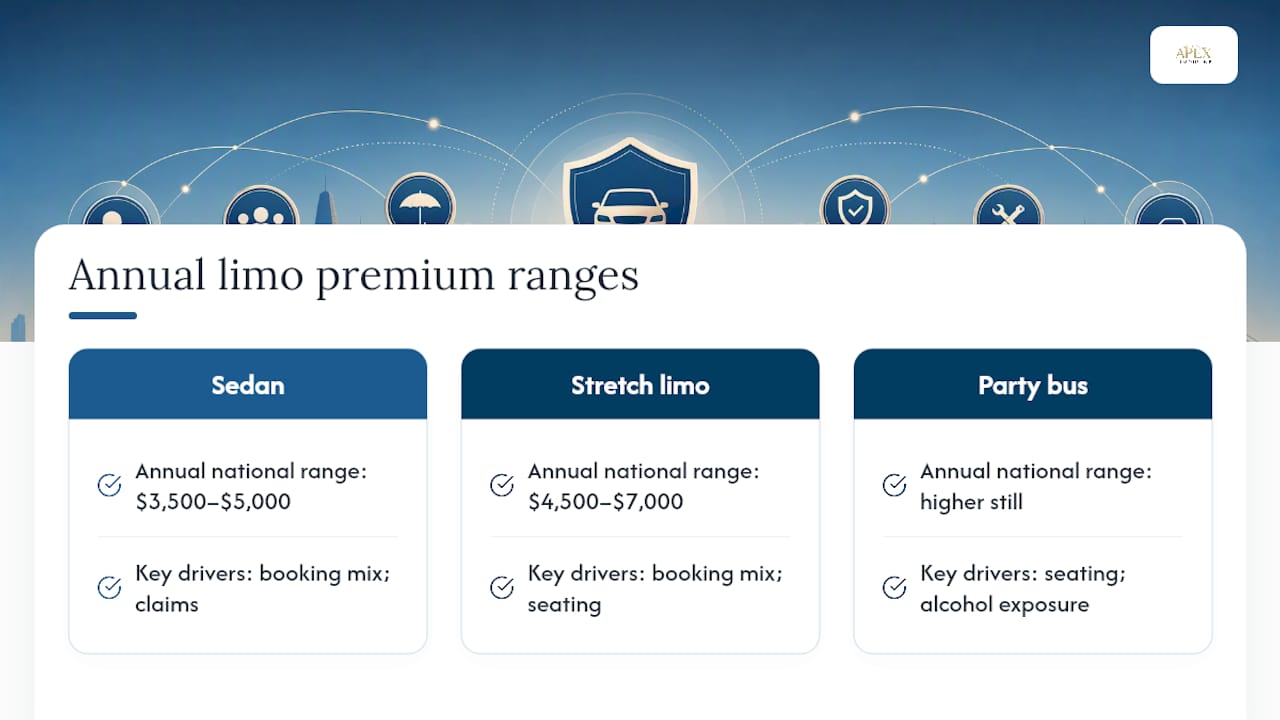
| Budget by vehicle type | Expect roughly $3,500 to $7,000 or more annually depending on whether you run sedans, stretch limos, or party buses. |
| Bring documentation to underwriting | VINs, driver MVRs, maintenance logs, and service mix percentages speed up accurate quotes. |
| Round out your coverage | General liability, workers' comp, and umbrella policies fill gaps a livery auto policy doesn't cover. |
Table of Contents
- What Coverage Does Commercial Limo Insurance Explained in Practice Actually Include?
- Do State Rules Change What Insurance You're Required to Carry?
- What Actually Drives the Cost of Limo Insurance?
- What Other Policies Should a Limo Business Carry?
- What Do Underwriters Actually Check Before They Quote a Limo Fleet?
- How Do You Get an Accurate Quote From an Agent or Carrier?
- What Mistakes Void Coverage or Spike Your Premium?
- What Do Experienced Limo Operators Say Actually Helps at Renewal?
- Ready to Book Reliable Transportation Backed by Real Standards?
- Frequently Asked Questions
- Sources
What Coverage Does Commercial Limo Insurance Explained in Practice Actually Include?
A livery policy bundles several coverages that, together, protect your vehicles, your passengers, and your business from the financial fallout of an accident. Progressive Commercial, one of the larger writers in this space, structures its livery insurance around a core set of protections built for paid passenger transport.
- Commercial auto liability: covers bodily injury and property damage you cause to others, usually written as a combined single limit.
- Passenger liability: specifically covers injuries to the people riding in your vehicle, separate from third-party liability.
- Physical damage (collision and comprehensive): repairs or replaces your vehicle after a crash, theft, or weather event.
- Uninsured/underinsured motorist: pays when the at-fault driver has no insurance or not enough.
- Medical payments: covers immediate medical costs for occupants regardless of fault.
- Hired and non-owned auto: protects you when you rent vehicles or use a subcontractor's car for overflow bookings.
- Umbrella/excess liability: adds a layer of protection above your primary limits, often required for large weddings or corporate contracts.
Watch for exclusions. Many policies exclude alcohol-related liability if you're serving drinks on board, and a standard rideshare endorsement won't cover pre-arranged livery work at all. Stretch limousines and custom conversions sometimes carry separate wording requirements, which is why Progressive maintains a dedicated black car and limousine product instead of folding it into generic commercial auto.
Do State Rules Change What Insurance You're Required to Carry?
Yes, and the differences are bigger than most new operators expect. Some states set statutory minimums well above what a typical commercial auto policy requires, and several add filing obligations on top.
- Florida allows for-hire passenger vehicle operators to prove financial responsibility through several paths, including minimum limits such as $125,000/250,000/50,000 for certain operators, with audited financial statements as an alternative for large fleets.
- Minnesota requires daily and annual vehicle inspections, specific safety equipment, and documented maintenance records that must be kept on file and produced on request.
- Large city markets add their own layer: the NYC Taxi & Limousine Commission requires specific insurance filings tied to permit status before a for-hire vehicle can operate.
Before you bind a policy, verify your state's Form E requirements, cancellation-notice timelines, and permit renewal rules directly with your regulator. A policy that satisfies your carrier's minimums doesn't automatically satisfy your state's.
What Actually Drives the Cost of Limo Insurance?
Premiums swing on a handful of factors underwriters weigh every time: vehicle type and replacement value, seating capacity, how much of your revenue comes from higher-risk bookings like proms and bachelor parties versus corporate transfers, driver records, your claims history, your territory, and the limits and deductibles you choose.
Published industry guidance from GetBusinessCoverage puts illustrative national annual ranges at roughly $3,500 to $5,000 for a sedan, $4,500 to $7,000 for a stretch limo, and higher still for party buses given their seating capacity and alcohol exposure. Treat these as a starting budget, not a quote. Your actual price depends heavily on your state and your specific operation.
You can push your rate down without cutting coverage. Documented driver vetting, a written preventive maintenance schedule, and a clean multi-year claims record all signal lower risk to an underwriter. Raising your deductible modestly, and negotiating limits based on your actual service mix rather than a generic template, both help too.
What Other Policies Should a Limo Business Carry?
Your livery auto policy covers vehicles on the road. It doesn't cover everything else that can go wrong.
- General liability: covers slip-and-fall injuries during loading, at your garage, or at an event you're staffing.
- Liquor/host liability: relevant if you supply or serve alcohol on board.
- Workers' compensation: required in most states once you have employees, including chauffeurs.
- Hired and non-owned auto: fills gaps when you use contracted drivers or rented vehicles.
- Garagekeepers coverage: protects vehicles you store or service on your property.
- Umbrella/excess liability: often demanded by venues or corporate clients requiring $1.5 million to $5 million in proof of coverage before granting access.
- Business Owners Policy (BOP): bundles property and liability coverage for your office or garage location.
What Do Underwriters Actually Check Before They Quote a Limo Fleet?
Carriers underwrite limo fleets against a specific set of documents and risk indicators. Walking in with these ready speeds up your quote and often improves your pricing.
- A vehicle list with VINs, current values, and seating capacity for each unit.
- A driver roster with motor vehicle records (MVRs) for every chauffeur.
- Your service mix as a percentage: weddings and parties versus corporate and airport work.
- Maintenance logs and recent inspection reports, especially where state inspection rules apply.
- Written safety and driver-training programs.
- A summary of claims over the past three to five years.
- Contracts with any hired or non-owned operators you use for overflow.
Have your DBA, EIN, permit numbers, and Form E filing (where your state requires one) organized in a single folder.
Pro Tip: Put your daily pre-trip inspection checklist and written alcohol-handling policy in writing before you call an agent. Underwriters reward documented process even when your claims history is thin.
How Do You Get an Accurate Quote From an Agent or Carrier?
Getting quotes that actually compare apples to apples takes a bit of prep work upfront.
- Gather your vehicle, driver, and permit documents before your first call.
- Confirm your state's for-hire permit status and any Form E filing requirement.
- Ask the agent to quote under a livery classification specifically, not standard commercial auto.
- Request the same limits and deductibles from every carrier you compare.
When you talk to an agent, ask directly:
- Are you writing this as for-hire livery insurance or standard commercial auto?
- Does this policy exclude alcohol-related claims?
- What endorsements do you typically add for stretch limos or party buses?
- Is there any chance a rideshare endorsement is being applied to my policy by mistake?
A specialty livery broker often finds better terms for mixed fleets or high-alcohol-exposure bookings. A direct carrier like Insureon or Progressive Commercial can work well if your fleet is simple: a couple of sedans doing mostly corporate work.
What Mistakes Void Coverage or Spike Your Premium?
A handful of avoidable errors cause most of the claim denials and premium spikes in this industry.
- Booking paid fares on a personal or rideshare policy: leads to outright claim denial since these policies exclude pre-arranged livery work.
- Not disclosing alcohol on board: can void coverage entirely if an incident occurs during a wedding or prom run.
- Misreporting seating capacity: risks rescission of coverage if an accident happens with more passengers than declared.
- Using an uninsured subcontractor: leaves you exposed for the full liability if their vehicle is in the crash.
- Skipping required inspections: can trigger both a regulatory fine and a coverage dispute if damage traces back to a mechanical issue.
Fix each one before it becomes a claim: disclose your full service mix to your carrier, verify subcontractor coverage in writing, and keep inspection records current.
What Do Experienced Limo Operators Say Actually Helps at Renewal?
Operators who consistently get better renewal terms tend to have one thing in common: they can document everything. Maintenance logs, driver MVRs, a clear breakdown of service mix, and a written no-alcohol clause for prom and wedding bookings all give an underwriter less to guess about.

Two things worth doing this week: pull your last three years of claims into one page you can hand to any agent, and put your alcohol policy in writing if you haven't already. Both cost nothing and both move the needle at renewal.
Ready to Book Reliable Transportation Backed by Real Standards?
Insurance paperwork matters because it protects the thing you're actually selling: a safe, dependable ride on someone's most important day. APEX LIMO built its Austin operation around that same standard, with trained chauffeurs, well-maintained vehicles, and a fully customizable booking process for weddings, proms, corporate events, and airport transfers. If you're planning an event and want transportation backed by real operational discipline rather than guesswork, see what APEX LIMO offers for your next booking.
Frequently Asked Questions
Is commercial limo insurance the same as regular commercial auto insurance? No. Commercial limo insurance is written under a for-hire livery classification specifically for vehicles carrying paying passengers, while standard commercial auto covers general business vehicle use without that passenger-for-hire component.
Can I use a rideshare endorsement instead of a livery policy? No. Rideshare endorsements are built for app-based, on-demand trips and typically exclude pre-arranged luxury or livery transportation, which means a claim tied to a wedding or corporate booking could be denied.
What's a realistic annual cost for limo insurance? Illustrative national ranges run roughly $3,500 to $5,000 for a sedan and $4,500 to $7,000 for a stretch limo, though your actual premium depends on your state, driving records, and claims history.
Do I need a separate policy if I serve alcohol on limo rides? Many livery policies exclude alcohol-related liability by default, so you'll likely need a liquor or host liability endorsement if you serve or allow alcohol on board.
What happens if I operate without proper commercial limo insurance? You risk regulatory fines, permit suspension, and full personal financial exposure if an accident occurs, since a personal or standard auto policy will typically deny a claim tied to for-hire passenger transport.
This article is general information, not a substitute for advice from a qualified financial advisor. Consult a qualified financial professional about your own circumstances before acting on anything here.
Sources
- Manner of proving financial responsibility; for-hire passenger transportation vehicles — Florida Statutes (s. 324.032)
- Vehicle insurance — NYC Taxi & Limousine Commission
- Commercial auto insurance tailored to for-hire drivers — Progressive Commercial
- How to Have a Successful Limousine Vehicle Inspection — MnDOT
- Limousine Insurance: Cost & Coverage Guide — GetBusinessCoverage
- 8880.0900 VEHICLE REQUIREMENTS — Minnesota Rules (part 8880.0900)