

Prom limo capacity rules are legal passenger limits set by federal and state safety regulations tied directly to vehicle certification, seatbelt provisions, and commercial licensing requirements. These rules are not arbitrary restrictions invented by limo companies. They exist because every seat in a certified limousine is crash-tested for one occupant, and exceeding that count puts every teenager in the vehicle at measurable risk. Understanding why prom limo capacity rules exist helps families book confidently, avoid legal complications, and make sure prom night stays memorable for the right reasons.
Why prom limo capacity rules exist under federal and state law
The legal foundation for limo capacity guidelines comes from the U.S. Department of Transportation and the Federal Motor Carrier Safety Administration. Under DOT commercial vehicle rules, any vehicle carrying 9 to 15 passengers for compensation, or 16 or more passengers regardless of compensation, is classified as a commercial motor vehicle. That classification triggers a strict set of safety requirements covering driver licensing, insurance minimums, vehicle inspections, and seating standards.
This threshold matters directly for prom transportation. A stretch limo carrying a group of 12 students for a paid ride crosses the commercial motor vehicle line. The operator must carry commercial insurance, and the driver must hold a Commercial Driver's License with a passenger endorsement. These are not optional upgrades. They are legal requirements tied to the passenger count written into the booking.
State regulations add another layer. New York, for example, defines a stretch limousine as any altered vehicle with 9 or more occupants including the driver, which places it under heightened safety requirements including CDL licensing and specific insurance minimums. Texas and other states follow similar frameworks, meaning the rules for prom transportation in Austin are shaped by both federal thresholds and state-level classifications.
The key takeaway here is that capacity is not just a comfort preference. It is a legal classification trigger. The number of passengers in a limo determines what kind of vehicle it legally is, what license the driver must hold, and what insurance must cover the ride.
- Vehicles carrying 9 to 15 passengers for compensation become commercial motor vehicles under DOT regulations
- Drivers of qualifying vehicles must hold a CDL with passenger endorsement
- State rules like New York's 9-plus occupant threshold add local compliance layers
- Insurance tiers change based on passenger count, affecting liability coverage
How safety engineering explains the passenger seat limits
Each seat in a certified limousine is not just a cushion bolted to the floor. Federal standards require passenger seats to withstand crash forces for the specific number of occupants the vehicle is certified to carry, with seatbelt access for each assigned position. When a limo is built and certified, engineers design the structural integrity, emergency exits, and restraint systems around a fixed occupant count. Adding more bodies than that count breaks the safety math.
Overcrowding increases injury risk in a crash because the physics of impact are calculated per seat. A passenger sitting on the floor or sharing a seat with another person has no crash-tested restraint system protecting them. In a collision, they become a projectile inside the cabin, which endangers not just themselves but every other passenger around them.
"Capacity caps exist to keep the real-world vehicle consistent with certified seating layouts for safe egress in emergencies." — NYC Limousine Safety Standards
Emergency egress is another factor families rarely consider. The number and placement of emergency exits in a stretch limo are designed around the certified passenger count. If 14 people are packed into a vehicle rated for 10, the exit routes become blocked and evacuation time increases. This is why safety regulations are systemic, linking seat count to crash-tested vehicle configuration and emergency egress designs rather than treating capacity as a single isolated number.
Prom groups are often large, and the temptation to squeeze in one or two extra friends is real. But every additional uncertified passenger represents a gap in the vehicle's engineered protection system.

How vehicle age and inspection requirements connect to capacity rules
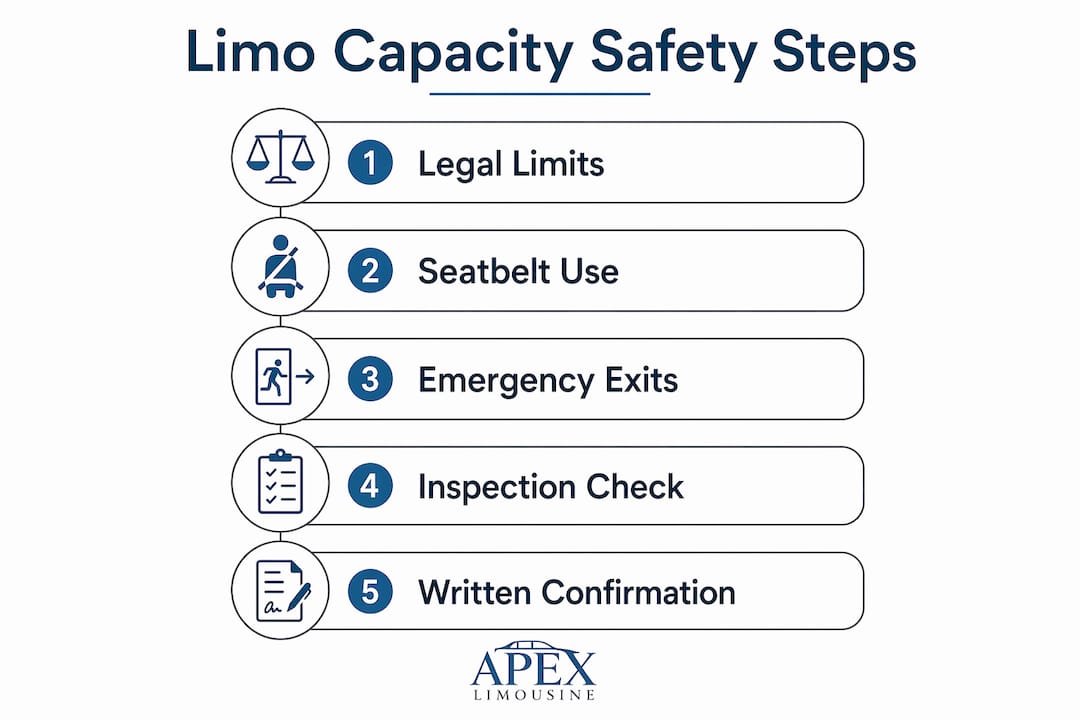
Limo capacity rules do not exist in isolation. They connect directly to vehicle inspection standards and eligibility requirements that determine whether a specific limo can legally serve a prom group at all.
New York's approach offers the clearest example of how this works in practice. The state mandates a 10-year or 350,000-mile retirement rule for stretch limousines, requiring operators to retire vehicles once they hit either threshold. This rule came directly from safety data showing that aging vehicles carry higher accident risk. Structural wear, outdated safety systems, and degraded restraint components all increase with age and mileage.
Here is how compliance and capacity connect in practice:
- Operators must document the vehicle's make, model, year, and certified seating layout before any booking is confirmed.
- Inspections verify that seatbelts, emergency exits, and safety equipment match the certified passenger count.
- Vehicles that fail inspection or exceed age and mileage thresholds cannot legally carry passengers, regardless of how new the interior looks.
- Booking confirmations from reputable operators include documented seating layouts to prevent ambiguity about maximum occupancy on prom night.
Families often focus on the look of a limo, the lighting, the sound system, and the overall style. Legal vehicle classification and compliance affect safety and regulations far more than any interior feature. A beautiful limo that has not passed inspection or exceeds its certified age is a liability, not a luxury.
Pro Tip: Ask your limo operator for the vehicle's inspection certificate and certified seating capacity in writing before you sign any contract. Reputable operators provide this without hesitation.
What students and parents should do before prom night
Understanding limo capacity laws is only useful if it leads to better decisions when booking. These steps protect your group and keep the night on track.
- Confirm certified seating capacity in writing. Every legitimate operator can provide documentation showing the vehicle's legal passenger limit. If they cannot, that is a warning sign.
- Count your group before you book, not after. Passenger count affects the vehicle class you need, the price tier, and the driver licensing requirements. Locking in the number early prevents last-minute overcrowding.
- Verify seatbelt availability for every seat. Capacity is determined by certified occupant seating with seatbelts, not by how many people can physically fit inside. Every passenger needs a working seatbelt.
- Understand the insurance implications. Overfilling a vehicle can invalidate coverage or expose the operator to regulatory penalties if a claim is filed. If something goes wrong in an overcrowded limo, your group may have no insurance protection.
- Follow the driver's instructions on occupancy. The driver is legally responsible for the vehicle and its passengers. If they say the vehicle is at capacity, that call is final and correct.
Pro Tip: Review Austin-specific prom limo regulations before booking so you know exactly what questions to ask your operator.
Families who understand these rules before prom night are the ones who avoid last-minute scrambles, unexpected costs, and safety risks. The rules exist to protect your group. Working with them, rather than around them, is the smarter move.
Key takeaways
Prom limo capacity rules exist because every certified passenger seat is safety-engineered for one occupant, and exceeding that count creates legal, insurance, and physical safety risks for every person in the vehicle.
| Point | Details |
|---|---|
| Capacity is a legal trigger | Carrying 9 or more passengers for compensation classifies a vehicle as a commercial motor vehicle under DOT rules. |
| Each seat is crash-tested | Federal standards engineer restraints and exit routes for a fixed occupant count, making overcrowding physically dangerous. |
| Vehicle age affects eligibility | Rules like New York's 10-year retirement mandate ensure only structurally sound vehicles carry prom passengers. |
| Insurance depends on compliance | Overfilling a limo can void coverage, leaving passengers unprotected if an accident occurs. |
| Documentation protects your group | Always request certified seating capacity and inspection records in writing before signing a booking contract. |
The part most families skip until it's too late
I have seen this pattern more times than I can count. A family spends weeks picking the perfect dress, coordinating corsages, and planning the dinner reservation, then books the limo in the final 48 hours based on price alone. They ask about the color and whether it has a sunroof. They do not ask about certified seating capacity, inspection records, or driver credentials.
The uncomfortable truth is that prom limo safety regulations are not complicated once you know what to ask. The problem is that most families do not know what to ask. They assume that any licensed limo company is automatically compliant with all capacity and safety rules. That assumption is wrong, and in rare but real cases, it has cost lives.
What I have found actually works is treating the limo booking like any other safety-critical decision. You would not put your teenager in a car with bald tires. You should not put them in a limo without confirming the vehicle's certified passenger limit and current inspection status. These are two questions. They take two minutes. They change the entire risk profile of the night.
The other thing worth saying directly: teenagers are not the problem here. Most teens are perfectly willing to follow capacity rules once someone explains the actual reason behind them. The issue is that adults often frame these rules as arbitrary restrictions rather than engineering realities. When a 17-year-old understands that the seat they are sitting in was crash-tested for exactly one person, they tend to take the rule seriously. Explanation beats enforcement every time.
Prom night should be one of the best memories of a teenager's life. The prom limo experience is a real part of that. Getting the safety foundation right does not diminish the fun. It protects it.
— Jason
Safe, compliant prom transportation in Austin with APEX LIMO

APEX LIMO operates every vehicle in full compliance with federal DOT regulations and Texas state transportation requirements, including certified seating documentation and current inspection records for every booking. Every driver holds the required commercial licensing and passenger endorsements. APEX LIMO provides transparent capacity limits at the time of booking so your group knows exactly what to expect before prom night arrives. For Austin families who want luxury transportation without the legal and safety guesswork, book your prom limo with APEX LIMO and get a confirmed, compliant vehicle your group can trust.
FAQ
Why do prom limo capacity rules exist?
Prom limo capacity rules exist because each passenger seat is safety-certified for one occupant with a seatbelt, and exceeding that count violates federal crash-test standards and commercial vehicle regulations. These rules also determine driver licensing, insurance requirements, and emergency egress design.
What happens if a limo is overcrowded on prom night?
Overcrowding can invalidate the vehicle's commercial insurance coverage and expose the operator to regulatory penalties, leaving passengers without protection if an accident occurs. Physically, passengers without assigned seatbelts face significantly higher injury risk in a crash.
How many passengers trigger commercial vehicle rules for limos?
Under DOT regulations, carrying 9 to 15 passengers for compensation, or 16 or more passengers regardless of payment, classifies a vehicle as a commercial motor vehicle with strict safety and licensing requirements.
What should parents ask before booking a prom limo?
Parents should request the vehicle's certified seating capacity in writing, confirm current inspection status, and verify that the driver holds a CDL with a passenger endorsement for the vehicle class being booked.
Do capacity rules differ by state?
Yes. States like New York define stretch limousines at 9 or more occupants including the driver and apply specific CDL and insurance requirements at that threshold. Texas and other states follow their own frameworks layered on top of federal DOT rules, so local regulations always apply alongside federal standards.