

Corporate transport liability means a company can be held legally and financially responsible when goods get lost or damaged, deliveries run late, or a passenger gets hurt during a transport operation it controls or contracts for. Three things to know right away: liability can land on the carrier, the freight broker, the shipper, or the employer, depending on who caused the failure; the governing rules change by mode, with the Carmack Amendment, COGSA, and the CMR Convention each setting different tests and caps; and insurance, not hope, is what actually transfers this risk off your balance sheet.
Before you do anything else:
- Pull your bill of lading or contract and check what liability regime it points to.
- Confirm your insurance coverage types and limits actually match your exposure.
- Start preserving trip records, photos, and communications now, before you need them.
Key Takeaways
Corporate transport liability depends on which party caused the failure, which legal regime governs the movement, and whether insurance limits actually match contractual exposure.
| Point | Details |
|---|---|
| Liability is party-specific | Carriers, brokers, shippers, and employers can each be held liable depending on who caused the failure. |
| Mode determines the rules | Carmack, COGSA, Montreal, Hague-Visby, and CMR each set different limits and defenses by transport mode. |
| Limits are formula-based | Caps like CMR's 8.33 SDR/kg or COGSA's 666.67 SDR per package rarely equal full replacement value. |
| Insurance must match contracts | Cargo, auto liability, passenger, and hired/non-owned coverages address different exposures and need separate limits review. |
| Documentation decides claims | Bills of lading, photos, and telematics logs are what most often determine claim outcomes. |
Table of Contents
- What Does Corporate Transport Liability Actually Cover?
- How Does Transport Liability Change by Mode?
- What Are Typical Liability Limits and Common Carrier Defenses?
- What Insurance Covers Corporate Transport Liability?
- What Happens During a Transport Liability Claim?
- How Can Businesses Reduce Their Transport Liability Exposure?
- Common Mistakes That Turn a Small Loss Into Full Exposure
- Why This Matters More Than Most Business Owners Realize
- Where to Learn More About Transport Liability Rules
- Frequently Asked Questions
- Sources
What Does Corporate Transport Liability Actually Cover?
Corporate transport liability covers physical loss, damage, delay, and personal injury tied to moving goods or people on a company's behalf. It's not one policy or one law. It's a bundle of exposures that gets assigned to whichever party's conduct or contract triggers responsibility.
Several parties can end up holding the bag:
- Carriers are exposed when goods are physically lost, stolen, or damaged in transit, or when a vehicle they operate causes injury.
- Freight brokers can face liability for negligent selection of an unsafe or uninsured carrier, even though they never touch the cargo.
- Shippers carry risk when improper packing or inaccurate declarations cause the loss, which can shift liability away from the carrier entirely.
- Employers face vicarious liability when an employee or contracted driver causes harm while acting within the scope of the job.
Cargo liability and passenger liability are not the same animal. Cargo claims are about the value of goods, replacement cost, and delay damages. Passenger claims involve bodily injury, medical costs, and pain and suffering, which is why passenger transport coverages typically bundle liability, physical damage, uninsured/underinsured motorist protection, and medical payments instead of a standard cargo policy.
Vicarious liability deserves special attention if you use subcontracted drivers or gig-style fleets. Courts increasingly look at whether the contracting company controlled dispatch, scheduling, or safety standards, and telematics and dispatch records are now common evidence in these disputes.
Pro Tip: If your contracts don't explicitly assign liability by scenario, in transit, during loading, or in storage, assume a court will interpret the gap against whichever party had the most control.
How Does Transport Liability Change by Mode?
The legal regime that applies depends almost entirely on how the goods or people moved, and mixing that up is one of the fastest ways to lose a claim you should have won.
- Carmack Amendment governs domestic U.S. motor and rail carriers and imposes something close to strict liability, meaning the carrier is presumed responsible unless it proves a specific defense.
- COGSA (Carriage of Goods by Sea Act) applies to ocean shipments to and from U.S. ports and caps liability while requiring claims within a strict window.
- Montreal Convention governs international air cargo and passenger claims, with its own notice periods and per-kilogram limits.
- Hague-Visby Rules apply to many international ocean shipments outside U.S. jurisdiction and share COGSA's lineage but differ in specific limits and defenses.
- CMR Convention covers cross-border road transport in adopting countries, mainly across Europe, and sets liability at 8.33 SDR per kilogram in most cases.
Which regime governs isn't automatic. Check the bill of lading, air waybill, or contract of carriage. That document usually names the governing law or incorporates a convention by reference, and it's the first place a court looks.
Here's a number that trips people up: liability regimes are so jurisdiction and mode dependent that a shipment crossing from domestic to international carriage, say, a truck-to-vessel move, can shift from Carmack to Hague-Visby mid-route, and contracts that don't address this handoff often leave companies exposed to full damages instead of the lower statutory caps they expected.
What Are Typical Liability Limits and Common Carrier Defenses?
Liability caps are usually expressed as a rate per weight or per package, not a flat dollar figure, which surprises a lot of business owners the first time they read a claim denial.
- CMR: capped around 8.33 SDR per kilogram for cross-border road transport.
- COGSA: commonly limited to 666.67 SDR per package or 2 SDR per kilogram, whichever is higher.
- Montreal Convention: sets tiered limits for air cargo and passenger claims, calculated in SDR.
- Carmack: often allows recovery closer to full value, though carriers frequently contract lower limits into their tariffs.
Carriers regularly assert defenses to reduce or eliminate payout. The most common are inherent vice of the goods, acts of war or public enemy, and shipper negligence, each of which shifts blame back onto the cargo's nature or the shipper's own conduct.
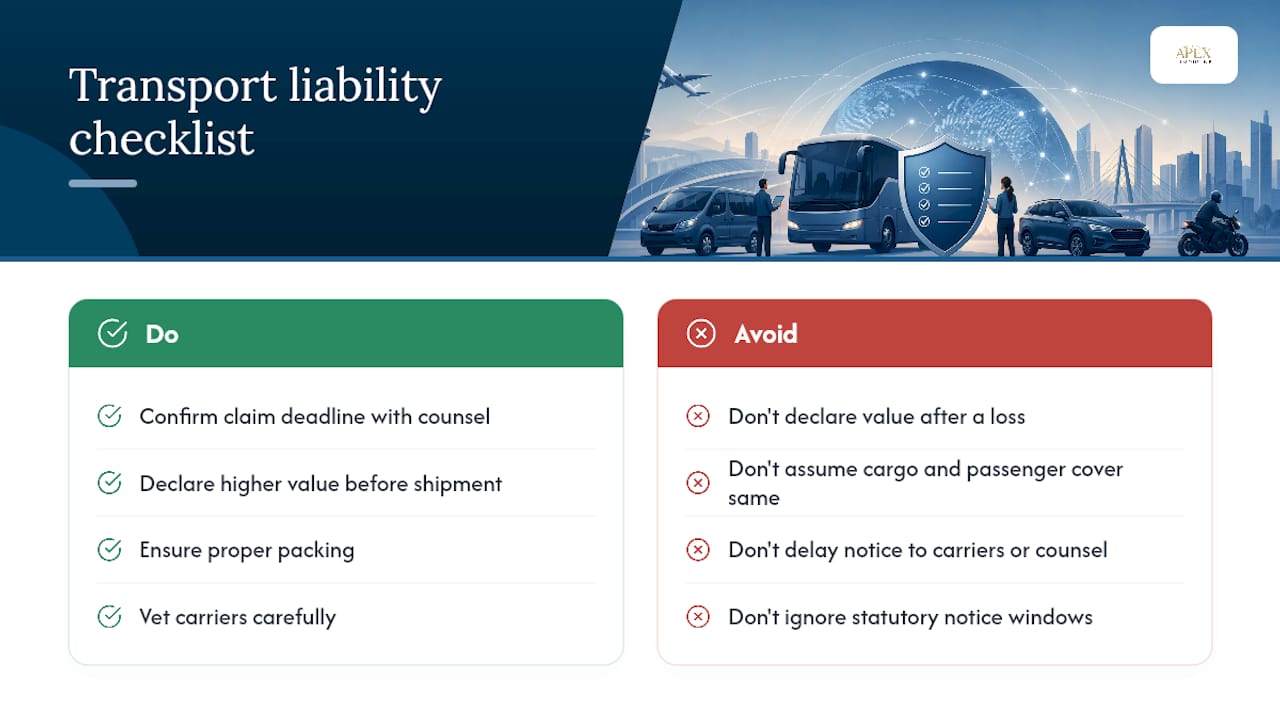
Pro Tip: Declaring a higher value on the bill of lading can override a statutory cap, but it usually comes with a surcharge and only works if the paperwork is filled out correctly before the shipment moves, not after a loss.
What Insurance Covers Corporate Transport Liability?
Insurance is how you actually transfer this risk instead of just acknowledging it exists. Each policy type maps to a specific exposure, and mismatching them is a common, expensive mistake.
- Motor truck cargo covers physical loss or damage to goods while in transit.
- Commercial auto liability covers third-party injury or property damage caused by your vehicles.
- Passenger transport liability addresses bodily injury and medical costs for riders, distinct from cargo-focused policies.
- Hired and non-owned auto covers vehicles you don't own but use for business, a gap many companies miss entirely.
- Umbrella or excess liability adds a layer above primary limits when exposure is high.
- Warehouseman's legal liability covers goods in your care while stored, not moving.
Underwriters price these policies based on fleet size, cargo type and value, destination risk, driver screening practices, telematics data, and claims history. A transport liability policy exists specifically to protect operators from the financial fallout of these claims, covering injury, property damage, and related losses in one package. Some public transportation programs offer liability limits up to $5 million, with higher limits and supplemental coverages available depending on state requirements.
Pro Tip: Match your policy limits to your actual contract obligations, then get a certificate of insurance with the exact required wording. A generic COI that doesn't name your business as an additional insured is worth almost nothing in a dispute.

What Happens During a Transport Liability Claim?
A claim moves fast, and the biggest risk is losing your rights through inaction rather than losing the argument on the merits.
- Preserve evidence immediately: photos, damaged goods, and any communication about the incident.
- Notify the carrier and your insurer without delay, in writing.
- File a formal claim with the bill of lading or waybill attached.
- Cooperate with any inspection the carrier or insurer requests.
- Escalate to litigation or arbitration if the claim is denied unfairly.
Timelines vary sharply by regime. COGSA gives claimants roughly a one-year suit period, while Montreal and CMR impose much shorter notice windows, sometimes just days. These are examples, not guarantees, so confirm the exact deadline with counsel for your specific shipment.
Pro Tip: The documents that decide most claims are the signed bill of lading, timestamped photos, inspection reports, and telematics logs showing vehicle condition and driver behavior before the incident.
How Can Businesses Reduce Their Transport Liability Exposure?
Vetting your carriers matters as much as buying travel technology features that integrate supplier verification and contract management. Check safety scores, insurance certificates, and complaint history before signing anyone.
- Require proof of active insurance meeting your stated minimums, not just a self-reported claim.
- Write contracts with explicit liability allocation, declared value clauses, and packing or inspection requirements.
- Add hold-harmless and indemnity language that references specific required insurance, not vague promises.
- Re-verify certificates of insurance periodically instead of filing them away after signing.
Pro Tip: A COI that expired six months ago is functionally the same as having no COI at all, so calendar the renewal date, not just the intake.
Common Mistakes That Turn a Small Loss Into Full Exposure
Most costly liability disputes trace back to the same handful of avoidable errors.
- Vague bill of lading language, corrected by specifying value, condition, and terms explicitly.
- Ignoring hired and non-owned auto exposure, corrected by adding that coverage before it's needed.
- Skipping declared value, corrected by declaring it every time cargo value exceeds statutory caps.
- Weak driver screening, corrected by verifying records and requiring documented safety checks.
Companies rarely lose coverage because the risk was unusual. They lose it because the paperwork didn't match the risk they actually carried.
Why This Matters More Than Most Business Owners Realize
Transport liability isn't a back-office insurance line item, it's a reputational and financial exposure that can outlast the shipment itself. The gap between a $5,000 cargo claim and a seven-figure injury lawsuit often comes down to whether your contracts and coverage were actually built for the operation you run. Review your current contracts and certificates of insurance this week. If your exposure looks bigger than your limits, talk to a broker before you need to talk to a lawyer, and if your business needs vetted, professionally insured transport for executive or corporate travel, APEX LIMO's executive chauffeur service is built around exactly these contract and insurance practices.
Where to Learn More About Transport Liability Rules
For deeper legal detail, review the Carmack Amendment for domestic U.S. carriage, COGSA for ocean shipments to U.S. ports, the Montreal Convention for international air transport, the Hague-Visby Rules for international ocean carriage outside U.S. jurisdiction, and the CMR Convention for cross-border European road transport. Insurer glossaries and passenger coverage pages, like those from National Indemnity, explain common policy terms in plain language. Always consult counsel for jurisdiction-specific interpretation before relying on any of these for an active dispute.
Frequently Asked Questions
What does corporate transport liability mean in simple terms? It means a business can be held financially responsible for loss, damage, delay, or injury connected to transporting goods or people, with the exact rules depending on the mode of transport and the contract in place.
Who is usually liable in a transport liability dispute? Liability typically falls on whichever party's conduct caused the failure: the carrier for physical damage, the broker for negligent carrier selection, the shipper for poor packing, or the employer under vicarious liability for a driver's actions.
Does corporate transport liability insurance cover passengers and cargo the same way? No. Cargo policies focus on the value and condition of goods, while passenger coverage addresses bodily injury, medical payments, and uninsured motorist protection, which is why the two require different policy structures.
How long do I have to file a transport liability claim? It varies by regime. COGSA generally allows about a year, while Montreal and CMR impose much shorter notice windows, so confirm the exact deadline for your shipment with counsel immediately after a loss.
Can declaring a higher value on the bill of lading increase what I can recover? Yes, in many cases declaring value overrides the statutory cap, though it usually requires a surcharge and must be done correctly before the shipment moves, not after a claim arises.
This article is general information, not a substitute for advice from a qualified lawyer. Consult a qualified legal professional about your own circumstances before acting on anything here.
Sources
- Cargo liability: global comparative analysis of legal regimes
- Traffic liability insurance (Ecclesia)
- Passenger transport — commercial auto (National Indemnity Company)
- Public transportation (RLI Corp)
- Establishing corporate trucking liability (Truck Case Lawyer)