

Wedding transport seating arrangements are the planned system for assigning guests to specific seats and boarding zones across your wedding day vehicles. Done right, they cut boarding time from over 8 minutes to under 3 minutes on a standard 25-seat bus, keep your schedule intact, and spare guests the confusion of hunting for a seat in formal wear. APEX LIMO works with Austin couples every season on exactly this kind of planning, and the difference between a structured seating plan and a free-for-all is visible within the first five minutes of boarding. This guide covers the zones, the vehicle math, the step-by-step workflow, and the day-of fixes that actually work.
What are the essential zones in wedding transport seating?
The most effective seating plan for wedding guests divides the vehicle into three distinct zones, each assigned by guest priority and mobility need.
Zone 1: Front rows belong to elderly guests and anyone with a mobility impairment. Front seats offer the easiest entry and exit, the smoothest ride, and the fastest unloading at each stop. Placing these guests first also sets a boarding order that the rest of the group naturally follows.
Zone 2: Middle rows hold immediate family members and the bridal party. These guests need to stay together for photos, processional timing, and reception introductions. Keeping them in one block prevents the scattered scramble that throws photo schedules off track. Wedding party buses function as mobile staging areas, and that function only works when the group boards and exits as a unit.
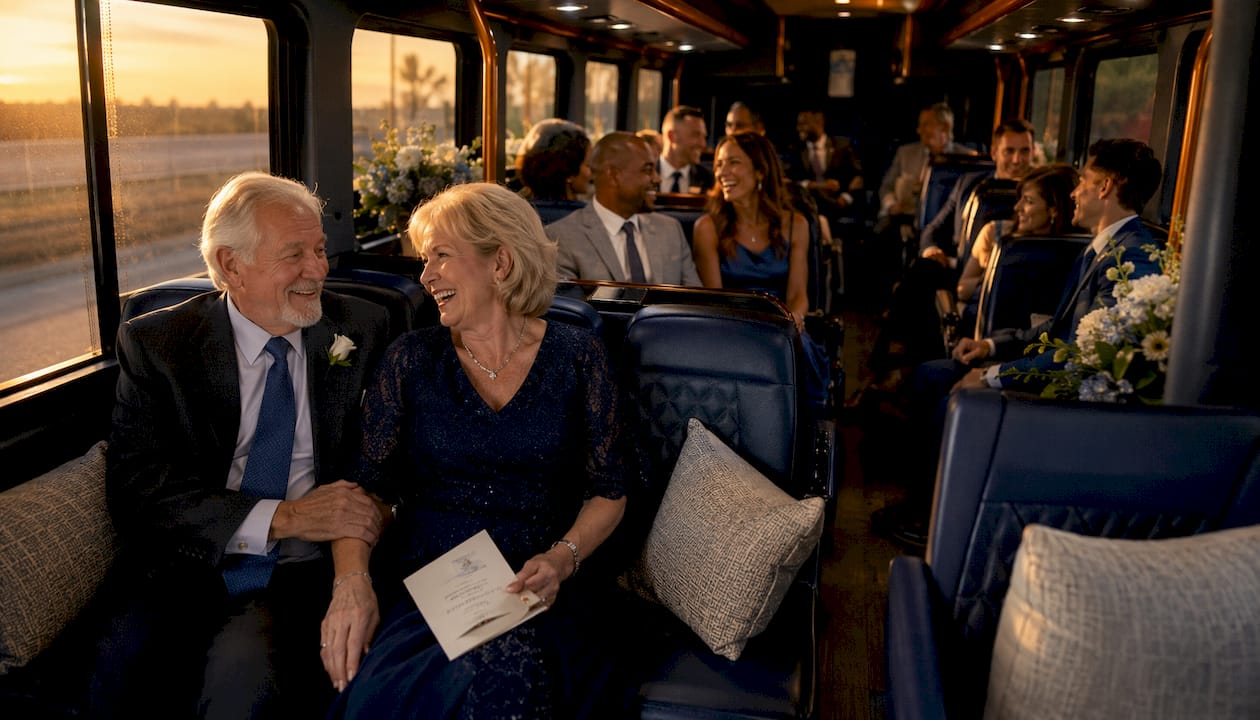
Zone 3: Rear rows accommodate general guests. This group is the most flexible, so placing them at the back means any last-minute seat swaps happen where they cause the least disruption.
The zone system does more than speed up boarding. It reduces seat disputes because every guest has a clear, pre-assigned location before they step on the vehicle. It also simplifies unloading at multi-stop weddings, since Zone 1 guests exit first at every venue without anyone needing to shuffle past them.
- Assign zones based on your finalized guest list, not RSVPs alone.
- Print a zone map and give copies to your driver and bus captain.
- Mark reserved seats with a small card or colored tape for clarity.
- Keep Zone 1 seats visually distinct so guests recognize them immediately.
Pro Tip: Structured boarding by zone reduces boarding time from 8–12 minutes to under 3 minutes on a 25-seat bus. That time savings compounds across every stop on your wedding day.
How do you match vehicle types to your wedding transport needs?
Vehicle selection is the most consequential decision in bridal party transportation, and most couples underestimate how much formal attire shrinks usable capacity.
Formal wear changes your math
A ball gown occupies the space of 2–3 standard seats. Across a full bridal party, formal attire reduces a vehicle's real usable capacity by 15–20% compared to its listed seat count. A 30-seat coach effectively carries 24–25 guests in formal wear once you account for gowns, garment bags, and accessories. Build this reduction into every vehicle you book.
| Vehicle type | Listed capacity | Usable capacity (formal wear) | Best use |
|---|---|---|---|
| Stretch limousine | 8–10 passengers | 6–8 passengers | Bridal party, VIP couples |
| Luxury SUV | 6–7 passengers | 5–6 passengers | Bride and groom, immediate family |
| Passenger van | 12–15 passengers | 10–12 passengers | Small wedding parties |
| Mini coach | 24–28 passengers | 20–24 passengers | Mid-size guest groups |
| Full-size coach | 40–55 passengers | 34–46 passengers | Large guest shuttles |
You can review vehicle capacity details for each type before committing to a booking.
Plan for 50% of your guest count at once
The standard rule for wedding shuttle service capacity is to cover at least 50% of your total guest count simultaneously. For a 200-person wedding, that means transport capacity for 100 passengers in a single wave. Shuttle usage consistently exceeds RSVP estimates because guests who planned to drive often change their minds on the day.
Check venue access before you book
Historic venues, rural properties, and downtown locations each create different vehicle restrictions. Venue access constraints like low bridges, narrow driveways, or limited parking can rule out full-size coaches entirely. Confirm turning radius clearance and drop-off zone dimensions with your venue coordinator before finalizing any vehicle booking.
Pro Tip: Add a 10–15% capacity buffer to every vehicle booking to cover last-minute additions and plus-ones. Booking slightly larger than your confirmed count prevents overloading and avoids turning guests away.
How do you organize boarding and seating step by step?
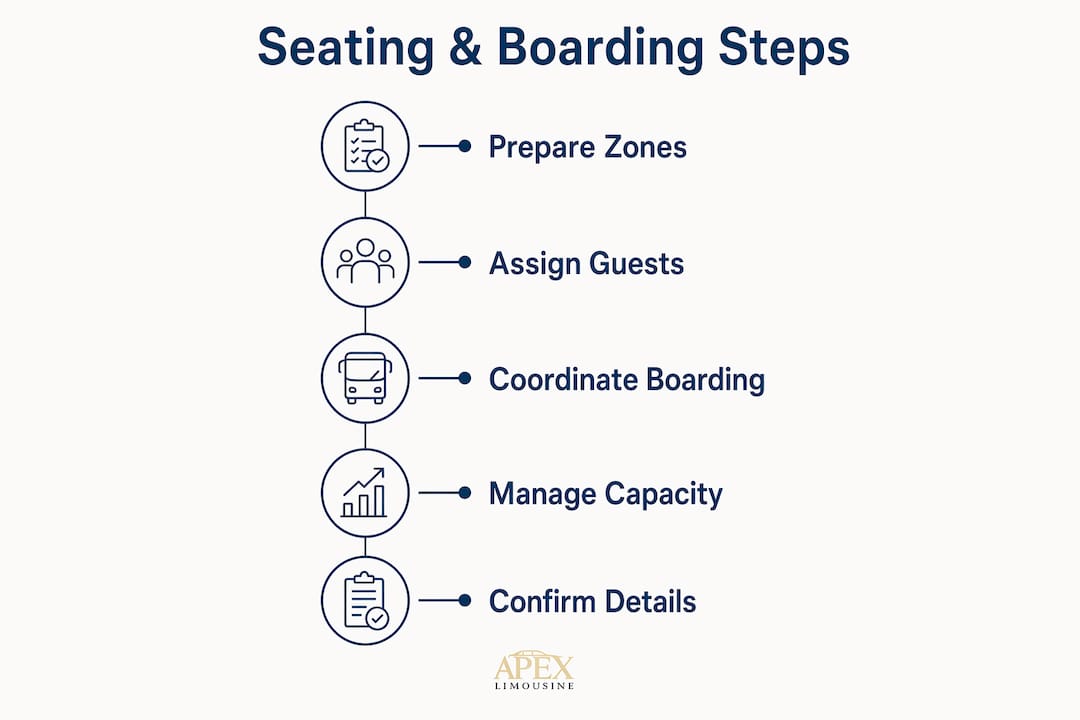
A clear workflow separates a smooth wedding day from a chaotic one. Treat transportation as a sequence of coordinated trips, with each leg planned independently and assigned to specific vehicles.
-
Collect final counts. Gather your confirmed guest count and transportation RSVPs at least two weeks before the wedding. Do not rely on estimates.
-
Build your zone assignments. Map every confirmed guest to Zone 1, 2, or 3 based on mobility needs and relationship to the couple. Cross-reference your seating plan for wedding guests with your transport list so the same logic applies in both places.
-
Create a boarding order list. Write out the exact sequence in which guests board, zone by zone. Print at least three copies: one for the bus captain, one for the driver, and one for your wedding coordinator.
-
Assign a bus captain. The bus captain is a trusted guest or coordinator who manages boarding logistics on the vehicle. Bus drivers focus on safety and route; the bus captain handles seat assignments and resolves any disputes before the vehicle moves. This role is the single biggest factor in smooth boarding.
-
Plan your unloading sequences. At each venue stop, determine which zone exits first and in what order. Align this with your venue coordinator so staff are ready to receive guests as they arrive.
-
Communicate pickup times clearly. Tell guests to arrive 10 minutes before boarding time, and communicate the boarding time explicitly, not the departure time. Guests who hear "departure at 2:00 PM" often arrive at 2:00 PM. Guests who hear "boarding at 1:50 PM" arrive earlier.
-
Add time buffers to every run. Build at least 20 minutes of buffer per shuttle run to absorb traffic, slow boarding, and minor delays. Weddings with multi-stop logistics need this buffer at every leg, not just the first one.
Pro Tip: Assign your bus captain a printed seating chart with guest photos if possible. Faces are faster to match than names when guests are boarding quickly in a crowd.
What are the most common transport seating problems and how do you fix them?
Even well-planned wedding transport seating arrangements hit friction on the day. Knowing the most common problems in advance lets you solve them before they affect your timeline.
- Late arrivals. Guests who miss the boarding window delay everyone. The fix is a firm departure policy communicated in advance. Your bus captain holds the departure time, not the late guest.
- Seat swapping after boarding. Guests who move to "better" seats displace others and create confusion at unloading. Printed seat cards and a bus captain who enforces assignments prevent this.
- Unexpected guests exceeding capacity. A 10–15% booking buffer handles most of these situations. For guests who still exceed capacity, have a backup plan: a rideshare credit, a taxi contact, or a second vehicle on standby.
- Accessibility gaps. Guests with wheelchairs, walkers, or other mobility aids need more than a front-row seat. Confirm with your transport provider that the vehicle has the right entry clearance, handrails, and floor space before the wedding day.
- Coordination breakdowns. The bus captain, driver, and wedding coordinator must share the same schedule and contact information. A single group text thread with all three parties resolves most real-time issues in seconds.
"The biggest source of transport delays at weddings isn't traffic. It's the gap between what guests were told and what they understood. Clear, specific communication about boarding time, pickup location, and seat assignment eliminates most day-of problems before they start."
Your wedding transportation coordinator can manage all of this communication in the weeks before the wedding, freeing you to focus on everything else.
Key Takeaways
Effective wedding transport seating arrangements require zone-based boarding, realistic vehicle capacity math, and a designated bus captain to keep every leg of the day on schedule.
| Point | Details |
|---|---|
| Use three seating zones | Assign guests by mobility need and priority to speed up boarding and unloading. |
| Adjust for formal wear | Reduce expected vehicle capacity by 15–20% to account for gowns and accessories. |
| Plan for 50% of guests at once | Size shuttle capacity to carry half your total guest count in a single wave. |
| Assign a bus captain | A dedicated person managing boarding logistics cuts confusion and enforces seating order. |
| Communicate boarding time | Tell guests to arrive 10 minutes before boarding, not departure, to prevent late arrivals. |
What I've learned about wedding transport that most guides skip
Most wedding transport articles focus on vehicle aesthetics. The couples I've seen struggle on their wedding day almost never had a vehicle problem. They had a communication problem.
The detail that changes everything is the distinction between boarding time and departure time. Guests interpret "departure at 3:00 PM" as permission to arrive at 2:58 PM. When you tell guests "boarding begins at 2:45 PM," the psychology shifts. They show up earlier, the bus captain has time to sort seating, and the vehicle leaves on schedule. That one change alone has saved more wedding timelines than any vehicle upgrade.
The second thing most guides undervalue is the bus captain role. Couples often skip it because it feels like an imposition on a guest. In practice, the right person loves the job. Give them a printed seating chart, a clear authority to enforce it, and a direct line to your coordinator. They become the most valuable person on the vehicle.
My honest advice: treat your transport plan like a rehearsal dinner seating chart. Give it the same attention, the same detail, and the same revision passes. The couples who do this arrive at every venue on time, in the right order, with the right people together. The couples who wing it spend the first 20 minutes of their reception waiting for guests who are still in the parking lot.
— Jason
APEX LIMO makes wedding transport planning straightforward
Planning transport for a wedding involves more moving parts than most couples expect. APEX LIMO works with Austin couples to build customized seating plans that account for guest count, formal attire, venue access, and multi-stop logistics from the start.

Every APEX LIMO booking includes professionally trained chauffeurs who coordinate directly with your bus captain and wedding coordinator. For bridal parties and VIP guests, the luxury SUV fleet offers the right combination of space, comfort, and style without sacrificing capacity. You can also review wedding transport packages to find the right fit for your guest count and venue. APEX LIMO handles the logistics so your wedding day runs the way you planned it.
FAQ
What are wedding transport seating arrangements?
Wedding transport seating arrangements are a structured plan that assigns guests to specific seats or boarding zones across wedding day vehicles. The goal is faster boarding, smoother unloading, and better guest comfort throughout the day.
How many guests should one shuttle cover at once?
Plan shuttle capacity to handle at least 50% of your total guest count simultaneously. For a 200-person wedding, that means transport for 100 passengers in a single wave to avoid delays.
How does formal attire affect vehicle capacity?
Formal wear, including ball gowns and garment bags, reduces a vehicle's usable capacity by 15–20% compared to its listed seat count. Always calculate based on adjusted capacity, not the number printed on the vehicle spec sheet.
What does a bus captain do at a wedding?
A bus captain is a designated person, typically a trusted guest or coordinator, who manages boarding order, enforces seat assignments, and communicates with the driver on timing. The driver focuses on safety and navigation; the bus captain handles everything inside the vehicle.
When should guests arrive for wedding shuttle boarding?
Guests should arrive 10 minutes before the scheduled boarding time. Communicate the boarding time explicitly in your invitations and reminder messages, not the departure time, to prevent late arrivals from delaying the entire group.