

The main types of limousines are the sedan limo, luxury SUV, stretch sedan, SUV/Hummer stretch, party bus (limo bus), and vintage or convertible models. Choosing between them comes down to one rule: match passenger count and luggage load to the experience you actually want, whether that's a quiet airport transfer, a nine-person wedding party, or a 30-person night out. Wikipedia's definition of a chauffeur-driven vehicle with a driver partition still holds. APEX LIMO builds every booking around that same logic.
TL;DR:
- Most limousines are designed to carry passengers comfortably with a partition separating the driver, with the main differences lying in capacity, length, and amenities.
- Sedans and luxury SUVs are ideal for small groups and luggage, while stretch limousines and SUV stretches suit larger parties but reduce luggage space.
- Party buses prioritize entertainment and social interaction over luggage capacity, making them unsuitable for multi-day trips requiring baggage.
- Proper vehicle selection depends on passenger number, luggage needs, route, and event atmosphere, with capacity and cargo space being the most critical factors.
- Booking early and confirming specific vehicle details, including model and luggage capacity, is essential to prevent shortages and ensure the right fit for your event.
Table of Contents
- Types of Limousines Explained by Capacity and Use
- Comparing Capacity, Luggage, and Cost Across Limo Types
- How To Choose The Right Limousine For Your Event
- When To Book Your Limousine And What To Expect
- How APEX LIMO Matches Vehicles To Real Events
- Partition Rules And What "Chauffeur-Driven" Actually Means
- Maintenance Realities Behind Each Limousine Type
- Weighing The Trade-Offs Of Each Limo Type
- Fuel Efficiency And Environmental Considerations
- Regional Preferences In Limousine Styles
- What Actually Matters When Picking A Limo
- Get A Free Quote For Your Austin Event
- Sources
Types of Limousines Explained by Capacity and Use
Every limo type on the road today traces back to the same basic idea: a chauffeured car with a partition separating the driver from the passenger cabin. What changes between models is the chassis, the length of the conversion, and how many people it's built to move comfortably. Here's how the main categories break down.
Sedan limo. This is the entry point for chauffeured travel, typically a Lincoln, Cadillac, or similar full-size sedan seating one to three passengers comfortably. Trunk space handles two to three standard suitcases without a problem, which makes it the default choice for airport runs and executive travel. Hourly rates generally land in a lower band than any stretch option, and there's no dance floor or bar to speak of. It's built for efficiency and a smooth ride, not spectacle.
Luxury SUV. Think Suburban, Escalade, or Navigator, seating four to six passengers with genuinely usable cargo room behind the third row. This is the vehicle families and small groups reach for when a sedan feels cramped but a stretch feels like overkill. Wine tours, small corporate groups, and airport pickups for families with real luggage all fit this category well. Pricing generally falls above a sedan but below a stretch, and the higher ride height means easier entry for older guests or anyone in formalwear.
Stretch sedan. This is what most people picture when they hear the word "limousine": a factory sedan cut at the chassis and extended by a certified coach builder, seating six to ten passengers around a wraparound bench. That coach-built conversion process is exactly why luggage capacity shrinks even as passenger capacity grows. You lose usable trunk space to the structural work that makes the extension safe. Amenities usually include mood lighting, a privacy partition, a sound system, and sometimes a small bar setup. This is the classic choice for weddings, proms, and milestone birthdays, where the vehicle itself is part of the event rather than just transportation.
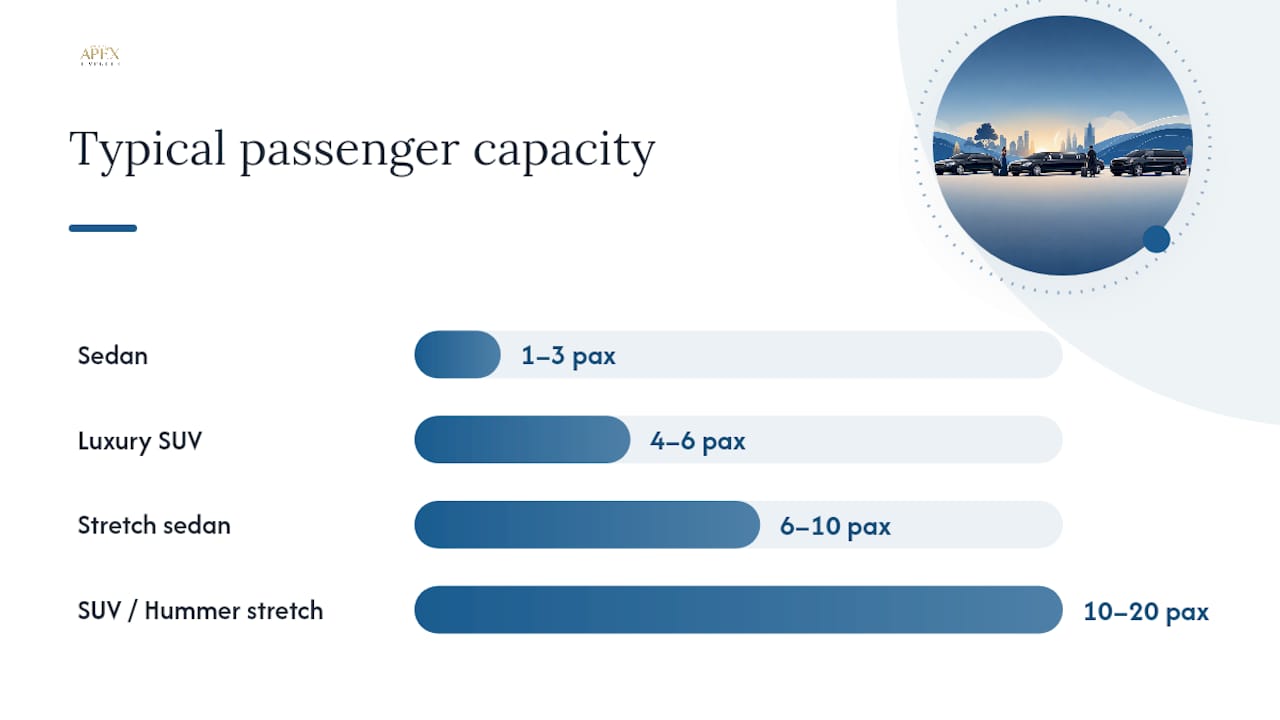
SUV stretch and Hummer/excursion stretch. These stretch conversions typically seat 10 to 20 passengers depending on the model, and the capacity ranges for SUV stretches tend to sit well above standard sedan stretches. The road presence is enormous, which is exactly the point for bachelor parties, quinceañeras, or any group that wants to arrive making a statement. Luggage capacity is limited relative to passenger count, and maneuverability in tight downtown streets or parking structures becomes a real factor. Book one of these for a night out, not for hauling suitcases.
Party bus / limo bus. Party buses typically seat large social groups and solve a different problem entirely. They typically carry entertainment features like sound systems, dance floors, and wet bars, and they're the right call for bachelorette weekends, large corporate outings, or brewery and winery tours where the group wants to stay together and keep the party going between stops. If your group needs to check real luggage, whether for a multi-day trip or a wedding with out-of-town guests, a motorcoach with under-bay storage handles that far better than any party bus.
Convertible and vintage/classic limos. These are the smallest-capacity option on this list, usually seating three to four passengers, and they exist almost entirely for the photo opportunity and the formal occasion feel. A 1960s Rolls-Royce or a classic convertible commands attention outside a wedding venue in a way a modern stretch never will. Availability is limited because these vehicles are rare and require specialized upkeep, so expect a price premium and a much narrower booking calendar than standard fleet vehicles.
- Sedan: 1 to 3 passengers, best for airport transfers and executive travel
- Luxury SUV: 4 to 6 passengers, best for families and small group tours
- Stretch sedan: 6 to 10 passengers, best for weddings and proms
- SUV/Hummer stretch: 10 to 20 passengers, best for nightlife and big group statements
- Party bus: 20 to 40 passengers, best for group parties and tours
- Vintage/convertible: 3 to 4 passengers, best for photos and ceremonial arrivals
For a closer look at how group size should drive the decision, Apex Limo's group-size guide walks through specific scenarios in more detail.
Comparing Capacity, Luggage, and Cost Across Limo Types
Side-by-side, the trade-offs become obvious fast. Comparative capacity data across vehicle classes shows a consistent pattern: as passenger capacity rises, luggage room and maneuverability both drop.
- Sedans and SUVs handle two to six full-size suitcases without strain and park in a standard space.
- Stretch sedans fit six to ten people but typically manage only two to four bags total, since the extended cabin eats into trunk space.
- SUV/Hummer stretches carry more people but even less usable luggage room relative to headcount, and they need wider turning radius and taller clearance for parking structures.
- Party buses solve the group-size problem but aren't built for checked baggage at all; a motorcoach with under-bay storage is the better call for 20+ people with real luggage.
- Vintage and convertible models trade luggage and headroom entirely for style, so they work only as short-hop, low-baggage options.
Accessibility varies too. Sedans and SUVs are the easiest entry for guests in formalwear or with mobility concerns, while low-slung stretch limos can be awkward to climb into in heels or a long gown.
On price, representative hourly ranges run roughly $60 to $100 per hour for a sedan, $85 to $135 for an SUV, and $125 or more per hour for a stretch, with weekend and peak-season minimums pushing those numbers higher. Treat these as a general shape, not a quote. Rates shift by market, date, and vehicle age.
Statistic callout: Booking-window data from the charter and limo industry points to three to four weeks as the standard reservation window for most events, with earlier booking strongly advised during prom and wedding season when specific vehicle models sell out fast.
How To Choose The Right Limousine For Your Event
Start with four questions: how many passengers, how much luggage, what's the route, and what atmosphere do you want? A quiet airport pickup calls for a completely different vehicle than a wedding exit with a photographer waiting outside.
Once you've got those answers, use this checklist when you call or email a provider:
- What's the exact vehicle model and year, not just the vehicle "type"?
- What's the comfortable seating capacity versus the maximum capacity?
- How much luggage can the vehicle actually hold, and where?
- Can the company provide proof of commercial insurance and chauffeur licensing?
- What's the hourly minimum, and does it change on weekends or holidays?
- What's the cancellation and rescheduling policy?
Red flags worth walking away from: a quote with no vehicle year or model listed, reluctance to share insurance details, or pricing that seems to shift every time you ask a follow-up question.
Pro Tip: If you need a specific vehicle model for photos, whether that's a particular stretch color or a vintage convertible, confirm that exact vehicle in writing for your date. Fleet substitutions happen, especially during peak wedding weekends.
Apex Limo's own guide to choosing a limousine service covers additional questions worth asking before you sign a contract.
When To Book Your Limousine And What To Expect
Three to four weeks ahead is the standard booking window for most events, but wedding and prom season tightens that considerably since popular vehicles get reserved months in advance.
Before the day arrives, confirm:
- Exact pickup and drop-off addresses, plus any stops in between
- How much luggage each passenger is bringing, and whether it fits the vehicle you booked
- The deposit amount and what triggers a refund
- Hourly minimums and whether gratuity is included or added separately
Most providers ask for a deposit at booking and the balance closer to the event, with a confirmation call or text the week prior to lock in timing.
How APEX LIMO Matches Vehicles To Real Events
We spend more time asking about luggage than most people expect. A wedding party of eight sounds like a straightforward stretch sedan booking until you learn three bridesmaids are bringing garment bags and overnight cases for a same-day flight out. That's when we shift the recommendation to a luxury SUV with a trailing sedan, rather than force everyone and everything into one stretch.
Matching the right vehicle to the right event isn't about upselling the biggest limo on the lot. It's about asking the questions that actually matter, passenger count, luggage, route, and timeline, before a client ever sees a contract.
That's the standard we hold every booking to, whether it's a two-hour airport run or an eight-hour wedding day.
Partition Rules And What "Chauffeur-Driven" Actually Means
A limousine is legally and practically defined by one feature above all others: the partition separating the driver's compartment from the passenger cabin. That's the detail Wikipedia's definition of a limousine centers on, and it's not just a design flourish. The partition creates a private space for passengers and puts full control of the vehicle in the hands of a professional driver, which is the entire point of chauffeur-driven transportation.
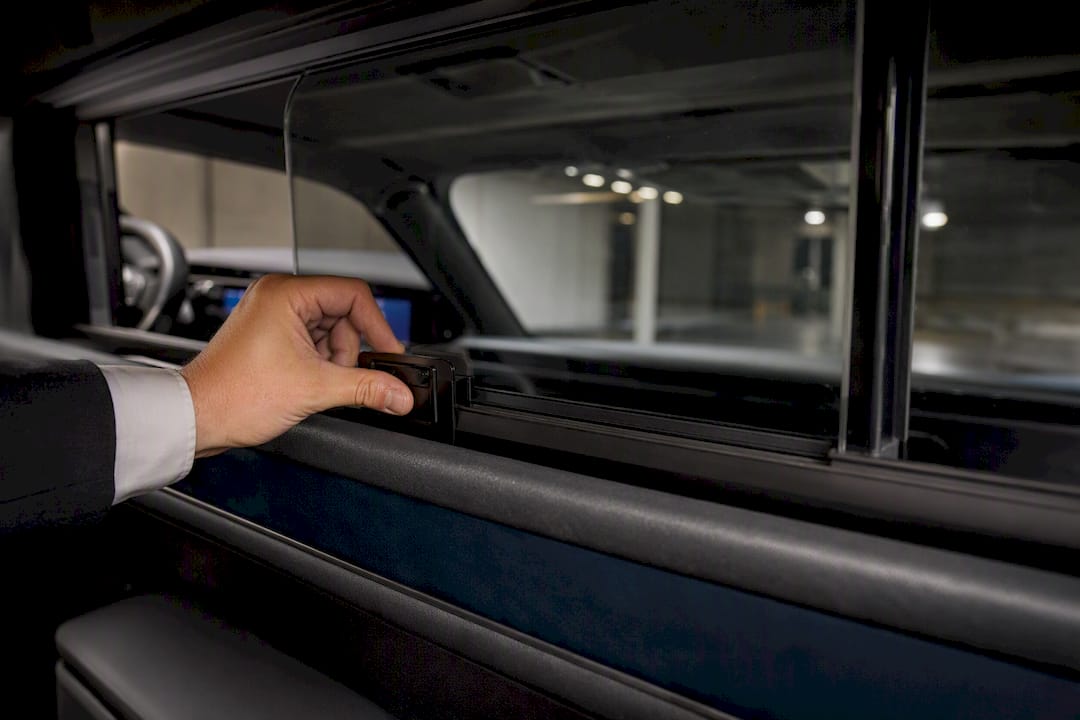
"Chauffeur-driven" means the vehicle comes with a trained, licensed professional operating it for the duration of the booking. You never touch the wheel, never worry about parking, and never have to think about a drink limit before a formal event. That distinction matters most on wedding days and prom nights, when a group needs a completely different level of care than a standard rideshare trip provides.
Partitions vary by vehicle. Stretch sedans and SUV stretches almost always include a manual or powered glass partition. Standard sedans and SUVs sometimes skip the full partition in favor of a simpler divider or none at all, since the trip is usually shorter and more transactional. Party buses generally don't have a partition at all, since the entire point is one shared, open space for the group. When safety and privacy both matter, ask specifically whether the vehicle you're booking includes a partition, rather than assuming every "limo" comes with one.
Maintenance Realities Behind Each Limousine Type
Upkeep costs and complexity scale directly with how much a vehicle has been modified from its factory form. Standard sedans and SUVs follow normal manufacturer service schedules, the same oil changes, brake work, and tire rotations any commercial fleet vehicle needs, which keeps costs predictable and parts easy to source.
Stretch limousines are a different story. Because the chassis has been cut and extended by a coach builder, the structural elements, the extended frame, additional wiring for lighting and sound, and the added weight on suspension components, all require specialized service. Fleet operators often need to work with shops experienced in stretch conversions specifically, not just any mechanic. That narrower service pool tends to push maintenance costs higher and repair timelines longer.
Party buses and SUV/Hummer stretches carry even more systems to maintain, including sound equipment, extra lighting, and sometimes bar fixtures, on top of the extended-chassis concerns. Vintage and classic limousines sit at the far end of the spectrum: parts can be scarce, specialized restoration shops are few, and a single mechanical issue can take a vehicle out of the booking calendar for weeks. That's a major reason reputable operators run smaller vintage fleets and price them at a premium. It's not just about rarity. It's about what it actually costs to keep a 60-year-old vehicle road-ready and safe.
Weighing The Trade-Offs Of Each Limo Type
No single limousine type wins across every category, which is exactly why matching vehicle to event matters so much. Sedans and SUVs offer efficiency, easy parking, and lower cost, but they can't accommodate a large wedding party or deliver the visual impact some events call for.
Stretch sedans deliver that classic limousine look and enough seating for a mid-size group, but the coach-built conversion process trims usable trunk space, so guests with real luggage often end up disappointed. SUV and Hummer stretches solve the capacity problem for larger groups and bring serious road presence, but they're genuinely less practical for tight city driving or luggage-heavy routes, and parking one downtown takes planning.
Party buses shine for large social groups who want to stay together and keep the energy going, with built-in entertainment that no sedan or stretch can match. Their downside is baggage capacity, they're built for people, not suitcases, so any group needing to check real luggage should look at a motorcoach instead.
Vintage and convertible limos deliver a look no modern vehicle can replicate, ideal for the ceremonial arrival or the photo that ends up framed on someone's wall for decades. The trade-off is availability and cost. Rare vehicles need specialized care, which limits fleet size and pushes prices well above standard options.
Fuel Efficiency And Environmental Considerations
Bigger vehicles burn more fuel, and limousines are no exception to that basic physics. Standard sedans, especially newer hybrid or fuel-efficient models some fleets have started adding, post the best fuel economy of any limousine category simply because they're the lightest and least modified from factory specifications.
Stretch conversions add substantial weight through the extended chassis, added glass, sound systems, and interior fixtures, which pulls fuel efficiency down compared to the same model in factory form. SUV stretches and Hummer-style limos sit at the lower end of fuel efficiency across the entire category, given their size, weight, and typically larger engines built for that added mass.
Party buses run on a completely different scale, closer to a small commercial bus than a car, so fuel consumption per trip is higher, but the calculation changes when you factor in passengers per vehicle. A 30-passenger party bus moving one group is often more fuel-efficient per person than three separate SUVs making the same trip. That math matters for corporate groups and event planners weighing environmental impact alongside cost. Some operators have begun adding hybrid sedans and SUVs to their fleets specifically to offer lower-emission options for environmentally conscious clients, a trend likely to expand as hybrid and electric vehicle technology matures across the luxury segment.
Regional Preferences In Limousine Styles
Limousine preferences shift noticeably by region and by the local event culture driving demand. Cities with dense downtown cores and tight street grids tend to favor sedans, SUVs, and shorter stretch sedans over the longer SUV/Hummer stretches, simply because maneuverability and parking availability make the bigger vehicles impractical for regular use.
Markets with a strong nightlife or entertainment-district culture, on the other hand, often see stronger demand for party buses and SUV stretches, since groups want a vehicle built for the night itself rather than just transportation to it. Wine country regions and areas built around outdoor group tourism tend to favor luxury SUVs and smaller party buses, which balance comfort with the ability to navigate rural or winding roads that a stretch limo would struggle with.
Cultural event traditions shape demand too. Quinceañeras and large multi-generational family celebrations often drive demand for higher-capacity stretch and party bus bookings, since the guest list itself tends to run larger than a typical American wedding party. Prom season creates a predictable seasonal spike for stretch sedans and SUV stretches in nearly every market, regardless of region, since the vehicle itself has become part of the tradition for many high schools. Regardless of the region, the underlying logic stays the same: local geography and local event culture both push demand toward specific vehicle types, and a good provider adjusts fleet mix accordingly.
What Actually Matters When Picking A Limo
Most limousine guides bury the one decision that actually determines satisfaction: luggage. Readers spend far more energy comparing amenities and interior features than they do confirming whether their bags will fit, and that's backwards. A stretch sedan with a built-in bar means nothing if three guests are stuck holding suitcases on their laps because nobody asked about trunk space ahead of time.
The conventional advice treats limo selection as primarily an aesthetic choice, sedan versus stretch versus party bus, based on how the vehicle looks in photos. That's a real factor, but it's the second question, not the first. Passenger count and luggage load should decide the vehicle category before atmosphere ever enters the conversation.
If there's one thing worth prioritizing above everything else in this guide, it's asking providers pointed questions about capacity and cargo before falling in love with a vehicle's look. A gorgeous SUV stretch that can't fit your group's bags is a worse choice than a plain sedan that handles the trip without a hitch.
— Jason
Get A Free Quote For Your Austin Event
APEX LIMO gives you access to the full range covered here, executive sedans, luxury SUVs, stretch limousines, and party buses, matched to your exact passenger count and luggage needs rather than whatever happens to be available that weekend.

Whether you need an executive chauffeur service for an airport run, a personal driver for hourly bookings around town, or a full stretch or party bus for a wedding party, the fastest way to lock in the right vehicle is to ask specifics up front: passenger count, luggage, and event timeline. For outdoor events with large guest lists, pairing your transportation with a partner like Nice Day Trailers' luxury restroom rentals rounds out the logistics. Ready to see what fits your date and budget? Request a free, no-obligation quote and get real pricing back within hours, not days.
Sources
- Limousine — Wikipedia
- Stretch Limo vs. SUV Limo: Which Is Right for You? · LimoBus
- Limo & Vehicle Types Compared — Capacity & Uses | LimousineHQ
- Prime Charter Bus resources — types of charter buses