
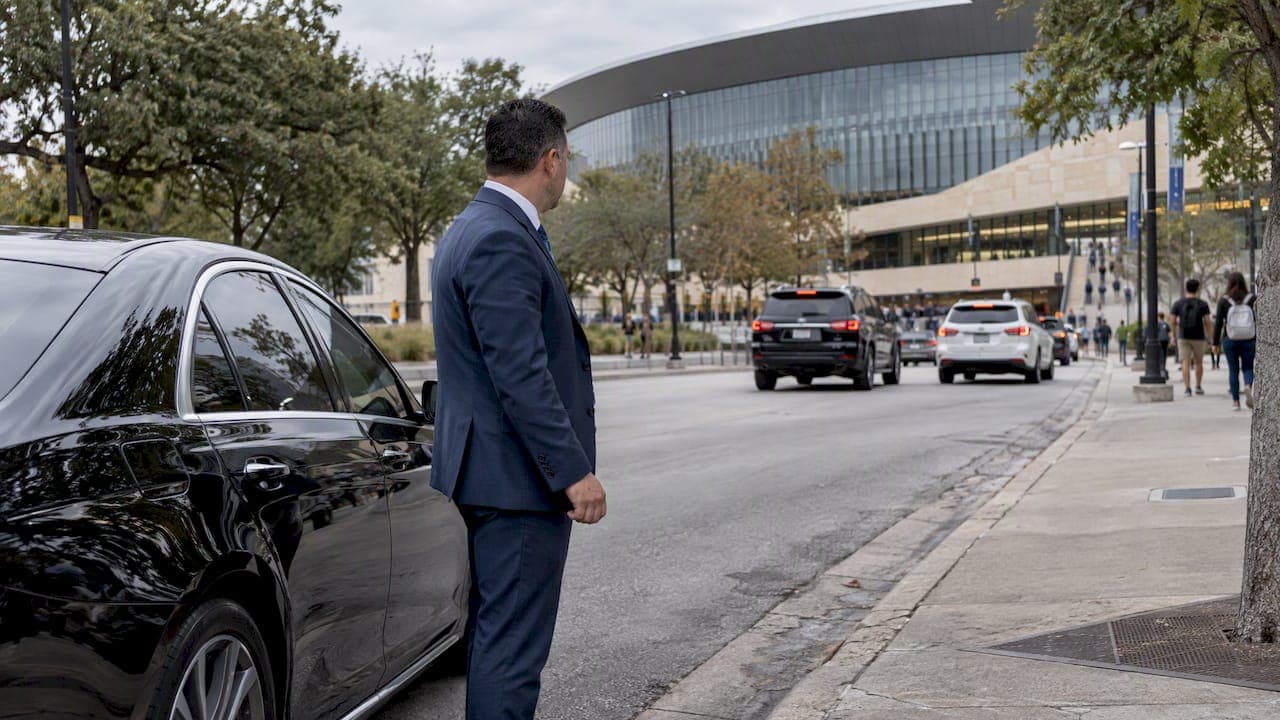
Route advance planning is the work done before a vehicle moves: choosing the route, scouting the exact drop-off and pick-up points, timing the drive at the hour you will actually travel, and building a backup. For a wedding, a concert at Moody Center or an executive arriving at Austin-Bergstrom, it is what separates a calm arrival from a stressed one. A navigation app finds a road. A plan decides where the car stops, when it leaves and what happens if something changes.
This guide explains how planners think about it, what it looks like at Austin venues, and how to judge whether your transportation provider really does it.
TL;DR
- Route advance planning covers more than directions: venue access points, timing windows, staging, a backup route and a post-event review.
- Consumer apps are good for live adjustments, but they optimize for current traffic and a venue address, not for the private entrance or the zone your driver is allowed to use.
- At venues like Moody Center, the rideshare and ADA zones sit in specific places, so your driver should confirm them before event day.
- Ask any provider for the plan in writing: pickup point, buffer time, flight tracking, a backup vehicle or route and a named contact.
- We build these plans for every Austin booking, from weddings to VIP escorts.
Table of Contents
- What route advance planning actually means
- Why a map app is not a plan
- What it looks like at Austin venues
- A step-by-step plan you can follow
- Choosing a vehicle that fits the plan
- Perspective: what we have learned planning Austin routes
- Questions to ask any provider about route planning
- Book a route that is planned before you ride
- FAQ
- Sources
What route advance planning actually means
In logistics, route planning is often about efficiency: fewer miles, lower fuel costs, more stops per day. That is the vehicle routing problem, and California DOT research on airport shuttles shows how simulation of passenger arrivals, dwell times and changing road traffic is used to optimize it.
Passenger transportation for an event asks a different question. You are not minimizing miles. You are trying to make arrival predictable. The federal ITS guidance on planned special events describes how cities handle large concerts, festivals and sporting events: coordination between agencies, testing of routes and scenarios, and evaluation afterward. Cities do this at a huge scale. A single chauffeured group does the same thing in miniature.
A good plan answers six questions:
- Where exactly does the car stop? Not the venue address, but the door, gate or zone.
- When does the car leave? Based on traffic at the time of the event, not at the time you book.
- What is the buffer? Extra minutes built in for the unexpected.
- What is the backup? A second route, a second pickup point or a spare vehicle.
- Who is in contact? The driver, a dispatcher and the person who owns the schedule on your side.
- What did we learn? The review after the event that improves the next one.
Why a map app is not a plan
Google Maps, Apple Maps and Waze are excellent. Apple Maps offers ETAs for future departures based on expected traffic, and Waze draws on reports from other drivers about what is happening on the road right now. We use tools like these for live adjustments, and you should too.
Their limits show up at events:
- They route to an address, not a zone. An address may put you at a public garage, a closed street or a gate your vehicle cannot use.
- They do not know your guest list. They will not tell you that the second wave of guests lands at 6:40 p.m. and needs a different staging point.
- They optimize for the fastest trip. A plan optimizes for the most reliable one, and the two are often different.
- They cannot coordinate. An app cannot call the venue's transportation contact, confirm a gate with security or hold a vehicle in a staging lot.
The federal briefing on special events stresses site testing and scenario planning, meaning physically checking how routes behave at the times that matter. That is the practical gap between navigation and planning.
What it looks like at Austin venues
Austin makes the case well. Downtown streets close for festivals, the University of Texas campus fills on game and concert days, and the airport sits well outside the core. Here are three situations we plan for.
Moody Center concert nights
Moody Center sits on the University of Texas campus, and its arrival logistics are specific. The venue's Plan My Trip page says the rideshare drop-off and pick-up area is at Lot 37, the LBJ Library parking lot, one block north of the venue off Red River St. and Clyde Littlefield Dr. It also lists a separate ADA drop-off and pick-up point on the northwest side on Robert Dedman Dr. The university's Moody Center travel plans page covers transit options and event access in more detail.
Venue arrangements change from season to season, so the right move is to confirm the current setup for your date. That confirmation is part of advance planning. A band or a party of singers arriving through a generic "Moody Center" pin can end up in the wrong place at the worst moment. Planning means knowing the zone, the approach road and the exit route before load-in or the first guest is in the car.

Airport arrivals at AUS
Austin-Bergstrom International Airport is roughly 8 miles southeast of Moody Center, according to the venue's trip guide. The airport's ground transportation page lists rideshare pickup locations and also names other ground services, including limousine operators, so pickup rules differ by service type.
For an executive or a CEO, the plan should cover the flight, the curb and the road:
- Flight tracking so the driver is there for the real landing time, not the scheduled one.
- A confirmed meeting point, agreed in advance with the passenger.
- A route to the hotel or meeting that has been checked against the day's traffic and any closures.
- A buffer before the first appointment.
Our AUS airport transportation service is built around these steps.
Weddings, proms and group events
For a wedding, the route is only half the plan. The other half is sequence: bride and groom from the getting-ready location to the ceremony, guests from the hotel, then everyone to the reception. Each leg has a pickup point, a drive time at that hour of the day and a person responsible for the schedule. Our wedding limo service works from that timeline.

For multi-vehicle groups, staging matters as much as routes. Our guide on choreographing event pickup staging walks planners through how to organize arrivals when several vehicles share one curb.
A step-by-step plan you can follow
Whether you work with us or arrange it yourself, this sequence works.
- Two to four weeks out: lock the facts. Event date, start and end times, venue, number of passengers, special access needs, any security requirements.
- Get the venue's transportation instructions. Many venues publish them. Note the drop-off zone, the pick-up zone, any ADA point and any restrictions on vehicle size.
- Choose the vehicle for the route. A large vehicle is not always better. A narrow approach or a restricted lot may favor an SUV or sedan over a bus.
- Scout and time the route. Drive it, or have your chauffeur drive it, at the same day and hour as the event.
- Set the buffer. Add time for the arrival window, not just the drive. Events that draw big crowds slow every approach road.
- Name a backup. A second pickup point, an alternate route and a way to reach the dispatcher.
- Share the plan. The passenger, the planner and the driver should all hold the same one-page schedule.
- Review afterward. What ran late, what ran early, which gate worked. The federal guidance describes evaluation after events as part of the cycle, and we treat it the same way.
Choosing a vehicle that fits the plan
Vehicle choice affects the route. The published starting rates on our fleet page are:
| Vehicle | Starting rate |
|---|---|
| Executive Black Sedan | from $120 per hour |
| Luxury Black SUV | from $160 per hour |
| Executive Sprinter Van | from $175 per hour |
| Classic Stretch Limousine | from $195 per hour |
| SUV Stretch Limousine | from $275 per hour |
| Party Bus | from $350 per hour |
You can see each option on the Apex Limo fleet page. A sedan or SUV suits a single executive or small party moving through tight access points. A Sprinter van keeps a team together. Stretch limos and the party bus suit celebrations where the vehicle is part of the occasion, and they need the most careful approach planning.
Perspective: what we have learned planning Austin routes
Most late arrivals are not caused by the drive. They are caused by decisions made days earlier: a wrong pickup point, no buffer, or a passenger who never learned where the car would be waiting.
That is why we treat the plan as the product. Flight tracking, buffer time and a vetted chauffeur who knows the venue are part of every booking, and our pricing is flat-rate with no surge fees, so a busy night does not change the plan or the price. For high-profile guests, we add coordination with security and the venue. We would rather spend an hour on the plan than twenty minutes fixing a missed entrance.
The same applies to planners. If you are moving executives, a band or a wedding party, hand us the schedule early. We will turn it into one document that the driver, the guest and your team all follow.
— Jason
Questions to ask any provider about route planning
Use these to separate a plan from a promise:
- Which exact pickup and drop-off points will you use at my venue?
- How do you track flights and adjust for delays?
- How much buffer time do you build in, and how do you decide?
- What is the backup if a road closes or a vehicle has a problem?
- Is the rate flat, or can it change with demand?
- Who can I call on the day, and will that person see my schedule?
Providers who plan well answer these quickly and specifically. If the answers are vague, the plan probably is too.
For corporate events, our guides on corporate event transportation in Austin and why executive event transport differs from standard service go further into how planners should brief a provider.
Book a route that is planned before you ride
If you are planning a wedding, a concert night, a conference or a VIP visit in Austin, we will build the route plan with you and quote the vehicle that fits. Start with our chauffeur and car services or go straight to the fleet. Frequent airport travelers can also look at our annual packages, Silver at $800 per year, Gold at $1,000 per year and Platinum at $1,200 per year, listed on our home page. Police escort and high-profile requests are quoted individually.
FAQ
How far ahead should I plan routes for an event?
For a wedding or corporate event, start two to four weeks out so you can collect venue instructions and confirm timing. For a major festival or a high-profile arrival, earlier is better. Large public events can involve agencies planning far ahead, as the federal planned special events briefing shows.
Is Google Maps enough for event day?
It is a useful tool for live traffic, but not a full plan. It routes to an address and does not know which entrance or zone your car is permitted to use. Your driver should confirm those points with the venue first and use the app only for real-time changes.
What is buffer time?
Buffer time is the extra margin built into a schedule for delays you cannot predict, such as a slow arrival lane, a late flight or a closed street. It is added on top of the estimated drive. The right amount depends on the venue, the hour and how critical the arrival is.
Where do private cars stop at Moody Center?
The venue lists a rideshare drop-off and pick-up area at Lot 37 and a separate ADA point on Robert Dedman Dr. on its Plan My Trip page. Arrangements can change by event, so confirm the current setup for your date with the venue and your chauffeur.
Sources
- Intelligent Transportation Systems for Planned Special Events, ITS Deployment Evaluation
- Centrally Coordinated Schedules and Routes of Airport Shuttles, California DOT
- Moody Center Plan My Trip
- Moody Center Travel Plans, UT Parking & Transportation
- Ground Transportation at the Barbara Jordan Terminal, Austin-Bergstrom Airport
- Apple Maps
- Waze Navigation & Live Traffic