
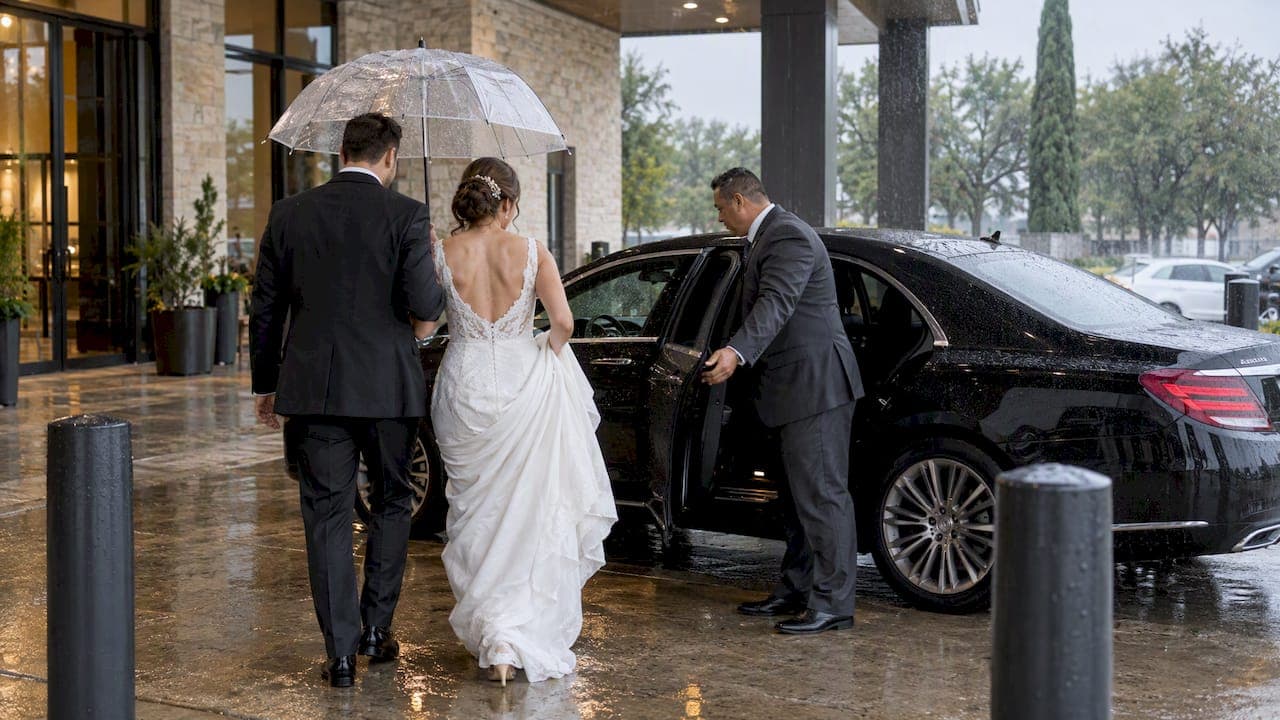
A rain-ready transport plan needs four things in writing: one named decision-maker, a documented Plan B with two sheltered pickup points per venue, buffer minutes built into every handoff, and a vendor notification chain that everyone has seen in advance. Check official National Weather Service probabilistic guidance at set intervals rather than a single app forecast, and confirm covered loading access with your venue and driver ahead of time. For couples who would rather hand this coordination to a chauffeur team, a managed service like ours can take on the day-of logistics directly.
TL;DR:
- Confirm covered loading access at each venue and confirm backup approaches and vehicles in writing to avoid last-minute confusion.
- Build in buffer time at every pickup and drop-off, especially when rain slows boarding and walking speeds, to prevent schedule slips.
- Assign a single decision-maker and communication channel to issue rain updates and avoid conflicting instructions that cause delays.
- Use scheduled loops over scattered trips for multiple guest pickups at hotel blocks to maintain timing predictability in rainy conditions.
- Prepare a waterproof gown bag, umbrella, and a small emergency kit to protect attire and accessories from rain-related damage.
Table of Contents
- What you need to know before writing a rain plan
- How a rain-ready transport timeline actually works
- Why rain changes cost, timing, and stress level
- Common missteps that ruin a rain transport plan
- Your step-by-step rain-ready transport plan
- Professional insight and execution checks from chauffeur teams
- When to hire a professional chauffeur team instead of DIY transport
- Contingency plans for guest transportation in severe weather
- Guidelines for communicating transportation changes to guests
- Safeguarding wedding attire and accessories during rain
- Coordination strategies between vendors and planners on rain day
- Parking and drop-off zones built for rainy conditions
- Practical habits that keep the day calm when weather forces change
- How APEX LIMO can support a rain-ready wedding transport plan
- FAQ
- Sources
What you need to know before writing a rain plan
A workable rain plan starts with facts, not guesses. Before you draft anything, walk through your venues and vehicles with a notebook, because the answers determine whether your Plan B is realistic or just wishful thinking.
Start with the building itself. Every venue has different rules about where a vehicle can stop, how close it can get to a covered entrance, and whether that entrance can handle a bridal gown or a wheelchair without a detour through gravel or stairs.
- Covered entrances and approach routes: confirm which doors have overhangs or porte-cochere access and whether vehicles are permitted to idle there.
- Load-in distance: measure how far guests and the wedding party would walk from parking to the nearest sheltered door if cars cannot pull up directly.
- Guest mobility and VIP count: note anyone using a wheelchair, cane, or stroller, plus how many out-of-town guests or elderly relatives need closer drop-off.
- Attire and luggage factors: long trains, tuxedo rentals that need to stay dry, and overnight bags for a same-night departure all affect vehicle choice and boarding time.
Pricing conventions matter here too. Wedding transportation is commonly charged by the hour with a three-hour minimum, and gratuity of 15% to 20% is standard practice though policies vary by contract. Rain often pushes bookings past that minimum because boarding slows down and routes sometimes shift to avoid standing water or blocked drop-off lanes.
Finally, put a weather-check schedule on your calendar. At two weeks out, you are looking at seasonal patterns and confirming venue flexibility. At seven days, you want a real forecast trend, not a single day's percentage. At 72 hours, the probabilistic forecast becomes specific enough to start locking vehicle counts. At 24 hours, you are making the final call, not reconsidering it.

How a rain-ready transport timeline actually works
A dry-weather schedule and a rain-ready one differ mainly in buffer math. The formula is the same for both, but rain changes every variable on the right side of the equation.
- Calculate the pickup window first: ceremony time minus desired arrival padding minus drive time minus boarding time gives you the moment the vehicle needs to leave.
- Add buffer minutes per handoff, not just once: boarding and unboarding slow down in rain, coats and umbrellas need handling, and wet pavement means people walk slower, so add that time at each stop rather than tacking extra minutes onto the end of the day.
- Map primary and backup approaches separately: confirm which entrance is legally permitted for vehicle loading in dry conditions and which one becomes the fallback if that lot floods or the fire lane gets blocked.
- Adjust for portrait and first-look timing: a first look before the ceremony changes when the wedding party needs transport, and rain often forces portraits indoors or to a covered backup location, which can shift pickup order entirely.
- Consider loops over one-off trips: when guests are staying across multiple hotels, a scheduled loop with two or three stops often beats sending a single vehicle back and forth, especially when rain adds unpredictable minutes to every leg.
The math only works if you build in slack at the right points. A dry-day itinerary might allow five minutes for the wedding party to board a limo. In rain, that same boarding routine, with umbrellas up and a train being gathered, often takes closer to ten or twelve. Multiply that across four or five pickups and the day can slip by half an hour if nobody planned for it.
Spread-out guest origins make this worse. If your guests are staying at three different hotels, a single vehicle making individual runs will almost certainly run late once rain slows down loading and unloading at each stop. A planned loop with a fixed order and realistic buffer per stop keeps the timeline predictable even when the weather does not cooperate. For seating counts and how formalwear affects capacity, our capacity guide for couples walks through realistic numbers by vehicle type.
Why rain changes cost, timing, and stress level
Rain rarely changes the hourly rate on your contract, but it changes how many hours you need and how many vehicles you need to cover the same number of people comfortably.
- Extra vehicle hours: slower boarding and rerouted drop-offs push bookings past the original time estimate, and extension fees apply once you exceed the reserved window.
- Additional shuttles: guests who would have walked from a parking lot in dry weather often need a ride when it is raining, which can mean adding a van or shuttle you had not budgeted for.
- Valet and parking costs: covered drop-off zones are often valet-only, and that service typically carries its own fee separate from transportation.
- Vendor overtime: photographers, coordinators, and drivers working past their contracted hours because of weather delays usually bill for that time.
Transportation typically represents a small fraction of a total wedding budget in some cost breakdowns, which makes it one of the more overlooked categories until rain forces last-minute additions, according to WeddingWire's cost guidance.
The hidden cost is time, not money. A sheltered walk that takes ninety seconds in dry weather can take three or four minutes when guests are navigating umbrellas and uneven pavement, and that adds up across a hundred-person guest list. Budget buffer time where it matters most: covered loading for the wedding party and VIPs first, and consider limiting full-guest shuttle service to a single consolidated run if your budget cannot stretch to cover every guest individually. For a full breakdown of typical price ranges and what drives them, see our wedding transportation cost guide.
Common missteps that ruin a rain transport plan
Most rain-day transportation failures trace back to a handful of avoidable gaps, and nearly all of them show up during planning, not on the actual day.
- Assuming a "covered" entrance is drivable: some overhangs exist for pedestrians only, and a vehicle that cannot legally or physically reach that door leaves guests exposed anyway.
- Skipping a single decision-maker: without one person authorized to call the rain plan, you end up with the photographer, the planner, and the parents each making a different call.
- Leaving Plan B out of the contract: a backup plan that exists only as a text thread is not a plan your vendors can act on with confidence.
- Underestimating per-load minutes: a schedule built on dry-weather boarding times falls apart the moment umbrellas and trains enter the picture.
- Expecting one vehicle to cover scattered pickups: without a scheduled loop, a single car trying to hit three hotels in sequence will run behind once rain slows every stop.
Your step-by-step rain-ready transport plan
A workable plan has checkpoints, not a single decision made in a panic the morning of. Build it backward from the ceremony time and confirm each stage before moving to the next.
- Two weeks out: confirm with your venue which entrances have covered access, whether tenting or flooring is available, and start looping in your transportation vendor on possible Plan B routes.
- Seven days out: finalize vehicle counts and lock both primary and backup loading points, then circulate a draft Plan B to every vendor involved, not just your transportation team.
- 72 hours out: check the National Weather Service probabilistic forecast and refine your timeline accordingly, confirming any last tenting or flooring needs with the venue.
- 24 hours out: make the operational rain call if your venue or contract requires a decision by this point, and note who is authorized to make it and how.
On the day itself, one person sends one message to every vendor. A simple script works: "Rain plan is active. Pickup at [location], 15 minutes added per stop. Confirm receipt." Guests get a shorter version through whatever channel the couple already uses, typically a text from the wedding party lead or a note from the coordinator at the welcome event.
- Short single-venue timeline: one pickup point, one drop-off, 15 minutes of buffer added to boarding alone.
- Two-venue timeline with short transfer: two pickup points, a covered transfer stop between ceremony and reception, 20 minutes of combined buffer across both handoffs.
- Multi-hotel guest loop: three pickup points on a fixed route, 10 minutes of buffer per stop, with the loop timed to arrive before the ceremony's final boarding window closes.
Pro Tip: Build buffer into the schedule at each stop, not as one lump sum at the end. A single 30-minute cushion tacked onto the finish line does nothing for a bride standing in the rain at stop two.
For seating assignments that match these timeline structures, our seating arrangements guide offers templates by vehicle type and group size.
Professional insight and execution checks from chauffeur teams
Experienced chauffeur teams treat rain as a logistics problem first and a weather problem second. The rule that holds up best across hundreds of events: one person makes the call, one deadline exists, and one message goes out.
Define one final weather decision-maker, a decision deadline, and a vendor notification chain to prevent contradictory instructions.
That single rule prevents the most common rain-day failure, which is three different people giving guests three different instructions. When we run wedding transportation, we ask couples to confirm three contract details before the booking is final: covered-loading access at both venues, a written commitment to a backup vehicle if one is needed, and a direct communication channel to the driver, not just the dispatch office.
Pro Tip: Ask your transportation provider how they add buffer time, per stop or only at the end of the route. The answer tells you how much real-world rain experience is behind the plan.
When to hire a professional chauffeur team instead of DIY transport
Some weddings genuinely need a managed transportation team, and others can get by with a family member's SUV and a good umbrella. The deciding factors are complexity and risk tolerance.
- Multiple venues or hotel blocks: more stops mean more chances for a DIY plan to fall behind once rain adds delays at each one.
- Guest mobility needs: wheelchairs, canes, or elderly relatives make sheltered, professionally coordinated pickup far more important.
- High probability of severe weather: a forecast trending toward heavy rain or storms justifies the added cost of a team with contingency procedures already built in.
- Desire to hand off day-of coordination: couples who want to enjoy the day without managing a group text about pickup times are better served by a dedicated chauffeur team.
A professional team brings consolidated responsibility: one contract, one point of contact, and drivers who already know which entrances work at your specific venue. Before signing, confirm covered loading access, a written backup vehicle commitment, extension fee terms if rain pushes the timeline past the reserved hours, and a written itinerary with pickup windows spelled out. Our guide on how wedding transportation contracts work covers each of these clauses in detail.
Contingency plans for guest transportation in severe weather
When rain turns into a genuine storm, the question shifts from comfort to safety, and your contingency plan needs a second layer beyond the standard rain plan.
Severe weather contingencies should include an alternate transport mode in case your primary vehicles cannot safely reach a venue, such as a van or SUV with higher ground clearance for flooded access roads. Shuttle services become more valuable here than on a standard rainy day, since consolidating guest movement into fewer vehicle trips reduces the number of times anyone is exposed to lightning or heavy downpour while walking between a car and a door.
Build in a hold point: if conditions worsen past a threshold you set in advance, who decides to delay pickups by fifteen or thirty minutes rather than sending vehicles out into unsafe conditions. This ties directly back to the single decision-maker rule, since severe weather calls need to be made faster and with less room for vendor disagreement than an ordinary rain plan.
If your venue has an indoor backup ceremony space, your transportation sequencing needs its own backup too, since guest drop-off points sometimes change entirely when a ceremony moves indoors. Confirm with your venue whether severe weather protocols affect parking lot access, since some properties close outdoor lots during lightning warnings regardless of your schedule. Couples planning weddings away from their home city should also loop in local coordination resources. For destination weddings specifically, a concierge planning workflow can help coordinate ground transportation alongside other logistics when you are not on-site to manage changes yourself.
Guidelines for communicating transportation changes to guests
The timing and channel of your communication matter as much as the content, because a correct message sent too late or through the wrong channel still causes confusion.
Send the first notification as soon as the rain plan is confirmed, ideally the evening before or the morning of, never in the middle of the ceremony window when guests are already in transit. Keep the message short: new pickup location, new time if it changed, and who to contact with questions. A text message or group chat works better than email for same-day changes, since most guests check texts faster.
Route every message through a single channel. If the wedding party lead sends updates by text while the coordinator posts a different note in a wedding app, guests end up following whichever one they saw first, and contradictions create real delays. Pick one channel in advance and tell guests at the welcome event or in the invitation suite which one to expect.
For out-of-town guests staying at hotels, consider a printed note left at the front desk or slipped under doors the night before, since not every guest checks phones first thing in the morning. Whatever method you choose, the message should match exactly what vendors received, since a guest who hears a different pickup time than the driver expects creates the same problem a missing Plan B does.
Safeguarding wedding attire and accessories during rain
Gowns, tuxedos, and accessories need their own protection plan separate from the human logistics, since fabric and rain do not mix well even during a short walk between a door and a car.
Pack a garment bag with a waterproof exterior for any gown or suit being transported between locations, and keep it inside the vehicle rather than in a trunk where it can shift during the drive. Carry a stack of clear umbrellas for the wedding party specifically, since clear umbrellas photograph better than solid colors and keep hands free for holding a train or bouquet.

Assign someone, often a bridesmaid or groomsman, to hold the gown's train clear of wet pavement during the walk from vehicle to entrance, since even a few seconds of contact with a puddle can stain fabric that is difficult or impossible to clean before photos. Bring a small kit with a lint roller, stain wipes, and a backup pair of shoes for the wedding party in case anyone steps in standing water.
For boutonnieres and corsages, keep them in a cooler or shaded spot inside the vehicle until the last possible moment, since humidity from rain can wilt delicate flowers faster than dry heat would. If your transportation plan includes a covered loading zone, use it specifically for the wedding party's entrance and exit, saving the most exposed walk for guests who are dressed less formally and have less at stake if a hem gets wet.
Coordination strategies between vendors and planners on rain day
Rain-day execution depends on every vendor working from the same information, which means coordination has to happen before the day starts, not during it.
The planner or transportation lead should circulate one current itinerary to the venue, photographer, transportation team, wedding party, and family members well before the wedding day. Day-of texts and multiple competing versions of the schedule are one of the most common sources of error, since a driver working from an outdated sheet will show up at the wrong time or the wrong entrance.
Set up a group communication channel specifically for vendors, separate from the guest channel, so that a rain-call update reaches the photographer, caterer, and transportation team simultaneously. This prevents the scenario where the driver knows about a delayed start time but the photographer does not, leading to a mismatched schedule once everyone arrives.
Confirm in advance who has authority to approve last-minute changes, since a driver stuck at a blocked entrance needs to know whether to wait, reroute, or call the planner directly rather than guessing. Build a brief call sheet that lists every vendor's phone number and arrival window, and hand a copy to the transportation lead and the day-of coordinator so that any last-minute problem gets routed to the right person immediately instead of causing a scramble.
Parking and drop-off zones built for rainy conditions
Where guests park and how far they walk from that lot matters more in rain than in any other weather condition, so this deserves its own planning pass separate from the general venue walkthrough.
Request the closest available lot to the venue's covered entrance, even if it costs more than a standard guest lot further away. If the venue offers valet service, use it for at least the wedding party and immediate family, since valet consolidates drop-off into a single supervised zone rather than guests navigating their own parking in the rain.
Mark the drop-off zone clearly with a sign or a greeter, since guests unfamiliar with the venue often default to the main entrance even when a closer covered option exists. If your venue has multiple lots, confirm which one connects most directly to a sheltered walkway, and direct all transportation vehicles and rideshare drop-offs to that same lot to avoid guests scattering across different entrances in the rain.
For venues without a dedicated covered drop-off, consider renting a small tent or canopy specifically for the loading zone, which protects guests during the brief window between stepping out of a vehicle and reaching the building. Confirm this is allowed under your venue's rain contingency terms before the day arrives, since some properties restrict temporary structures near entrances for fire code reasons.
Practical habits that keep the day calm when weather forces change
The calmest rain-day weddings I have seen share one habit: a single itinerary that everyone rehearsed, not just read. Walking the Plan B route once, even casually, removes the hesitation that turns a fifteen-minute delay into a thirty-minute one.
Choose a backup plan you would actually be happy with, not just one that technically works. Couples who genuinely like their indoor portrait spot or their covered loading zone pivot to it without visible stress, and that calm spreads to the wedding party and guests faster than any announcement could.
The last habit is restraint: pick one communication channel and stick to it. The couples who handle rain best are not the ones with the most detailed contingency document. They are the ones who made a decision early, told one person to communicate it, and let that single channel carry every update for the rest of the day.
— Jason
How APEX LIMO can support a rain-ready wedding transport plan
We build wedding transportation around the plan you already have, not a generic package, which means your rain contingency gets the same attention as your primary timeline. Our fleet ranges from the Executive Black Sedan to stretch limousines and SUVs, so vehicle selection can match your guest count and formalwear needs even if the plan changes the morning of.

When you reach out, tell us your venues, passenger counts, and your preferred primary and backup entrances, along with your ceremony and reception timeline. We use that information to build a written itinerary with pickup windows and buffer time already factored in, so there is no renegotiating logistics if rain shows up. Our wedding limo service page has more detail on how we structure a request, and it is the fastest way to start a rain-ready quote with our team.
FAQ
What is the average cost of transportation for a wedding?
Wedding transportation is typically charged by the hour with a three-hour minimum, and the total depends on vehicle type, duration, and number of vehicles booked. Transportation often represents about 2% of a total wedding budget in some cost breakdowns, according to WeddingWire, though rain can push costs higher through extended hours or added shuttles.
How do I plan for rain on a wedding day?
A solid rain plan names one final decision-maker, documents two pickup points per venue, and builds buffer minutes into every handoff rather than only at the end of the schedule. Check official forecast guidance at two weeks, seven days, 72 hours, and 24 hours out, and confirm covered loading access with your venue and transportation provider in writing.
What is the 30-5 rule for weddings?
This is not a standardized industry term with a single official definition, so treat any version you encounter as a rule of thumb rather than a fixed standard. Some planners use variations of it to describe spending focused time with each guest, but it is not a transportation planning concept and does not apply to rain contingency logistics.
Is it rude not to provide wedding transportation?
Transportation is not required for every wedding, but it becomes especially valuable when guests face long walks, multiple venues, limited parking, mobility needs, or severe weather, according to WeddingWire's planning guidance. For weddings without those factors, skipping guest transportation is a common and accepted choice, though providing it for the wedding party and immediate family remains standard practice.
Sources
- The Average Wedding Transportation Cost, According to Data
- Probabilistic QPF explanation — NWS
- Wedding transportation cost guidance (WeddingWire)