
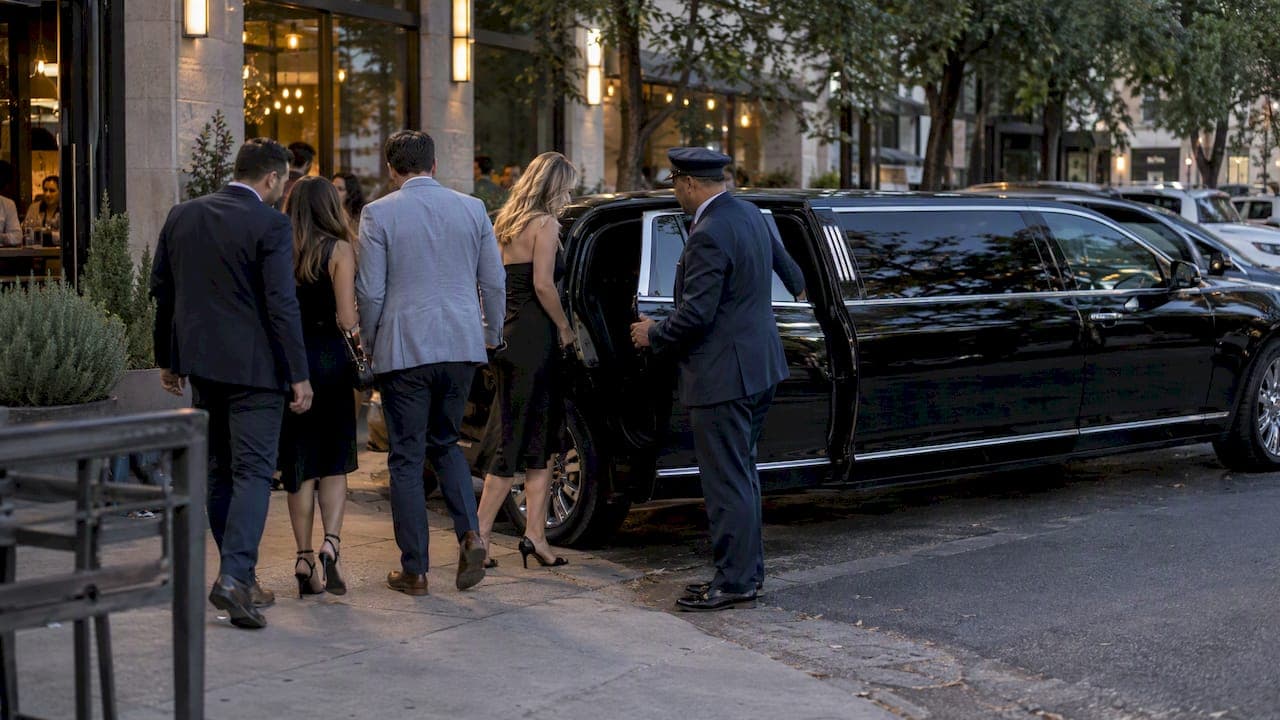
Hiring a limo or party bus is the most reliable way to run a progressive dinner without the stress of designated drivers, parking hunts, or scattered guests. Start by reserving your main-course restaurant and picking a compact neighborhood cluster for the other stops. Plan on about an hour per course with some buffer time between stops, and request a quote from a chauffeur service like APEX LIMO to lock in the schedule early.
TL;DR:
- Book the restaurant for the main course first, then fit appetizer and dessert reservations around its confirmed time; three or four stops keep pacing manageable.
- Plan 45–60 minutes per venue and add a 15–30 minute buffer for travel and settling in; keep drives within 10–20 minutes.
- Stretch limos suit small groups, sprinter vans fit medium parties, and party buses serve larger groups; confirm restroom access and step free entry before booking.
- Transport quotes may include hourly rates, minimum hours, mileage, waiting time, and service fees; confirm gratuity and agree how guests will split payment.
- Book transportation two to three weeks ahead for busy event weekends, and give a sober point person the full itinerary and chauffeur’s phone number.
Table of Contents
- Quick planning checklist for progressive dinners by limo
- Timing and routing: how should you schedule each stop?
- Which limo or bus fits your group size?
- Booking restaurants and coordinating reservations across stops
- Budgeting, payment, and tipping for a limo progressive dinner
- Safety, legal, and logistical considerations for limo progressive dinners
- Why APEX LIMO works well for a progressive dinner
- What actually makes a progressive dinner work
- How to book APEX LIMO for your progressive dinner
- FAQ
- Sources
Quick planning checklist for progressive dinners by limo
A progressive dinner works best when the logistics are nailed down before you send a single invite. Here's the order that keeps hosts from scrambling in the final week.
- Settle on guest count, date, and a tightly grouped neighborhood so stops stay close together.
- Reserve the main-course restaurant first, since it anchors every other reservation around it.
- Book appetizer and dessert spots once the main-course time is confirmed.
- Request an hourly quote from your transport provider that includes wait time between stops.
- Collect dietary restrictions and mobility needs, then pass them along to both the restaurants and the chauffeur.
- Send guests a timed itinerary with addresses, stop order, and a contact number for the night.
Skipping any of these steps usually shows up later as a scheduling conflict or a guest standing on a curb wondering where everyone went.
Timing and routing: how should you schedule each stop?
Most progressive dinners run into trouble not because the food is wrong, but because the clock is. The Wikipedia overview of progressive dinners describes the format as a multi-stop event, typically three to five locations covering appetizers, a main course, and dessert, where travel time between stops is central to making the night work.
- Budget about an hour per course and some additional time for transitions, as recommended by Apartment Guide's progressive dinner guide.
- Anchor the whole evening on your main-course reservation since it's the hardest one to move once it's booked.
- Keep stops clustered in one neighborhood and aim for drives of 10 to 20 minutes between venues.
- Factor in parking, loading zones, and each restaurant's service window before finalizing your route.
Pro Tip: Map your three or four stops on a single app before calling any restaurant. If the drive times between them exceed 20 minutes, swap one venue before you start booking.
Which limo or bus fits your group size?
The right vehicle depends on headcount as much as style. A stretch limo suits a smaller, intimate party, while larger groups need more seating and onboard amenities to stay comfortable between stops.
- A classic stretch limo comfortably handles smaller parties and keeps the evening feeling personal.
- A sprinter van works well for mid-size groups who want extra legroom and easier entry and exit.
- A party bus fits larger groups and typically includes more open seating and climate control for longer nights out.
- Ask about restroom access on larger buses, since multi-hour outings without a restroom onboard can be a real inconvenience.
- Request step-free access or space for mobility devices when you book if anyone in your group needs it.
- Confirm storage for coats, gifts, or takeout boxes, since progressive dinners often involve guests carrying items between stops.
- Clarify onboard rules for alcohol, music volume, and decorations, since these vary by vehicle and provider and can affect pricing.
Vehicle choice also shifts your hourly rate, so match capacity to your actual guest count rather than renting more vehicle than you need.
Booking restaurants and coordinating reservations across stops
Once your main-course restaurant confirms a time, build the rest of the night around it. Appetizer and dessert reservations should slot in before and after with enough buffer to account for the drive and a few minutes to settle at each table.
- Lock in the main-course reservation first, then work backward and forward from that time.
- Call restaurants during off-peak hours and explain the progressive format directly to a manager, who can often accommodate a custom schedule once they understand the plan.
- Ask each venue about corkage fees, separate checks, set menus, and how long they expect your table to be seated.
- Build extra buffer time into your vehicle booking so a late course at one restaurant doesn't collapse the rest of the schedule.
Three or four stops is the sweet spot according to Apartment Therapy's guide to throwing a progressive dinner, which notes that a shared digital invite listing the stop order, courses, and addresses helps guests arrive on time even if they join late or leave early.
Budgeting, payment, and tipping for a limo progressive dinner
Transport pricing usually comes down to a few predictable line items: an hourly vehicle rate, a minimum number of hours, mileage, any waiting or extra time, and a service fee. Event-transport providers commonly price this way, according to Denver Party Ride's planning guide, and those add-ons can shift your total more than the base rate does.
- Estimate per-person cost by dividing the full transport quote plus anticipated restaurant spend across your guest count.
- Tip chauffeurs separately from restaurant gratuities, since the two are rarely bundled into one bill.
- Decide ahead of time whether one person pays everything up front or the group splits costs digitally after the night.
- Ask your provider whether gratuity is included in the quoted rate or added separately at the end.
Safety, legal, and logistical considerations for limo progressive dinners
Multi-stop nights come with a few practical risks that are easy to overlook until they become a problem mid-evening. Confirm alcohol policies with both your restaurants and your transport provider, since open-container rules differ by vehicle and by city.
- Scout each drop-off and pickup spot ahead of time and share curb rules with your chauffeur before the night starts.
- Designate one sober point person per group and give the driver their phone number.
- Build in buffer time for delays, and ask whether a backup vehicle is available if something goes wrong.
- Confirm your transport provider's rules on alcohol, noise, and decorations before guests board.
Pro Tip: Share your full itinerary, including every address and the chauffeur's contact number, with your sober point person before the first stop. It's the easiest safeguard against a confused or separated guest.
Why APEX LIMO works well for a progressive dinner
Our fleet maps directly onto the way progressive dinners scale: a stretch limousine suits a smaller, intimate group, a sprinter van handles a mid-size party comfortably, and a party bus carries larger groups between stops without cramming anyone in.
- Chauffeurs are trained to handle multi-stop routing, including timed pickups and curbside coordination at each restaurant.
- Punctuality procedures can include buffer time between stops so one delayed course doesn't derail the night.
- Chauffeurs can be briefed on the night's stopping points in advance, so transitions happen without guests waiting curbside.
- Packages can be customizable, allowing a host to match vehicle size and hours to the number of stops planned.
This kind of event-specific coordination is also useful background for anyone planning transport around Austin's busiest event weekends, when availability tightens and lead time matters more.
What actually makes a progressive dinner work
The planning advice around progressive dinners tends to focus on the food: which course goes where, which restaurant to call first. That's backward. The single biggest point of failure in a multi-stop dinner is the gap between stops, not the meal itself. A kitchen running ten minutes behind is a minor annoyance. A vehicle that shows up late, or a driver who doesn't know the curb situation at your second stop, turns a planned evening into a scramble.

The conventional advice to "just book an Uber between stops" ignores exactly this. A rideshare driver has no idea about your schedule, your group size, or the fact that three more people are still finishing dessert. A chauffeured vehicle booked for the whole night, with buffer time built in, is the difference between a dinner that flows and one that fractures into separate arrivals.
If you prioritize one thing, prioritize the vehicle booking before the third restaurant reservation. The food will work itself out. The transportation won't, unless you plan it first.
— Jason
How to book APEX LIMO for your progressive dinner
Booking can be straightforward once you have a few details ready: your date, guest count, neighborhood cluster, the anchor time for your main-course reservation, and a vehicle preference. With those in hand, a quote typically comes together fast, and it may account for buffer time between stops rather than charging extra later.

- Review hourly packages and service details on our services page.
- Request a quote directly through our main booking page once your stops are confirmed.
| What to have ready | Why it matters |
|---|---|
| Date and guest count | Determines vehicle size and hourly minimum |
| Neighborhood cluster | Keeps drive times short between stops |
| Anchor restaurant time | Sets the schedule for every other reservation |
| Vehicle preference | Matches comfort and capacity to your group |
Event weekends book up quickly, so reserving two to three weeks ahead gives you the best shot at your preferred vehicle. If your evening ends with an overnight stay, a hotel with an in-room hot tub can make a nice final stop after the last course.
FAQ
What does a progressive dinner mean?
A progressive dinner is a multi-stop social event where guests travel to a different location for each course, often moving between three to five venues for appetizers, the main course, and dessert, according to the Wikipedia entry on progressive dinners. Chauffeured transport has become a common way to handle the travel between stops.
How do you throw a progressive dinner party?
Start by booking your main-course restaurant, then build appetizer and dessert reservations around that time. Limiting the night to three or four stops keeps the pacing manageable, a structure recommended by Apartment Therapy's progressive dinner guide, and sharing a timed itinerary with guests in advance reduces confusion.
How much time should you budget per stop?
Plan on 45 to 60 minutes at each venue plus a 15 to 30 minute buffer for travel and settling in, a guideline from Apartment Guide's planning advice. This buffer absorbs small delays without throwing off the rest of the schedule.
What size vehicle do you need for a progressive dinner?
Vehicle choice depends on guest count: a stretch limousine suits smaller, intimate groups, a sprinter van fits mid-size parties, and a party bus handles larger groups comfortably. Our fleet page lists current vehicle options and capacities for planning purposes.
How far in advance should you book transportation?
Booking two to three weeks ahead is a reasonable target, especially during busy event weekends when availability tightens. Reach out early with your date, stop count, and guest number so your quote can account for buffer time between venues.
Sources
- Progressive dinner - Wikipedia
- How to throw a progressive dinner party | Apartment Guide
- What Is a Progressive Dinner & How to Throw One | Apartment Therapy