
For most Austin conferences, the best approach is a timed hotel-to-venue shuttle circuit backed by a mixed fleet: chauffeured sedans and SUVs for VIPs, Sprinter or executive vans for small breakout groups, and motorcoach or minibus shuttles for clustered hotel blocks. Pair that with fixed service windows, an onsite operations lead, and a single attendee communications workflow, and you have a program that runs without surprises.
Three things determine whether it actually works:
- Reliability: Fixed service windows (not "on demand") so drivers, hotel concierges, and attendees all know exactly when the next vehicle departs.
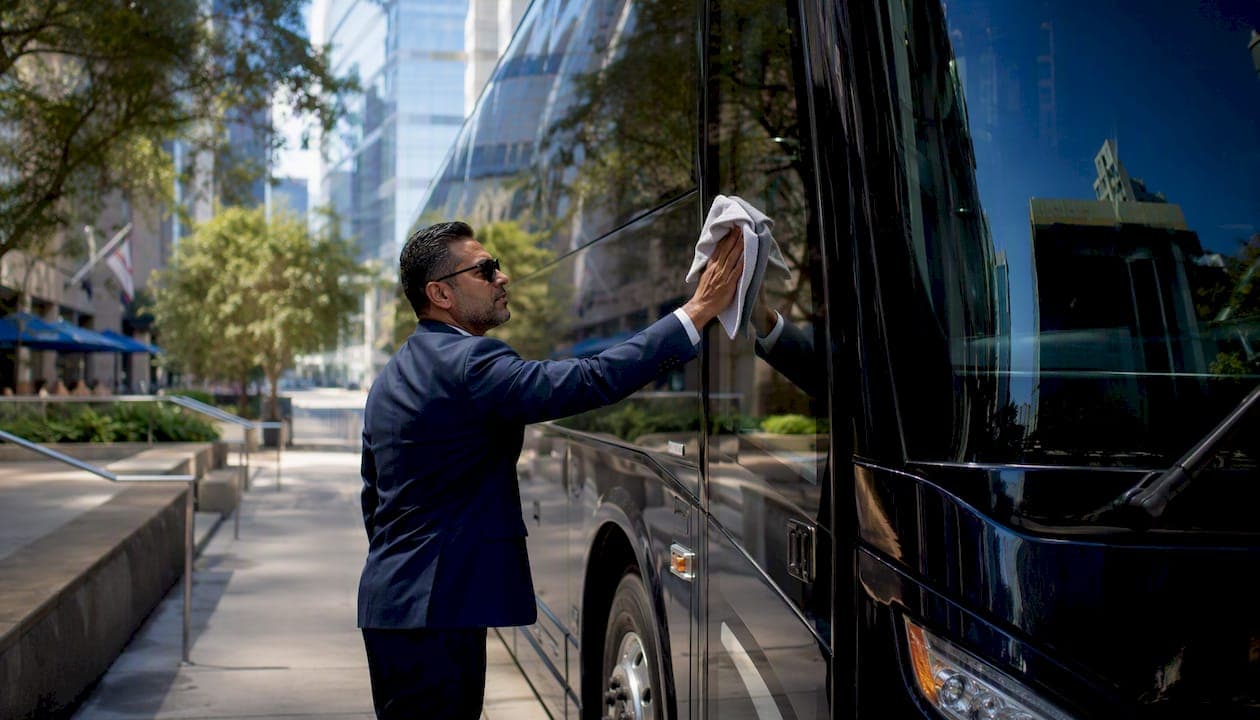
- Guest experience: Uniformed, trained chauffeurs who handle luggage, greet by name for VIPs, and communicate proactively when a run is delayed.
- Contingency: At least one spare vehicle on standby and 15-minute buffers built into every downtown loop.
To get a custom quote from APEX LIMO or use the sample RFP snippet in Section 9, visit APEX LIMO's services page and have your attendee count, hotel list, and event dates ready.
Key Takeaways
Premium conference transport in Austin works when timed shuttle circuits, a mixed fleet, and onsite staffing are planned together from the start, not assembled at the last minute.
| Point | Details |
|---|---|
| Book early | Motorcoach inventory in Austin books out 6–12 weeks ahead; VIP vehicles need 2–8 weeks depending on the event period. |
| Use timed circuits | Fixed service windows reduce wait times, consolidate loading, and make attendee communications straightforward. |
| Mix your fleet | Pair a motorcoach for hotel-block volume with chauffeured SUVs for VIPs to control costs without sacrificing the premium experience. |
| Build in buffers | Add 15 minutes to downtown loops and 30 minutes to AUS airport runs during peak traffic hours. |
| APEX LIMO for Austin | APEX LIMO provides the full fleet mix, trained chauffeurs, and onsite staffing that a premium conference transport program requires. |
Table of Contents
- What are the key priorities for premium conference transport in Austin?
- Why do timed shuttle circuits outperform ad hoc rides for conferences?
- How do you build a shuttle plan for Austin that actually runs on time?
- How do you match vehicle types to attendee movement and service expectations?
- What Austin-specific routing and scheduling issues should you plan around?
- Which operational details actually separate premium service from commodity service?
- When should you book, and what drives the cost of premium conference transport?
- What does a practical sample shuttle timeline and planner checklist look like?
- How does APEX LIMO meet premium conference transport needs in Austin?
- A planner's honest take on conference transport in Austin
- Ready to get a quote for your Austin conference transport?
- Useful sources and resources for Austin conference transport planning
What are the key priorities for premium conference transport in Austin?
Reliability and guest experience are the two non-negotiables, but the full planner checklist is longer than most RFPs reflect. The Austin CVB's meeting-planner toolkit lists the categories of transport available to Austin planners, and the consistent theme is this: trusted local partners, booked early, with clear operational agreements.
Here is what belongs in every vendor contract or RFP:
- On-time reliability: Require a written on-time performance standard and ask how the vendor handles delays.
- Passenger comfort and branding: Specify vehicle condition standards, interior cleanliness, and whether branded signage or welcome cards are included.
- Baggage handling: Clarify whether drivers assist with luggage and what the policy is for oversized bags or AV equipment.
- ADA accessibility: Confirm at least one ADA-accessible vehicle is available for every service window, not just on request.
- Clear pickup and drop zones: Get written confirmation of staging locations at each hotel and the venue before the event.
- Driver training and identification: Require uniformed drivers with visible credentials and ask about background check protocols.
- Communication chain: Specify who the planner calls if a vehicle is late, and who the driver calls if a pickup location changes.
Each of these priorities carries a cost implication. ADA vehicles typically add to the base rate. Onsite staffing (an ops lead plus a staging marshal) adds a few hundred dollars per day but cuts confusion dramatically. Branded signage is usually a flat add-on, but it needs to be ordered in advance.
Pro Tip: When writing your RFP, ask vendors to respond to each checklist item individually rather than submitting a general capabilities statement. Vendors who skip items or give vague answers on ADA access or driver credentialing are telling you something important.
Why do timed shuttle circuits outperform ad hoc rides for conferences?
The short answer: predictability. When attendees know a shuttle departs the Marriott at 8:00 AM, 8:20 AM, and 8:40 AM, they plan around it. When they are told to "request a ride when ready," you get a wave of simultaneous requests, a 20-minute wait, and a packed general session that starts late.
Timed circuits also consolidate loading and unloading into designated zones, which matters enormously at venues like the Austin Convention Center where loading dock access is controlled and street parking near the entrance is limited.
Circuits vs. ad hoc rides:
Circuits:
- Predictable arrival windows that planners can publish in the event app
- Consolidated loading reduces curbside congestion
- Simpler driver briefings (fixed route, fixed stops, fixed times)
- Easier to staff with an onsite marshal
- Lower per-head cost at scale
Ad hoc rides:
- More flexible for small VIP groups or late arrivals
- No fixed schedule to communicate or enforce
- Surge pricing and availability gaps during peak event windows
- No guaranteed vehicle standard or driver training level
- Harder to track or troubleshoot in real time
A practical circuit layout for a downtown Austin conference looks like this: hotels cluster into two or three geographic groups (say, the Rainey Street corridor, the Domain, and the Convention Center hotel block). Each cluster gets its own loop with a staging lot near the venue as the common drop point. Vehicles cycle continuously through their assigned cluster during the morning arrival window, then compress into a single return loop for the evening. VIP sedans run parallel to the main circuit on a separate, smaller schedule.
How do you build a shuttle plan for Austin that actually runs on time?
Start with data, not assumptions. Here is the sequence that works:
- Gather attendee hotel data. Pull the room block report from your hotel partners. You need the number of rooms per property, not just the hotel names.
- Cluster hotels by geography. Group properties within a half-mile of each other into a single circuit stop. Use Google Maps in traffic view during your target service window to estimate realistic drive times between clusters.
- Assign vehicle types. A cluster of 80 attendees needs a 55-passenger motorcoach or two 28-passenger minibuses. A cluster of 12 VIPs needs two chauffeured SUVs. Match capacity to the room block, not the total event headcount.
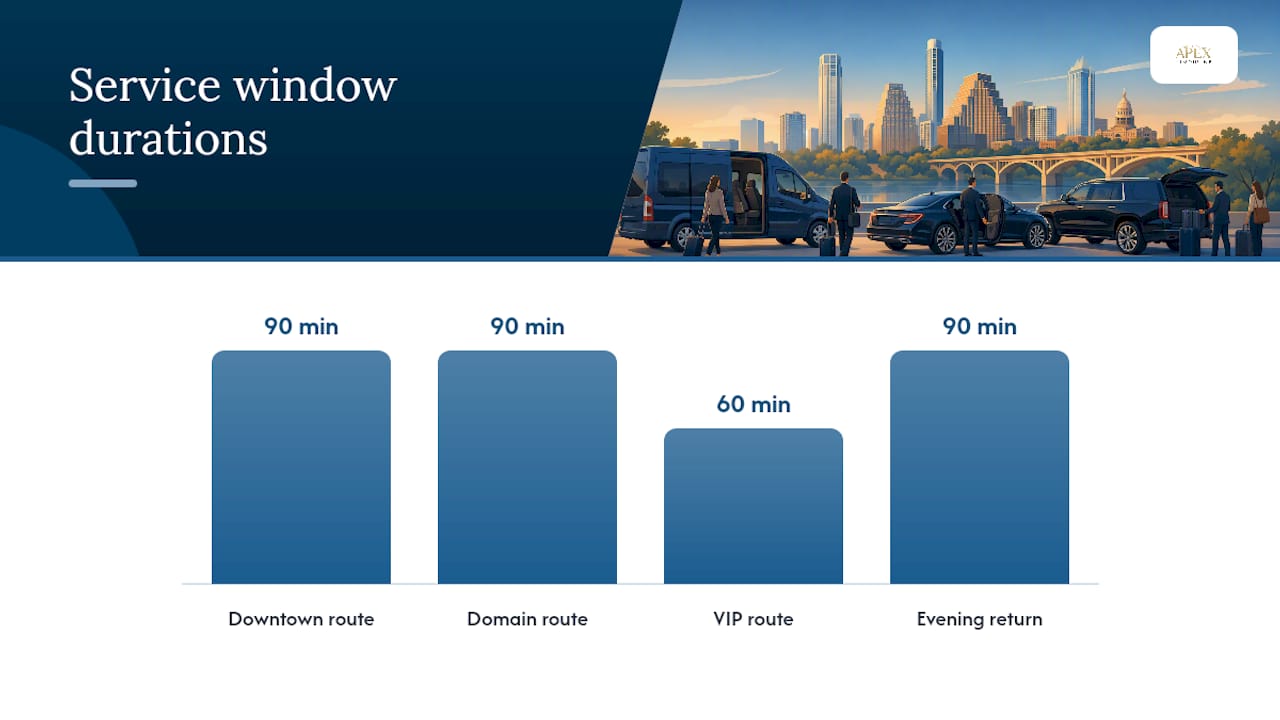
- Set service windows. A service window is the span of time a vehicle is actively running a route. For a morning arrival, a 90-minute window (7:30–9:00 AM) covers most attendees. For an evening return after a dinner event, a 60-minute window is usually sufficient.
- Build the manifest and communications. Create a one-page attendee reference card with pickup times, pickup locations, and a single contact number for transport questions.
Sample service-window template:
| Route | Service Window | Frequency | Vehicle Type |
|---|---|---|---|
| Downtown hotel cluster → venue | 7:30–9:00 AM | Every 20 min | 55-passenger motorcoach |
| Domain hotel cluster → venue | 7:45–9:15 AM | Every 30 min | 28-passenger minibus |
| VIP hotel → venue | 8:00–9:00 AM | On call | Chauffeured SUV |
| Venue → hotels (evening) | 9:00–10:30 PM | Every 30 min | Mixed fleet |
For airport runs, add 30 minutes to any estimated drive time during morning rush (7:00–9:00 AM) or afternoon rush (4:30–6:30 PM). Austin-Bergstrom International Airport (AUS) is roughly 20 minutes from downtown in light traffic but can stretch to 45 minutes during peak periods.
Sample attendee communication phrasing:
Keep it short. Attendees do not read long transport instructions.
Pro Tip: Brief hotel concierges the day before the event, not the morning of. Give them a printed one-pager with departure times and the coordinator's number. A well-briefed concierge is your best on-the-ground communications asset.
How do you match vehicle types to attendee movement and service expectations?
The right vehicle mix depends on group size, route length, and the experience level you are delivering. Here is a practical breakdown from APEX LIMO's full fleet and service catalog:
- Chauffeured sedans and SUVs: Best for VIP transfers, C-suite arrivals, and airport pickups where individual attention matters. Capacity: 3–6 passengers. These vehicles signal premium treatment immediately and allow for personalized service (name cards, preferred beverages, luggage handling).
- Sprinter and executive vans: Ideal for small breakout groups (8–14 passengers), speaker transfers, or sponsor VIP shuttles. More intimate than a bus, more efficient than running multiple sedans.
- Minibuses (24–35 passengers): The workhorse for mid-sized hotel clusters. Comfortable enough for a 20-minute ride, easy to stage at most hotel entrances, and cost-effective per head.
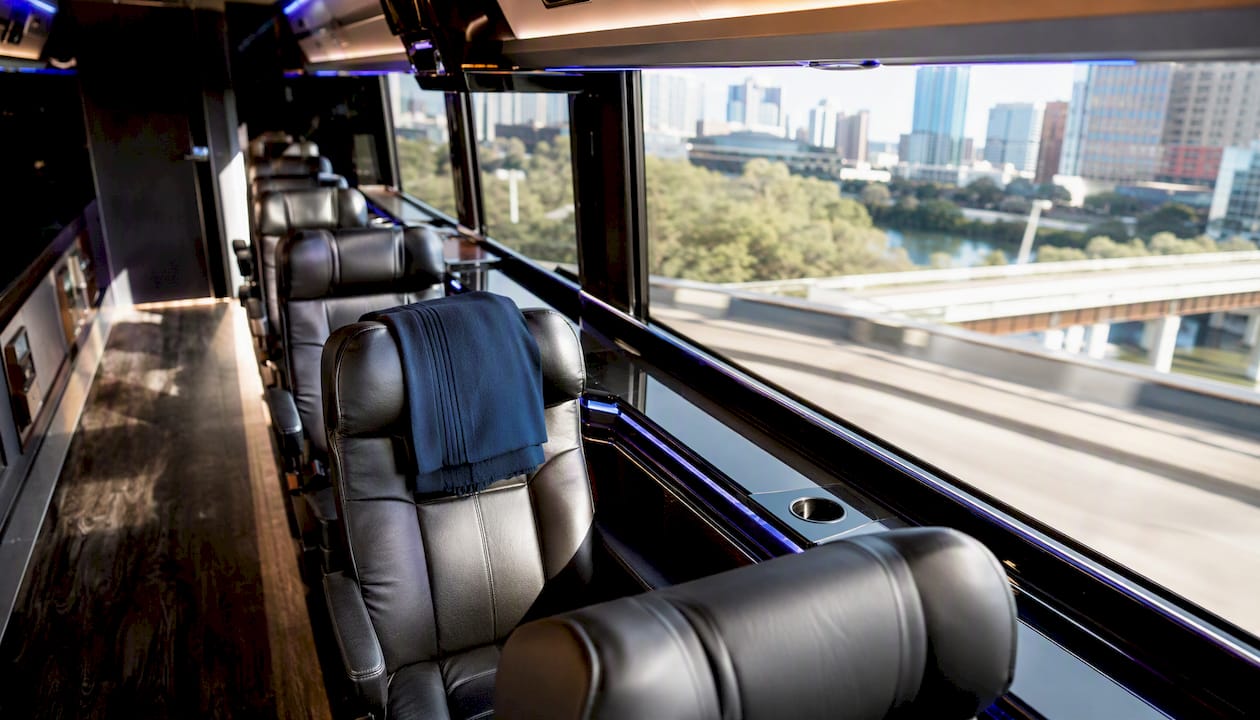
- Full motorcoaches (45–55 passengers): Right for large hotel blocks or end-of-day return runs when the full attendee group moves at once. Many coaches now include Wi-Fi and power outlets, which matters for groups traveling 45+ minutes.
ADA accessibility: confirm with your vendor that at least one vehicle per service window has a lift or ramp. Do not assume it is standard.
Pro Tip: Running a mixed fleet (one motorcoach for the main hotel block, one Sprinter for VIPs) often costs less than running all sedans while still delivering a premium experience where it counts most. The motorcoach handles volume; the Sprinter handles perception.
Full-sized coaches with amenities like Wi-Fi and reclining seats can meaningfully improve the experience for groups on longer transfers, such as Hill Country venue runs or airport shuttles that stretch past 30 minutes.
What Austin-specific routing and scheduling issues should you plan around?
Austin's growth has made its traffic patterns less predictable than they were five years ago, and several local factors can derail a well-designed shuttle plan if you do not account for them.
- Downtown congestion: Congress Avenue and the blocks surrounding the Austin Convention Center are consistently congested from 7:30–9:30 AM and 4:30–7:00 PM on weekdays. Build 15-minute buffers into any downtown loop during these windows.
- SXSW and ACL season: March and October bring city-wide street closures, permit restrictions, and dramatically reduced parking near major venues. If your conference overlaps with either festival, confirm loading zone access at least 60 days out and expect higher vehicle rates.
- Austin-Bergstrom (AUS) timing: The airport's pickup and drop-off zones are actively managed. Vehicles cannot stage in the cell phone lot indefinitely. Coordinate flight manifest data with your transport vendor so drivers are dispatched to meet actual arrivals, not scheduled arrivals.
- Convention Center loading and egress rules: The Austin Convention Center has specific rules about which entrances vehicles may use and during which hours. Confirm these directly with the venue's event services team before finalizing your staging plan. APEX LIMO's Austin Convention Center shuttle guide covers the key staging and coordination considerations.
- Hill Country transfers: Venues in Dripping Springs, Wimberley, or Fredericksburg add 45–90 minutes each way. These runs require a different vehicle (full coach or executive van), a longer service window, and a driver who knows the routes, since GPS routing on some Hill Country roads is unreliable.
- Permits and loading zones: The City of Austin requires permits for some curbside staging operations. Your vendor should handle this, but confirm it is in the contract.
Recommended schedule buffers by route type:
- Downtown loop: 15 minutes per circuit
- AUS airport run: 30 minutes each direction during peak hours
- Hill Country venue transfer: 20 minutes each direction, plus a driver rest stop on runs over 90 minutes
Which operational details actually separate premium service from commodity service?
The difference between a premium conference transport program and a basic shuttle operation usually comes down to three things: staffing, signage, and proactive communication. Most commodity vendors handle the driving. Premium vendors handle the experience around the driving.
Staffing:
- Onsite operations lead: One person whose only job is transport coordination. They are not driving; they are watching the circuit, communicating with drivers, and solving problems before attendees notice them.
- Staging marshal: Positioned at the hotel pickup point or venue drop zone to direct attendees, manage luggage, and confirm headcounts before each departure.
- VIP concierge: For high-profile attendees, a dedicated point of contact who confirms pickup times, handles last-minute changes, and meets the vehicle.
Signage and guest flow:
| Touchpoint | What to provide | Why it matters |
|---|---|---|
| Hotel lobby | Branded shuttle sign with departure times | Reduces concierge questions and late arrivals |
| Hotel entrance | Curbside marshal with handheld sign | Directs attendees to correct vehicle |
| Venue drop zone | Directional signage to registration | Prevents bottlenecks at the entrance |
| Event app | Real-time shuttle status updates | Reduces calls to the transport coordinator |
Safety and driver standards: Require background checks for all drivers as a contract term, not a request. For events with government officials, executives, or high-profile speakers, ask specifically about the vendor's protocol for credentialing and secure transfers. APEX LIMO's luxury transport guide outlines the vehicle condition and chauffeur training standards that distinguish a premium provider from a commodity one.
When should you book, and what drives the cost of premium conference transport?
Lead times:
- Chauffeured sedans and SUVs: 2–4 weeks for standard events; 6–8 weeks for large conferences or events overlapping with SXSW, ACL, or Formula 1 weekend.
- Sprinter and executive vans: 4–6 weeks.
- Motorcoaches and minibuses: 6–12 weeks. Full coach inventory in Austin is limited, and major events book out the city's fleet quickly.
- Full multi-vehicle programs with onsite staffing: 8–12 weeks minimum to allow for route planning, hotel briefings, permit applications, and driver assignments.
The Austin CVB's transportation resource reinforces this: working with trusted local partners and planning early is the consistent recommendation for securing preferred pickup and loading zones.
Primary cost drivers:
- Vehicle type and count
- Total hours of service (including staging time before the first pickup)
- Onsite staffing (ops lead, staging marshal)
- Permit and parking fees
- Overtime beyond the contracted service window
- Gratuity (often 18–20% and sometimes not included in the base quote)
- Fuel surcharges for long-distance runs
What to request in every vendor quote:
- Hourly rate vs. flat-rate breakdown (and which applies to your service windows)
- Overtime rate per hour beyond the contracted window
- Staging fees (time the vehicle is on-site before the first pickup)
- Parking and permit costs (itemized, not bundled)
- Toll charges for airport and Hill Country routes
- Gratuity policy
- Cancellation and modification terms
What does a practical sample shuttle timeline and planner checklist look like?
Sample one-day shuttle itinerary (500-person conference, downtown Austin):
Morning arrival loop (7:30–9:30 AM):
- 7:30 AM: First motorcoach departs downtown hotel cluster, arrives venue 7:45 AM
- 7:50 AM: VIP SUVs begin individual pickups from headquarter hotel
- Every 20 minutes: Motorcoach circuit continues through 9:30 AM
Mid-day venue shuttle (12:00–1:30 PM):
- Sprinter vans run on-call for speaker and sponsor transfers between venue and nearby hotels
Evening return loop (9:00–10:30 PM):
- 9:00 PM: First motorcoach departs venue
- Every 30 minutes: Return circuit through 10:30 PM
- VIP SUVs available on-call through 11:00 PM
Pre-event checklist:
- Confirm loading zone permits with the City of Austin and the venue
- Brief hotel concierges with printed departure schedules (48 hours before event)
- Confirm ADA vehicle availability for each service window
- Send attendee transport reference card via event app and email
- Walk the staging area at the venue with the ops lead
Day-of checklist:
- Ops lead on-site 30 minutes before first departure
- Confirm all vehicles and drivers checked in by 7:00 AM
- Verify signage is posted at all hotel pickup points
- Confirm driver contact list is current and shared with the planner
- Check in with staging marshal at the venue drop zone
Sample RFP snippet:
How does APEX LIMO meet premium conference transport needs in Austin?
APEX LIMO's conference group transportation guide maps directly to the planner checklist above. The fleet covers every tier a conference program needs: sedans and SUVs for VIP and executive transfers, Sprinter and executive vans for small groups, stretch limos for special occasions, and buses for large hotel-block shuttles.
Key capabilities that align with planner priorities:
- Fleet depth: Sedans, SUVs, vans, stretch limos, and buses available for mixed-fleet programs, so you are not patching together multiple vendors.
- Chauffeur training: Uniformed, professionally trained drivers with background checks as a standard, not an add-on.
- Onsite staffing: Ops leads and staging support available for multi-vehicle programs.
- Austin-specific routing knowledge: Familiarity with Convention Center staging rules, AUS pickup protocols, and Hill Country routes.
- Bespoke packages: Custom service windows, branded signage, and VIP concierge handling available on request.
For executive roadshow or smaller VIP-heavy programs running alongside a conference, APEX LIMO's executive roadshow guide covers the specific logistics of high-touch, small-group transfers.
Pro Tip: When requesting a quote, send your hotel room block report and a draft service-window schedule rather than just an attendee count. Vendors who receive structured data can quote more accurately and flag routing issues before they become day-of problems.
A planner's honest take on conference transport in Austin
Most conference transport programs fail at the same point: the gap between what the planner specified and what the ops team actually executes on the day. A contract that says "premium service" means nothing if the driver does not know which hotel entrance to use or the staging marshal does not show up until 10 minutes after the first departure.
The operational details in this guide, particularly the onsite staffing structure and the hotel concierge briefing, are where premium programs actually separate themselves from commodity ones. A motorcoach is a motorcoach. What makes the experience feel premium is the person standing at the hotel entrance with a sign, the driver who already knows your VIP's name, and the ops lead who calls you before you call them.
Austin's growth also means the city's transport infrastructure is under more pressure than it was a few years ago. Planners who booked the same vendor at the same venue last year and assumed the same timing would work in 2026 have been caught out by new construction, changed loading zone rules, and tighter competition for coach inventory. Build the buffers. Book early. Brief the concierges.
Ready to get a quote for your Austin conference transport?
APEX LIMO handles the full spectrum of premium conference transport in Austin, from single VIP airport pickups to multi-vehicle, multi-day shuttle programs for large conferences. The concrete difference for planners: one vendor, one ops lead, one contact number, and a fleet that covers every tier from chauffeured sedan to full motorcoach.

To get a custom quote, visit APEX LIMO's booking page and have the following ready:
- Total attendee count and hotel list with room block numbers
- Event dates and service windows (morning arrival, evening return, mid-day shuttles)
- Venue name and any known loading zone or staging constraints
- VIP list and any special handling requirements (ADA, security, luggage)
The team can turn around a line-item quote quickly when you provide structured data. Reach out early, especially if your event falls during SXSW, ACL, or Formula 1 weekend.
Useful sources and resources for Austin conference transport planning
- APEX LIMO Conference Group Transportation Guide — operational planning guidance specific to Austin conferences, including timed circuits, fleet selection, and onsite staffing.
- APEX LIMO Austin Convention Center Shuttle Guide — venue-specific staging and coordination tips for planners using the Convention Center.
- Corporate Event Shuttle Service: A Planner's Guide — foundational guide on how corporate shuttle programs operate and what to expect when outsourcing event transport.