

A pre-booked private car or a dedicated shuttle is the single best move for a stylish, reliable influencer arrival in Austin. It gives you curb control, predictable timing, and a branded first impression that rideshare pickup lines simply cannot match. The next step is concrete. Book the vehicle now, then confirm meet-and-greet instructions, driver contact, and a written pickup point before wheels touch down at Austin-Bergstrom.
TL;DR:
- Booking a private chauffeur or pre-arranged shuttle at least four weeks in advance is essential for major events or when traveling in large groups to ensure availability and smooth arrival.
- Confirm that your driver has real-time flight tracking, specific meet instructions, current vehicle photos, and proper credentials before finalizing the booking to prevent delays or misunderstandings.
- Incorporate a 20 to 30-minute buffer time from Austin-Bergstrom Airport to downtown, especially during festivals or conferences, to account for potential traffic or delays.
- Coordinate directly with the venue or hotel in advance to secure loading zone access, parking instructions, and security clearances, avoiding last-minute issues that could disrupt timing.
- Treat transport as a content opportunity by planning curbside shots, lighting, and permissions beforehand, turning the transfer into an on-brand moment rather than a mere logistical step.
Table of Contents
- Best Transfer Options for an Influencer Arrival in Austin
- When to Book: Timing for Austin's Event Calendar
- Your Arrival Day, Step by Step
- Venue Pickup and On-Site Staging
- Turning the Transfer Into On-Brand Content
- What to Ask When You Book a Chauffeur for an Austin Arrival
- What Happens When the App Dies or the Flight Gets Delayed
- A Sample Arrival Timeline That Actually Works
- Working With Photographers, Stylists, and Assistants on the Ground
- Keeping Everyone on the Same Page in Real Time
- Why the Arrival Deserves More Planning Than It Gets
- Book Your Austin Arrival With APEX LIMO
- Sources
- FAQ
Best Transfer Options for an Influencer Arrival in Austin
Your transfer choice depends on group size, luggage, and how much of the arrival you plan to film. Getting this decision right is the foundation of any influencer arrival planning Austin campaign builds on, because everything downstream (timing, content capture, venue check in) depends on how the car gets there.
- Private car or limo: Best for solo talent or high-profile arrivals. You get direct curb pickup, a driver who knows your schedule, and a vehicle that looks intentional on camera rather than incidental.
- Pre-arranged shuttle or minibus: Best for entourages, six or more people, or a team traveling with equipment. It keeps everyone together and cuts the per-person cost without sacrificing staging control.
- Rideshare: Flexible and easy to book last minute, but the pickup area at Austin-Bergstrom sits beneath the Consolidated Rental Car Facility, which routinely adds walking and waiting time during peak arrivals.
- CapMetro Route 20: The budget option, running between AUS and downtown or the UT campus for roughly $1.25 one way. It works fine for light luggage and a loose schedule, not for a camera-ready entrance.
Run through a short checklist before deciding: how many people are arriving, how much luggage and gear is coming with them, how tight the window is between landing and the first event, and whether any part of the arrival needs to be filmed. A solo creator with one carry-on and a flexible afternoon can gamble on rideshare. A five-person team arriving two hours before a brand activation cannot.
When to Book: Timing for Austin's Event Calendar
Austin's event calendar creates real demand swings, and transfer availability tightens fast around them. SXSW-scale conferences and major festivals push up both hotel rates and transportation demand, which means the vehicles you want get booked out weeks in advance.
- Major conferences or festival weeks: Book six to ten weeks out. Vehicle inventory disappears fast once a convention fills downtown hotels.
- Standard brand events or launches: Two to four weeks is usually enough, though earlier is always safer.
- Groups of four or more: Add another week to your lead time, since larger vehicles are a smaller pool to draw from.
- Hosted press or influencer trips: If Visit Austin or a brand partner is coordinating your visit, note that hosted trip requests need at least four weeks' notice, and Visit Austin does not arrange your ground transportation. That part is on you or your handler.
Once the vehicle is booked, lock in four confirmations in writing: flight tracking on the driver's end, a direct driver contact number, current vehicle photos, and a specific meet location description, not just "at the airport."
Pro Tip: Save your driver's number and the hotel address as a screenshot, not just in a booking app. If your phone drops signal or the app glitches curbside, you still have what you need in your camera roll.
Your Arrival Day, Step by Step
This is the sequence that keeps an arrival looking effortless instead of scrambled.
- Before landing: Confirm the driver has your flight number, has an offline backup contact, and knows the staging plan for photos.
- Deplaning: Head straight to baggage claim. Your driver should already have your flight tracked and be positioned near the pickup point you confirmed in writing.
- Curbside meet: At AUS, private vehicles typically stage closer to the terminal than rideshare, which is funneled toward the Consolidated Rental Car Facility. Confirm the exact meeting spot ahead of time so nobody is circling.
- Quick touch-ups: Handle luggage loading first, outfit and hair touch-ups second. Most usable arrival footage happens at the vehicle door, not in the terminal.
- Travel time: Budget 20 to 30 minutes from AUS to downtown, more if you land during rush hour.
Pro Tip: Airports and hotel lobbies often have filming restrictions. Confirm you're clear to shoot before you plan a curb reveal, not after your videographer is already rolling.
Venue Pickup and On-Site Staging
The arrival doesn't end at the hotel door. Loading zones, valet lines, and security checkpoints can undo a perfectly timed transfer if nobody coordinated with the venue ahead of time.
- Request loading-zone access or valet directly with the hotel or venue, ideally when you confirm your reservation, not the morning of.
- Send your arrival window and guest list to venue operations and security so your car isn't stopped at a checkpoint that doesn't recognize your name.
- Ask about peak-time access rules. Busy event days often mean restricted loading zones, and a blocked curb turns a smooth entrance into a scramble.
- Get a named on-site contact before you arrive, along with parking instructions and a basic emergency plan, so there's a real person to call if something shifts.
A five-minute email exchange with venue operations the week before saves you from finding out about a closed loading dock while your driver is idling in traffic.
Turning the Transfer Into On-Brand Content
The ride itself is free content if you plan for it. A curb reveal, a door-hop shot, quick interior B-roll, or a chauffeur handoff moment all read as intentional when they're framed and lit, and sloppy when they're not.
- Shortlist concepts before you land: curb reveal, door-open shot, interior detail pan, driver handoff.
- Prioritize light over gear. Natural light at the curb usually beats a ring light fumbled in a moving car.
- Check permission first. Confirm venue and airport filming rules before setup, not while your camera operator is already framing the shot.
- Brief your photographer on a two-minute shot list so nobody is improvising curbside while a driver waits.
Pro Tip: Treat the transfer itself as a content channel, not just a way to get somewhere. Curated hospitality on arrival sets the tone for everything else in the campaign.
What to Ask When You Book a Chauffeur for an Austin Arrival
APEX LIMO builds its Austin service around exactly this kind of moment: a distinguished, brand-forward arrival for weddings, corporate events, and high-visibility appearances where the vehicle and the driver are part of the presentation, not an afterthought. Chauffeurs go through training focused on comfort and safety, and clients are guided through what a well-run pickup should look like from booking to curbside handoff. Customer testimonials often mention vehicle condition and driver professionalism, factors important to how an arrival photographs.
Before you confirm any booking, ask for:
- Real-time flight tracking so the driver adjusts to delays automatically.
- Specific meet-and-greet instructions, not a general terminal name.
- Current photos of the actual vehicle you'll be riding in.
- Chauffeur credentials and any on-board amenities relevant to your shoot or schedule.
What Happens When the App Dies or the Flight Gets Delayed
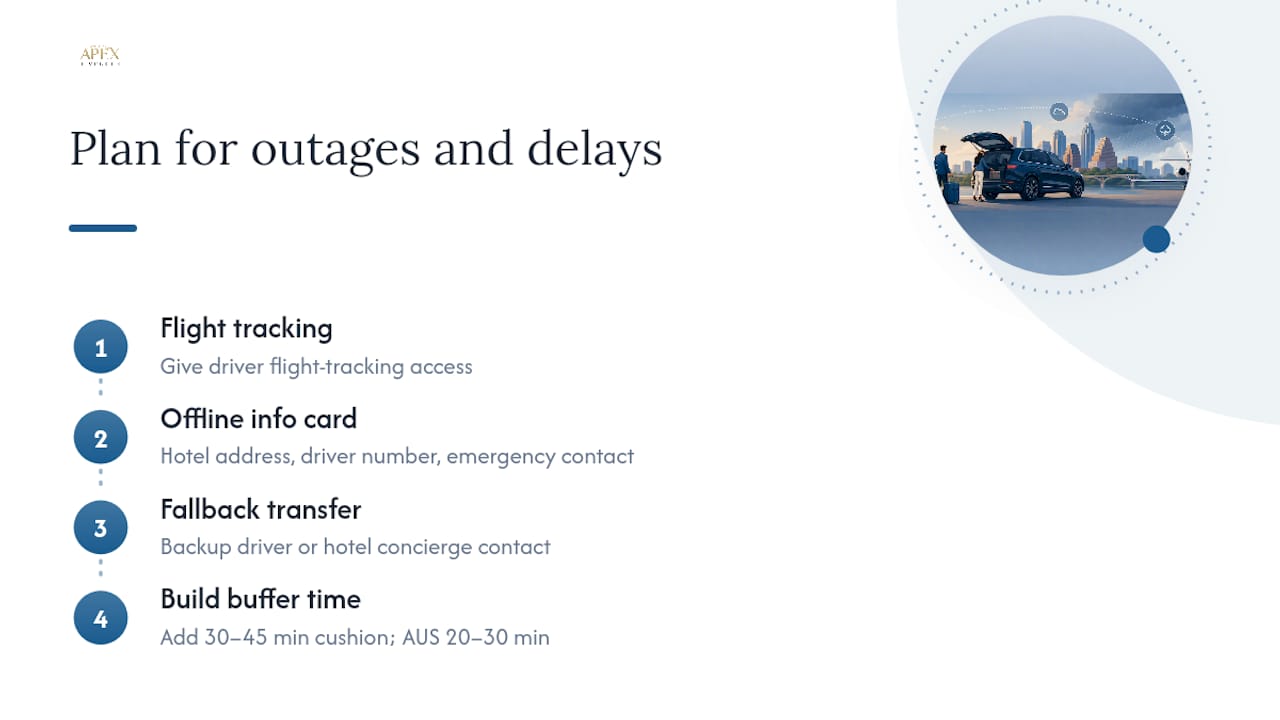
Plan for the outage, not just the delay. A flight running two hours late is annoying but manageable if your driver already knows. A dead phone battery or a cellular dead zone at baggage claim with no backup plan is what turns a manageable delay into a missed booking.
Build in three layers of backup. First, give your driver flight-tracking access so a delay updates their schedule without you having to call anyone. Second, save a printed or screenshotted card with the hotel address, driver's direct number, and a local emergency contact, since insiders in the airport-transfer world routinely advise keeping this offline in case an app or cell network goes down during a high-traffic event weekend. Third, know your fallback transfer option. If your primary car is stuck in unexpected traffic or a rideshare pickup queue balloons, having a second contact, whether that's a hotel concierge line or a backup driver, saves the arrival.
Buffer time matters more than people think. If your event call time is 4:00 p.m., don't book a car that lands you at 3:55. Build in a 30 to 45 minute cushion for anything tied to a flight, since AUS traffic to downtown runs 20 to 30 minutes under normal conditions and longer during festival weeks or major conferences. The cushion is what keeps a delayed bag or a slow jet bridge from becoming a missed content window.
A Sample Arrival Timeline That Actually Works
Here's how a well-sequenced influencer arrival typically runs, mapped hour by hour for a mid-morning flight into AUS.
T-minus 2 weeks: Vehicle booked, meet-and-greet instructions confirmed, venue loading-zone request submitted.
T-minus 24 hours: Driver contact reconfirmed, flight number shared, offline backup contact saved to phone and printed.
Landing: Driver receives automatic flight-tracking update, positions at the confirmed pickup point.
0 to 15 minutes after landing: Baggage claim, quick check-in with driver by text or call to confirm exact location.
15 to 20 minutes: Vehicle load, first content capture (curb reveal or door shot) if lighting and permissions allow.
20 to 50 minutes: Transfer to venue or hotel, allowing for the standard 20 to 30 minute drive plus buffer.
Arrival at venue: Valet or loading-zone handoff, quick styling touch-up, security check-in using the guest list submitted in advance.
Check-in sequencing: Luggage to room or green room first, wardrobe and hair touch-up second, content team briefing third, so nobody is rushing the first real shot of the day.
This sequence holds up because each step has a built-in confirmation point. If the driver isn't where expected, you know within minutes, not after you've already wasted twenty of them standing at the wrong curb.
Working With Photographers, Stylists, and Assistants on the Ground
An arrival with a content team attached needs its own choreography, separate from the transportation plan. The driver gets you there; the ground team makes sure the moment is captured and the look holds up.
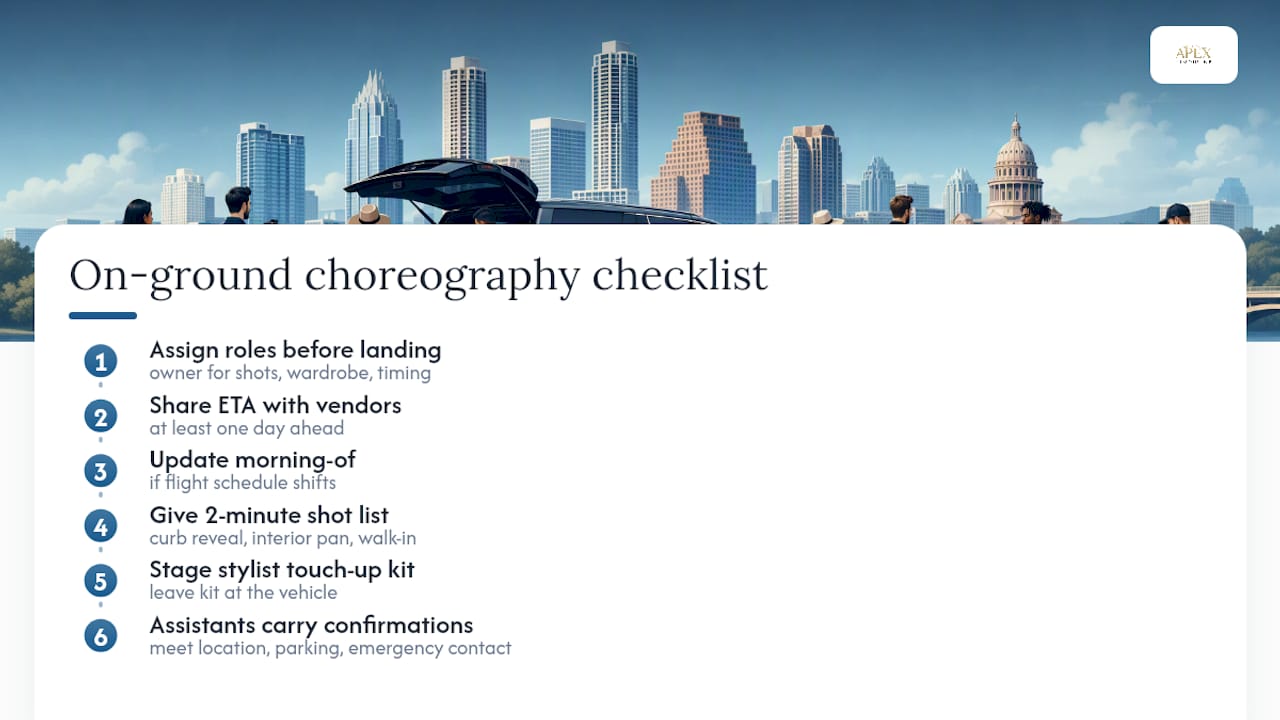
Assign roles before landing, not curbside. Someone owns the shot list, someone owns wardrobe and touch-ups, and someone owns timing, calling out when the group needs to move so the driver isn't circling the block. Share the transfer's estimated arrival window with every vendor at least a day ahead, and update it the morning of if the flight shifts.
Give your photographer or videographer a two-minute shot list rather than open-ended creative freedom at the curb. A curb reveal, one interior pan, and a walk-in shot cover most short-form needs without turning a five-minute pickup into a twenty-minute production that backs up the loading zone. If you're working with a larger production or campaign team, tools built for event-day operations, like Jubiliq, can help keep transfer times, vendor call times, and on-site scheduling synced in one place instead of scattered across text threads.
Stylists should stage touch-up kits at the vehicle, not inside the venue, since most usable footage happens in that thirty-second window between the car door and the entrance. Assistants should carry the written confirmations (meet location, parking instructions, emergency contact) so no single person is the only one holding critical information.
Keeping Everyone on the Same Page in Real Time
The arrival plan only works if everyone involved is working off the same information at the same time. A group text with a photo of the itinerary is not a communication system; it's a liability once a flight shifts or a driver hits traffic.
Set up one shared thread or lightweight coordination tool before the day starts, with the driver, the point person, and any on-ground vendors included. Full-service influencer campaign management already leans on this kind of setup: itinerary planning and real-time coordination let the talent focus on content instead of logistics, and the same principle scales down to a single arrival.
Assign one person as the point of contact for the driver, not the whole group. That person relays flight updates, confirms the pickup point, and pushes timing changes to everyone else. For multi-stop days involving catering or vendor deliveries alongside the arrival, a platform like CaterFlow AI can help keep food and beverage timing aligned with the transfer schedule so nothing collides at the venue door.
Keep a written backup of every key detail (meet location, driver number, hotel address, emergency contact) outside the app ecosystem. Screenshots work. A printed card works better if a phone dies. The goal is redundancy, not more apps.
Why the Arrival Deserves More Planning Than It Gets
Most influencer arrival advice treats transportation as a checkbox: book a car, get to the hotel, move on. That framing misses what actually matters. The arrival is the first piece of content a campaign produces, often before a single planned shot happens at the actual event, and it either sets a polished tone or it doesn't.
The conventional wisdom of "just grab a rideshare, it's easier" falls apart the moment you factor in AUS's rideshare pickup layout beneath the Consolidated Rental Car Facility, or a festival week that quietly triples transfer demand. Ease and reliability are not the same thing, and influencers who learn that the hard way usually learn it on a tight schedule with a camera rolling.
What the research actually supports is simple: treat the transfer as a branded touchpoint with its own timeline, its own confirmations, and its own contingency plan, not an afterthought squeezed in after the outfit and the shot list are locked. Prioritize the booking first. Everything else, the styling, the content capture, the venue coordination, works better once the transportation is a solved problem instead of a live variable.
— Jason
Book Your Austin Arrival With APEX LIMO
APEX LIMO turns the transfer itself into part of the presentation, not just a way to get from the airport to the venue. Where a rideshare pickup means walking to the Consolidated Rental Car Facility and hoping for a clean pickup, a pre-booked chauffeur means a trained driver, a specific meet point, and a vehicle that photographs the way your brand needs it to.
When you submit a booking request, include your preferred vehicle type, exact flight details, meet-and-greet instructions, and any staging notes for content capture at pickup or drop-off. Locking these details in ahead of time is what turns a standard airport run into a smooth, camera-ready arrival, and it's a lot easier to fix a detail during booking than to fix it curbside with a flight already on the ground. If you're planning an event, a shoot, or a press appearance in Austin, request a quote for your arrival and get your transfer confirmed before your travel dates fill in around it.
Sources
- Airport transportation — UT Austin ISSS
- Your first day in Austin: what to do after you arrive at Austin-Bergstrom International Airport — UT Austin ISSS blog
- Press trip request — Visit Austin
- Austin influencer marketing agency — The Influencer Marketing Factory
FAQ
How far in advance should I book a car for an influencer event in Austin?
Book six to ten weeks out for major conferences or festival weeks, and two to four weeks out for standard events; groups of four or more should add another week.
Is rideshare a reliable option for arriving at AUS?
It can work, but rideshare pickups are staged at the Consolidated Rental Car Facility, which adds walking and wait time that a pre-booked private car avoids.
How long does it take to get from AUS to downtown Austin?
Typically, 20 to 30 minutes, though traffic during festivals or conferences can extend that window, so build in a buffer.
What should I confirm before booking a chauffeur service like APEX LIMO?
Ask for real-time flight tracking, specific meet-and-greet instructions, current vehicle photos, and chauffeur credentials before you finalize the booking.
What's the backup plan if my phone or an app fails during pickup?
Save your driver's number, hotel address, and an emergency contact offline as a screenshot or printed card so a dead phone or cellular outage doesn't strand you curbside.