
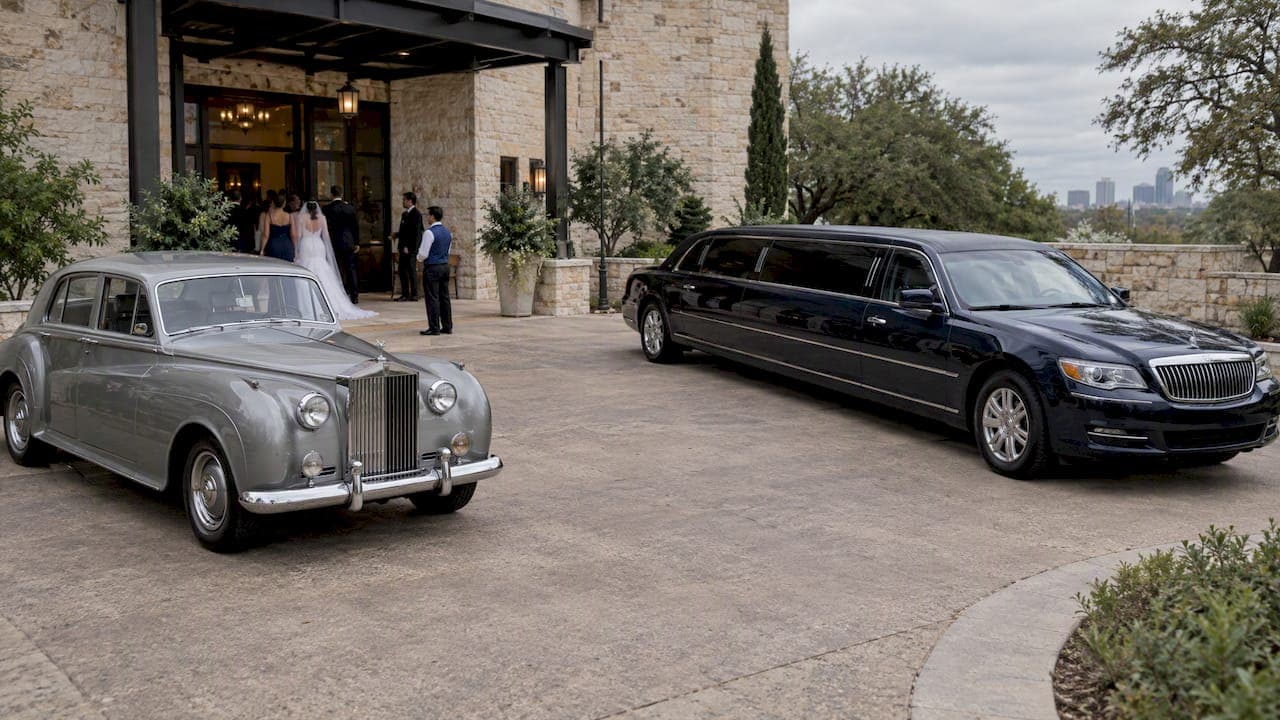
A classic car suits a couple-focused arrival, a short route, and portrait-style photography, while a limousine fits larger bridal parties, multi-stop timelines, and guaranteed climate control. Before you book either one, ask two questions: how many people can actually sit inside with gowns and luggage, and can the vendor show proof of commercial insurance. The Knot's guidance on wedding limos frames the decision around party size and convenience, and we work through both paths below so you can match the vehicle to your wedding day.
TL;DR:
- Ask vendors for usable passenger capacity, door clearance, and room for gowns and luggage; advertised seat counts may not reflect comfortable seating.
- Compare quotes only after confirming minimum hours, travel and waiting charges, gratuity, and decoration fees, since vendors may include these costs differently.
- Get written proof of commercial insurance and licensing, then record cancellation terms, overtime rates, gratuity responsibility, and a backup vehicle plan in the contract.
- Older classic cars may lack air conditioning or easy gown access, so check current condition, accessibility, and the operator’s breakdown plan before booking.
- Get written approval from the operator and venue before attaching decorations, because ribbons, magnets, or cans can scratch paint or damage vehicle parts.
Table of Contents
- Pros and trade-offs: classic cars vs limousine options
- Passenger capacity and usable seating: exact questions to ask vendors
- Style, photo fit, and decoration guidance
- Comfort, climate control, privacy, and accessibility
- Cost, hourly rules, and booking timeline to compare quotes fairly
- Insurance and contract checklist before you reserve
- Recommendations based on wedding theme or formality
- A practical decision flow for choosing your wedding car
- If you want help now: how we map our fleet to your wedding needs
- FAQ
- Sources
Pros and trade-offs: classic cars vs limousine options
Each option solves a different problem, and the right pick depends on what matters most to you on the day itself.
Classic cars tend to win on:
- Photo value, since a vintage body style gives photographers a distinct backdrop that a modern vehicle cannot match.
- Romantic arrival and getaway moments, especially for a couple making a solo exit after the reception.
- Uniqueness in portraits, where one striking car often photographs better than a long black vehicle in the background.
Limousines tend to win on:
- Larger usable seating, which matters when the whole bridal party needs to travel together.
- Climate control, keeping makeup and hairstyles intact during a Texas afternoon or a cold evening.
- Privacy for dressing or group travel, with tinted windows and a closed cabin between the salon and the ceremony.
- Easier coordination of multiple pickups, since one vehicle can collect several people instead of running separate trips.
A short ceremony-to-reception distance and a photography-heavy timeline favor the classic car. A larger bridal party, multiple stops, or a tight schedule with little room for error favors the limousine.
Passenger capacity and usable seating: exact questions to ask vendors
Advertised capacity numbers rarely match what fits comfortably once gowns, suits, and bags are in the car. Ask every vendor for usable seating and door clearance, not just a marketing figure.
As general guidance, not a vendor-specific claim, two-seat classic roadsters work only for the couple, while vintage sedans from the same era may suit small groups. Ask vendors for the usable passenger capacity of each vehicle, since seating varies by model. Our own breakdown of wedding limo capacity walks through how operators count usable seats versus listed capacity.
When the bridal party outgrows one vehicle, booking two smaller cars, or a classic car plus a limo, often keeps the timeline tighter than squeezing everyone into one overcrowded vehicle, since loading and unloading time adds up fast between stops.
Style, photo fit, and decoration guidance
The vehicle you choose shapes your photos as much as your venue does. A classic car brings vintage curves, chrome trim, and a lower stance that reads as romantic in portrait shots, especially for a couple exiting alone. A limousine photographs well in formal, coordinated processions, with the whole party lined up or stepping out in sequence for a staged group shot.
Decorations add personality, but they carry real risk if you skip approval:
- Get written sign-off from the operator and the venue before attaching ribbons, magnets, or signs.
- Avoid anything that could scratch paint, block exhaust, or scrape the undercarriage, including cans dragged behind the car.
The tradition of tying cans to the back bumper is a playful send-off, but special-event insurance guidance notes it can damage paint, wheels, or exhaust components if done without care, so confirm with the chauffeur first. For more vehicle style ideas, our guide to luxury wedding vehicle types and NoirFleet's photo-ready getaway car guide both cover safe decorating approaches.
Comfort, climate control, privacy, and accessibility
Modern limousines and Sprinter vans generally offer stronger climate control, tinted privacy glass, and dedicated storage for bouquets and bags than an older classic car does. That matters on a hot afternoon or when a bride's gown needs room to settle without wrinkling.
Older classics sometimes lack air conditioning entirely or use a bench seat layout that was never designed for a full-length gown. Ask the operator directly about the car's current mechanical condition, whether it has working climate control, and what the contingency plan looks like if that specific car has an issue the morning of your wedding.
If you are transporting elderly guests or anyone who needs extra room to enter and exit, ask for details on door height, step clearance, and seat firmness before you commit, since a stunning classic car with a low door can be genuinely difficult for some guests to use.

Cost, hourly rules, and booking timeline to compare quotes fairly
Wedding transportation may be priced hourly, and booking minimums vary by vendor and vehicle type. Rates vary by location, vehicle age, and how far in advance you book, so a quote from one vendor rarely lines up cleanly with another unless you check the fine print.
Before comparing two hourly rates side by side, confirm these are identical across both quotes:
- Minimum booking hours, since different booking minimums change the real total.
- Travel and waiting time, which some vendors bill separately.
- Gratuity, which may be built in rather than added later.
- Decoration fees, which some vendors charge and others do not.
Event-planner guidance on hiring wedding transportation confirms that rates shift with availability, peak timing, and vehicle size, so the headline number alone tells you little. Our own breakdown of typical wedding transport costs covers the range couples usually plan for.
Book ahead for a peak-season wedding, since popular classic cars and limousines may be reserved early.
Insurance and contract checklist before you reserve
A handful of contract items separate a smooth wedding-day pickup from a stressful one. Work through this list with any vendor before you put down a deposit:
- Ask for proof of commercial insurance and licensing. Insurance-industry guidance notes that commercial passenger coverage is different from a personal auto policy or a rideshare driver's coverage.
- Confirm minimum hours, cancellation terms, overtime rates, and gratuity policy in writing, not verbally.
- Require a backup vehicle or contingency plan, especially for an older classic car that is more prone to mechanical issues on short notice.
- Put the payer and gratuity responsibility in the contract, since assuming a parent or family member will cover it without writing it down leads to confusion later.
Pro Tip: Keep a printed copy of the signed contract in your wedding-day bag so any disagreement about hours or fees can be resolved on the spot instead of after the fact.
Special-event insurance can protect your deposit against weather or illness, but Triple-I is clear that it is not a substitute for the vendor's own commercial liability coverage.
Recommendations based on wedding theme or formality
A black-tie or formal wedding generally calls for a limousine or a matching set of sedans, since the symmetry of a coordinated fleet reinforces a polished, formal arrival. A vintage or garden-style wedding leans naturally toward a classic car, where the era of the vehicle echoes the overall aesthetic instead of competing with it.
For a large, traditional wedding with a sizable bridal party, a Sprinter van or stretch limo keeps everyone together and on schedule, which matters more as guest and attendant counts grow. A small, intimate ceremony with just the couple and immediate family often works better with a single classic car for the arrival and a second for the getaway, since you are not trying to move a crowd.
Modern or minimalist weddings sometimes skip the classic look entirely in favor of a sleek black SUV or sedan, which photographs cleanly without pulling focus from contemporary decor. Whatever the theme, match the vehicle's visual weight to the formality of the event: an ornate vintage car at a casual backyard wedding can look out of place, just as a plain sedan can underwhelm at a formal ballroom reception.

A practical decision flow for choosing your wedding car
If the day centers on the couple, the route is short, and photos are the priority, a classic car is the natural fit. If you are moving a bridal party, hitting multiple stops, or want guaranteed comfort regardless of weather, a limousine or Sprinter van solves that better.
We built our fleet around exactly that range, with trained chauffeurs and punctuality planning, so couples do not have to choose between style and reliability. Whichever direction you lean, confirm the insurance, capacity, and contract details covered above before you sign anything.
— Jason
If you want help now: how we map our fleet to your wedding needs
We carry the full range this comparison covers: a Classic Stretch Limousine for a traditional look, Executive Black Sedans and a Luxury Black SUV for smaller formal parties, and an Executive Sprinter Van or Party Bus when the whole bridal party needs to travel together.

On your call, ask us for usable seating, proof of commercial insurance, and our backup vehicle plan. Start with our wedding limo service page to see what fits your date and party size.
FAQ
Who pays for a limo at a wedding?
The couple usually covers wedding transportation themselves, though The Knot notes that parents or other family members sometimes offer to pay as a gift. Either way, put the payer and the included services in writing so deposits, gratuity, and overtime are not left to assumption.
Is a 25 year old car considered vintage?
There is no single, universal age cutoff that makes a car "vintage," and definitions vary by source. For a wedding booking, focus on the exact model year, seating layout, mechanical condition, and backup plan rather than relying on a label alone.
How much is a vintage wedding car?
Pricing for a classic or vintage wedding car follows the same hourly structure as other wedding transportation, with rates shifting based on location, vehicle age, and availability around your date. Event-planner guidance recommends comparing quotes only after confirming identical minimum hours and inclusions.
Why do people tie cans to wedding cars?
Tying cans to the back of a getaway car is a long-standing, lighthearted send-off tradition rather than one with a single documented origin. Before adding cans, ribbons, or signs to any wedding vehicle, get the operator's permission, since improper attachments can damage paint, wheels, or exhaust components.