
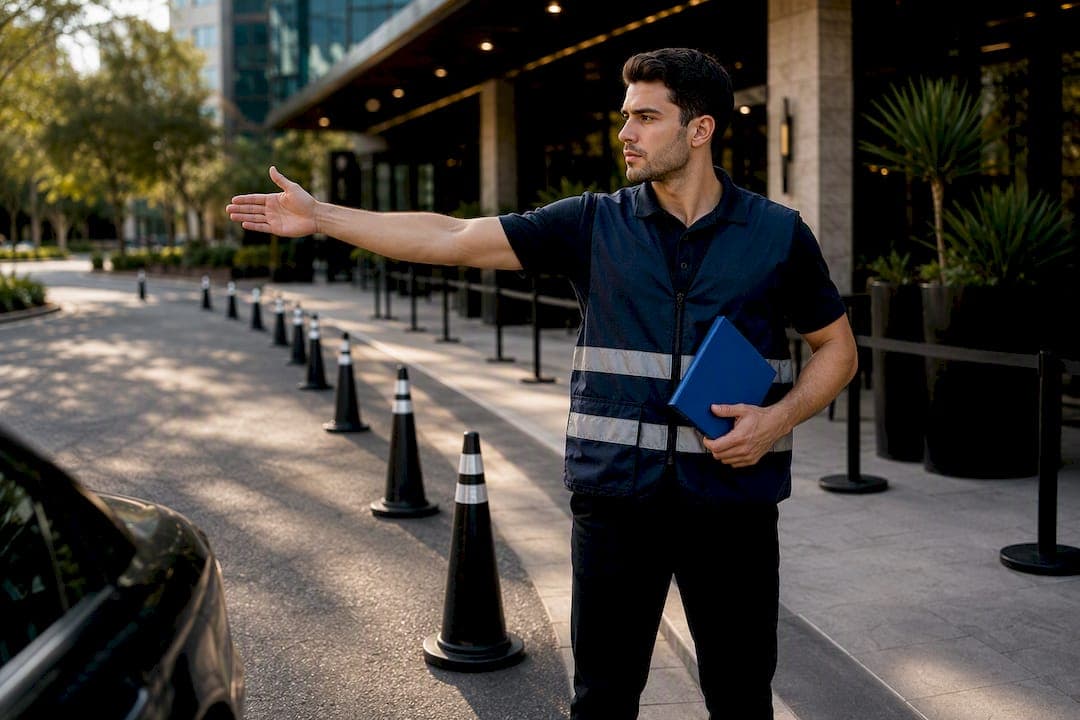
Choose your transportation model first, map a primary route with a working backup, then verify every vendor's safety and insurance paperwork before you sign a contract. Do those three things in order and everything else, staging, schedules, guest communication, falls into place. Skip them, and even a well-funded Austin event ends with guests stranded on a closed street during a festival week, wondering where the shuttle went.
TL;DR:
- Verify safety records, insurance coverage, and operational authority of vendors before signing contracts to avoid high-risk carriers and compliance issues.
- Use actual guest counts from RSVPs and hotel reservations to determine fleet size, avoiding over or underbooking by segmenting guests by lodging, needs, and arrival times.
- Map venue access thoroughly, considering curb space, loading zones, ADA pathways, and backup routes, to ensure vehicle maneuverability and smooth pickups.
- Build a realistic schedule with full trip cycle times, buffers based on event season, and staggered departure times, to prevent delays and last-minute vehicle shortages.
- Incorporate site-specific planning, impact assessments, and pedestrian-vehicle flow separation to reduce neighborhood disruption and enhance safety during high-profile events.
Table of Contents
- What Does Austin Event Traffic Planning Actually Involve?
- How Do You Assess Guest Transportation Needs?
- How Do You Map Venue Access and Plan Backup Routes?
- Which Vehicles Fit Your Event and Site?
- How Do You Build a Realistic Transportation Schedule?
- What Vendor Safety and Compliance Checks Should You Require?
- How Do You Keep Guests and Drivers Informed on Event Day?
- What Local Lessons Change How You Plan in Austin?
- How Does Event Traffic Affect Surrounding Streets and Residents?
- How Should You Manage Parking and On-Site Traffic Flow?
- How Do You Coordinate Pedestrian Flow With Vehicle Traffic?
- Can Traffic Simulation Tools Help You Plan Better?
- What Sustainability Factors Matter in Event Transportation Planning?
- The Checklist Beats the Instinct
- Request a Custom Austin Transportation Plan
- Sources
- FAQ
What Does Austin Event Traffic Planning Actually Involve?
Austin event traffic planning means matching your guest list, venue access, and vehicle choices into a schedule that survives real-world delays. It's the logistics layer underneath every wedding shuttle loop, corporate hotel run, and airport transfer fleet, not the city's street closures or festival permitting. For event hosts, that means answering three questions before you book anything: how many people need to move, from where to where, and what happens when the fastest route is blocked.
How Do You Assess Guest Transportation Needs?
Start with the guest list, not the vehicle brochure. A 200-person wedding invite list rarely means 200 riders needing transport. Some guests drive themselves, some carpool, some skip the shuttle entirely. Pull your actual numbers from RSVPs and hotel block reservations instead of the invite count, and you'll avoid overbooking (or worse, underbooking) your fleet.
Segment your list before you call any vendor:
- Guests by lodging cluster: which hotel or neighborhood, and how many riders per pickup point
- VIP or wedding-party members who need a dedicated vehicle and earlier pickup
- Anyone with mobility needs requiring a wheelchair-accessible vehicle or ground-level boarding
- Likely arrival windows, since a 6 PM ceremony pulls a different crowd than an 11 AM brunch
Once you have real ridership numbers, decide whether you need separate VIP runs, luggage-capable vans for out-of-town guests, or a single shared loop. This step alone prevents the most common planning mistake: booking a stretch limo fleet for people who were always going to rideshare.
How Do You Map Venue Access and Plan Backup Routes?
Walk the site, or study the venue map, with these checks before you finalize any route:
- Curb access and turning radius. Can a Sprinter van or stretch limo actually pull up and turn around, or does the driveway dead-end into a service alley?
- Loading zones and vendor ingress/egress. Catering trucks, florists, and your shuttle may be competing for the same 40 feet of curb.
- ADA-compliant paths. Confirm a ramp or level entry exists near the drop point, not just somewhere on the property.
- A clear pickup marker. Guests and drivers both need one unmistakable spot, a specific awning, a numbered sign, not "near the entrance."
- A primary route and one genuine backup. During SXSW, ACL, or F1 week, downtown access changes fast, so larger buffers of 45 to 60 minutes for arrival windows aren't overkill, they're the minimum.
Access constraints should drive your vehicle selection, not the other way around. If the venue can't accommodate a motorcoach's turning radius, that decision is made for you before you ever compare pricing.
Which Vehicles Fit Your Event and Site?
Vehicle choice is where good planning meets bad access. A 40-passenger motorcoach moves the most people per trip, but only if the site has room to maneuver it. Tight downtown venues, historic properties, and residential streets often can't accommodate one, no matter how efficient it looks on paper.
- Motorcoaches work well for airport-hotel loops and open convention center circuits, where capacity beats maneuverability.
- Sprinter vans and minibuses usually reduce dwell time on constrained sites since they load faster and fit into tighter curb space.
- Sedans and SUVs make sense for VIP wedding party transport, executive airport transfers, and any guest who needs a private, timed pickup.
- Stretch limos and party buses suit celebratory event segments, proms, bachelor and bachelorette runs, where the experience matters as much as the logistics.
Pro Tip: Match boarding speed to your schedule, not just headcount. A 14-passenger Sprinter that loads in ninety seconds can outperform a 40-seat coach that takes ten minutes to fill on a site with one narrow driveway.
How Do You Build a Realistic Transportation Schedule?
A ten-minute drive rarely stays ten minutes once you account for the full trip cycle: staging, boarding, the drive itself, unloading, and turnaround back to the pickup point. On a constrained site, that same ten-minute drive can stretch to 35 or 40 minutes once boarding delays are factored in.
- Calculate the full cycle, not just drive time, for every route your vehicles run.
- Apply a buffer. A standard 20% cushion covers ordinary Austin traffic; downtown during a festival week deserves the fuller 45 to 60 minute window.
- Stagger departures instead of releasing everyone at once, and calculate loop frequency based on how many complete cycles each vehicle can finish before the last boarding time.
- Reserve contingency time and, budget permitting, one extra vehicle on standby rather than assuming a single coach will cover the whole event.
Experienced planners run this cycle math before quoting a headcount to a vendor. Skipping it is how "we only need one shuttle" turns into forty guests waiting in the Texas heat.
What Vendor Safety and Compliance Checks Should You Require?
Before you book any charter vehicle, ask for documentation, not just a friendly sales call. The FMCSA's chartering checklist makes clear that carriers with a final "Unsatisfactory" safety rating are considered high risk and are prohibited from operating.
By the numbers: Federal rules set minimum insurance at $5,000,000 for any vehicle carrying 16 or more passengers, and $1,500,000 for vehicles seating 15 or fewer.
For carriers operating only within Texas, TxDMV requires intrastate operating authority for any vehicle transporting more than 15 passengers, along with insurance filed with the state and retained operational records.
Request these items with every quote:
- USDOT number and a SAFER safety-rating lookup for interstate carriers
- TxDMV operating authority number for intrastate carriers over 15 passengers
- Current certificate of insurance matching the seating capacity
- CDL with passenger endorsement for drivers, plus recent maintenance logs
- A named point of contact reachable on the actual event day
If a vendor hesitates to produce any of this, that hesitation is your answer.
How Do You Keep Guests and Drivers Informed on Event Day?
Confusion on the ground usually traces back to unclear messaging beforehand, not a broken vehicle. Guests need one message with pickup time, exact location, driver contact, and what to do if they're running late. Drivers need signage they can spot fast: a numbered placard, a venue name, something more specific than "wedding group."
- Send one consolidated message per pickup wave, not five scattered texts
- Post visible, driver-facing signage at every pickup point
- Assign a single Navigation Lead with authority to shift schedules or call in a backup vehicle without waiting on approval
- Keep a rideshare coordination plan and one staged extra vehicle ready for last-minute gaps
Pro Tip: Give your Navigation Lead a phone number distinct from the couple's or the CEO's personal line. Drivers calling the wrong person at 6:45 PM is how small delays become an hour-long scramble.
What Local Lessons Change How You Plan in Austin?
Austin's calendar isn't neutral. During SXSW, ACL, or F1 week, downtown access shifts daily, and the buffers that work on an ordinary Tuesday won't hold up. Consult the city's event mobility guide before finalizing routes during these windows, and build in the larger arrival cushion rather than trimming it to save an hour of shuttle time.
The planners who get burned usually make one of three mistakes: they book a single vehicle with no contingency, they skip the vendor's insurance paperwork because the price was right, or they assume a route that worked in March will work the same way during ACL week in October. An effective approach to event transportation includes staging early, padding buffers during event season, and keeping a documented vendor vetting process to avoid common mistakes.
- Read our conference group transportation guide for hospitality-specific coordination examples
- Review expert tips for booking the right limousine for timeline and vehicle-selection guidance
How Does Event Traffic Affect Surrounding Streets and Residents?
Every shuttle loop and limo queue you run has a footprint beyond your venue's curb. A 30-vehicle wedding shuttle rotation on a residential street can back up neighborhood traffic for blocks if pickup and drop-off aren't staggered properly. Corporate events with continuous shuttle service face the same issue at scale: a convention hotel running vehicles every ten minutes creates a steady stream that neighboring businesses and residents notice fast.
The fix starts with honest impact estimation before the event, not damage control after. Map how many vehicle trips your event generates per hour at peak arrival and departure, then compare that volume to the street's normal traffic. A quiet residential block near a wedding venue absorbs far less shuttle volume gracefully than a commercial corridor near a convention center.
Where volume is genuinely high, hosts and venues benefit from a short advance notice to immediate neighbors, especially for events running past 10 PM or starting before 8 AM. This isn't a formal permitting requirement for private guest transportation, but it heads off the noise complaints and parked-car frustration that turn into venue relationship problems down the line. Venues that host events regularly often already have a preferred communication template for this; if yours doesn't, a simple flyer or text alert to adjacent residents covers most of the goodwill.
Staggering shuttle waves by 10 to 15 minutes instead of releasing every vehicle at once also reduces the visible spike outsiders notice. It's a small scheduling choice with an outsized effect on how the event feels to the streets around it.

How Should You Manage Parking and On-Site Traffic Flow?
Parking chaos at the venue entrance is usually a routing problem wearing a parking problem's clothes. If your shuttle drop-off point and your self-parking guests share the same driveway, you've built a bottleneck before the first car arrives.
Separate the flows physically wherever the site allows it. Shuttle and limo drop-off gets one lane or entrance; self-parking guests get another. When the venue only has a single access road, stagger the timing instead, request that self-parking guests arrive before the shuttle waves begin, and hold shuttle drop-off until that surge clears.

Inside the property, mark a clear one-way flow for vehicles so drivers aren't backing up or executing three-point turns near pedestrians. A simple loop, in one entrance, around a staging loop, out a separate exit, moves far more vehicles per hour than a dead-end driveway where every car has to reverse out.
For valet or self-park lots, calculate capacity against your actual guest count, not the venue's advertised maximum. A lot rated for 150 cars handles far fewer once you account for oversized vehicles, accessible spaces, and vendor parking that eats into the count. Reserve a block near the entrance for mobility-limited guests and VIP drop-off, and mark it clearly so it doesn't get claimed by the first arrivals.
How Do You Coordinate Pedestrian Flow With Vehicle Traffic?
Guests on foot and vehicles sharing the same event footprint is where most near-misses happen, not on the open road. A drop-off zone that dumps guests directly into a vehicle path, rather than onto a marked walkway, invites exactly the kind of confusion that slows everything down and creates real safety risk.
Design pedestrian paths as a separate layer from your vehicle routes, not an afterthought squeezed between them. Mark a walkway from every drop-off point to the venue entrance, ideally with a barrier, cone line, or simple rope, so guests aren't crossing active vehicle lanes to reach the door.
For larger events with continuous shuttle arrivals, station a greeter or staff member at the drop-off point during peak waves. Their job isn't just hospitality, it's actively directing foot traffic away from where the next shuttle needs to pull in. This matters most at night events, when visibility drops and guests in formal wear move slower than a driver expects.
Crowd bottlenecks tend to form at single points: one entrance, one check-in table, one bar. Wherever your event creates a natural crowd cluster, keep vehicle access at least 15 to 20 feet clear of it. That gap gives arriving shuttles room to stop without idling directly next to a packed walkway.
Can Traffic Simulation Tools Help You Plan Better?
Large corporate events and multi-day conferences increasingly use routing and simulation software to model vehicle flow before the event happens, rather than discovering problems on the day. These tools let planners input pickup points, vehicle counts, and departure windows to see where congestion is likely to build.
For most weddings and mid-size corporate events, a full simulation platform is overkill. Simple route-mapping apps like Google Maps' traffic layer, checked at the actual time of day your event runs, give a reasonably accurate read on congestion patterns without any specialized software. Run that check during the same hour and day of week as your event, not just once in advance, since Austin traffic patterns shift meaningfully between a Tuesday afternoon and a Friday evening.
For larger productions, coordinate directly with your transportation vendor's dispatch team. A vendor running Sprinter vans and charter coaches across multiple routes with real-time routing capability can often flag a developing bottleneck mid-event and reroute before it cascades into missed pickups. That real-time adjustment matters more on event day than any pre-planned simulation, since Austin's road conditions during festival season change faster than static models predict.
What Sustainability Factors Matter in Event Transportation Planning?
Consolidating riders into fewer, fuller vehicles is the single biggest lever event hosts have over their transportation footprint. A 12-passenger Sprinter running at capacity replaces roughly six individual rideshare trips, cutting both congestion and emissions per guest moved.
Route efficiency compounds that effect. A shuttle loop with a tight, well-planned circuit burns less fuel and produces less idling time than one that backtracks or sits waiting at poorly staged pickup points. This is another reason full trip cycle planning matters beyond just scheduling accuracy, it also determines how much unnecessary idling your fleet generates.
For hosts who want to factor sustainability into vendor selection, ask directly about fleet age and maintenance standards. Newer vehicles generally run cleaner and more efficiently than older ones, and a well-maintained fleet avoids the fuel waste that comes with mechanical inefficiency. It's a smaller consideration than route planning or vehicle consolidation, but it's a fair question to put on any vendor's quote request.
The Checklist Beats the Instinct
Most event traffic planning guides treat compliance and scheduling as separate problems, but using a complete organizer's checklist can help planners handle both efficiently. They aren't. A vendor with a lapsed insurance filing and a planner who skipped the full trip cycle math will produce the exact same result: guests stranded, timelines blown, and a host fielding angry calls during their own event.
What the research actually supports is boring but true: the planners who avoid disasters are the ones who ran the numbers before the event, not the ones with the most charming vendor rep. Conventional advice tends to focus heavily on vehicle aesthetics and pricing while treating FMCSA and TxDMV compliance checks as an afterthought, something to confirm after the contract is signed, if at all.
Prioritize in this order: verify the vendor's safety record first, calculate your real full trip cycle second, and only then compare vehicle options and pricing. Reverse that order, and you're gambling on an Austin event week that has no patience for gambling.
— Jason
Request a Custom Austin Transportation Plan
Transportation plans benefit from using the checklist outlined in this guide, verifying vendor compliance upfront, sizing buffers for the actual event calendar, and choosing a vehicle mix based on venue access constraints rather than guesswork. Shuttle loops are sized according to hotel block counts for weddings, while corporate planners are advised to staff conference hotel shuttles for peak arrival waves. Airport transfers should be tracked against actual flight times.

When you request a quote, come with three things: your estimated headcount by pickup point, your preferred buffer window, and any known site access constraints. APEX LIMO will confirm insurance and vehicle availability against those details rather than a generic package. Browse the full fleet lineup, from the Executive Black Sedan to the SUV Stretch Limousine, or check the wedding limo service page if you're planning ceremony-to-reception shuttle loops. For corporate groups, the corporate car service page covers fleet and staffing options directly. Get a custom quote before your event date, especially if it lands during SXSW, ACL, or F1 week, since availability tightens fast during those windows.
Sources
- Tips for Chartering a Bus | FMCSA
- Tips for Compliant Operations as a Texas Bus Operator | TxDMV
- Logistics guide for event shuttles | Charter a Coach
- Austin wedding during SXSW: how to plan without traffic stress | Ma Maison
FAQ
How Far in Advance Should I Book Event Transportation in Austin?
Book at least four to six weeks out for standard weddings and corporate events, and two to three months ahead if your date falls during SXSW, ACL, or F1 week. Vendor availability, including APEX LIMO's fleet, tightens considerably during those festival windows.
How Big Should My Buffer Time Be for Austin Event Traffic?
During downtown event weeks, add 45 to 60 minutes to arrival windows to account for closures and surge congestion.
What Insurance Should I Verify Before Booking a Charter Vehicle?
Confirm coverage matches seating capacity: $5,000,000 minimum for vehicles carrying 16 or more passengers, and $1,500,000 for smaller vehicles. Always request a current certificate of insurance, not just a verbal confirmation.
How Many Backup Vehicles Do I Need for a Large Event?
Most planners reserve one contingency vehicle for every three to four active routes, budget permitting, plus a documented rideshare coordination fallback. The right number depends on your full trip cycle math and how tight your schedule buffers are.
Does APEX LIMO Handle Both Small Weddings and Large Corporate Fleets?
Yes. APEX LIMO's vehicle mix ranges from executive sedans for VIP airport runs to party buses and Sprinter vans for larger groups, with packages sized to guest count. Current pricing and package details are available on the fleet page.